9/28/2015
Video: Falling and Flying - A BASE Jumping Review Of 2013
This video holds the appropriate title of "Falling and Flying" as it follows filmmaker Charley Kurlinkus on a years worth of BASE jumping activities that includes wingsuits, paragliding and giant rope swings in some fairly impressive settings. It isn't intended for those who have a fear of flying. Or falling for that matter. Proceed with caution.
2013 Falling and Flying from Charley Kurlinkus on Vimeo.

9/25/2015
Video: Whale Encounters Don't Come Any Closer Than This!
We've seen some interesting whale encounters captured on video over the years, but none of them are as close as this one. A feeding humpback wandered into Knudson Cove in Ketchikan, Alaska and when it breached it was right inside the harbor. It isn't often that you see a whale this closely, let alone capture it on video. Wow!
9/24/2015
Video: Wings of Kilimanjaro 2016 Expedition
Next week, 29 climbers will set out for the "Roof of Africa" as part of the Wings of Kilimanjaro initiative. The team, which is being led by my friends over at Tusker Trail, will attempt to trek to the top of Mt. Kilimanjaro, the tallest peak in Africa, where they will then paraglide off the mountain. But the group isn't there just to have an amazing adventure. They'll also be raising funds to support a number of projects that are improving the lives of people living in Tanzania. Those projects include installing pumps to deliver clean water, teaching local farmers to grow crops in a sustainable fashion, and improving the education of the children that live there. In the video below, you'll learn a bit more about the program, but you'll also see some amazing shots of their previous climbs up Kili, and the epic flights they've taken from the summit. It looks like a great way to see an already impressive mountain, and its all for a good cause.
9/22/2015
Gear Closet: Nikon AW130 Digital Camera
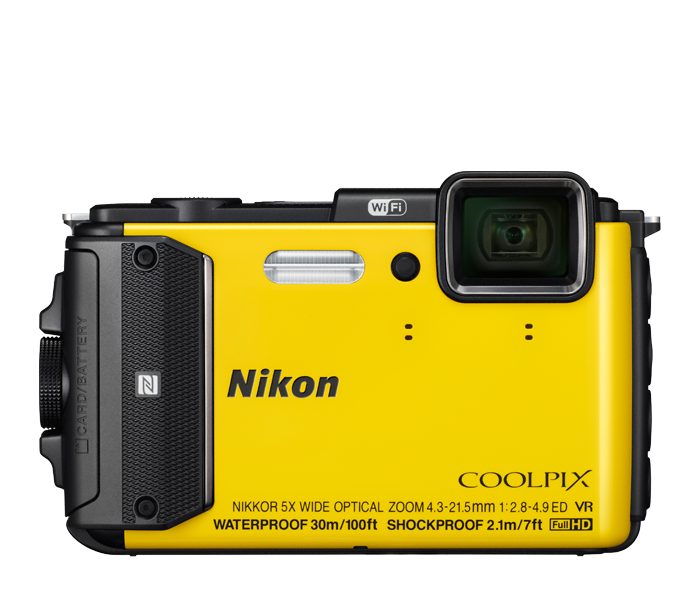
The AW130 is Nikon's most recent generation of rugged camera. I also happen to own the AW100, which is a few years old now, but is still a solid camera to take with me on some of trips. But, the new model shows that Nikon has listened to critics of its earlier models, and has addressed some of their concerns. The results are a camera that has evolved nicely from my older model, while retaining some of the characteristics that made the original stand out.
So what exactly does the AW130 bring to the table for adventure travelers? For starters, it is waterproof down to 100 feet (30 meters), freeze proof down to 14ºF (-10ºC) and drop proof from a height of 7 feet (2.1 meters). Those characteristics alone make it a good option for challenging environments. For instance, I took the camera with me on a kayaking excursion along the Russian River and Pacific Coast in California, and didn't have to worry about getting it wet. It can even shoot photos underwater too. And since it can function in cold weather and is well protected from accidental drops, you'll have a camera that can survive just about anything you throw at it.
This camera isn't just tough however. It features plenty of other useful features too, including a 16 megapixel sensor, a 3" OLED display, and a 5x glass zoom. It also has a built-in GPS receiver for geotagging photos, as well as WiFi and NFC connections for sharing images with your smartphone or tablet. The AW130 is capable of shooting five images per second, and can capture video at full 1080p resolutions. As if that wasn't enough, it also has onboard vibration reduction for steadier photos and video, as well as a fast autofocus that is always ready to shoot.
The design of the camera makes it easy to hold in your hand, even when you're taking part in active sports. It has an small, but useful, textured grip that comes in handy in slick conditions, and the buttons and switches are all large enough that they can be easily operated, even while wearing a pair of gloves. The operating system is typical for point and shoot cameras, which is to say it isn't overly intuitive, but it is fairly easy to find what you're looking for on those rare occasions when you need to go delving into its menus.
Putting the camera to the test in the field, I found it to be a solid point and shoot that was responsive and quick. It is easy to use, and snapping photos is a lot of fun in general with the AW130. The fact that you know you can take it with you anywhere is big plus, as its rugged design brings a nice sense of freedom about how and where you can use it.
In terms of image quality, the photos taken with the AW130 are good, but won't necessarily blow you away. In fact, there were times when I felt my iPhone did a better job of capturing a similar image, with better color reproduction and less noise. On the other hand, there were also times when the Nikon's zoom and glass lens took better photos as well, so performance is certainly impacted by the location and setting. All in all, you won't be disappointed by the photos taken by this camera, just don't expect DSLR levels of quality.
The battery life on my old AW100 was always a bit of a disappointment. It tended to run out of power at the most inopportune times, and far too quickly for my liking. That has been addressed in subsequent generations to a degree however, as I found the AW130 to have far better battery life than my older model. Of course, certain features such at GPS can really kill the battery quickly, so its best to turn it off unless you absolutely need the geotagging features or plan on recharging the camera regularly. Nikon says the AW130 can take 370 photos between charges, but that number drops substantially with GPS or even WiFi use.
The camera's 5x zoom is another source of irritation for me. On the one hand, I'm glad that it has any kind of mechanical zoom, as I far prefer it to digital zoom on any camera. But 5x is hardly anything to get too excited about, and I would have liked to have seen a longer zoom added to the latest model of Nikon's rugged line-up. But, some limitations come along with the design. If you want a waterproof camera, you'll need to make sacrifices in other areas, and this is one of them. Adding something with a longer zoom would compromise the ability to survive in water, which is ultimately one of the main functions of this camera.
Indeed, the one thing you constantly have to keep in mind when it comes to the AW130 is that in making it rugged and durable, Nikon had to make compromises elsewhere. If you want a better camera in terms of speed, features, battery life, and image quality, there are plenty of point and shoots on the market that will fulfill those needs, with most costing less than this one. But if you truly need a camera that can survive in the outdoors, and take very good photos along the way, this is great option.
Personally, I tend to carry the AW130 (or AW100) with me a secondary, companion camera. Depending on the trip, I'll take my DSLR and this one, as they compliment one another quite well. It also happens to make a good companion with a smartphone, surviving in places you'll want to keep your mobile device away from, while being able to share images wirelessly. As a stand alone camera it is still versatile enough to get the job done, just know ahead of time that you'll be trading some functionality in favor of ruggedness.
Wit its $300 price tag, the AW130 is on the more expensive side of the P&S market, particularly as that segment continues to be eaten away by smartphone usage. But, that price delivers a camera that is very rugged and built to survive in some very demanding environments. In the end, that's exactly what you're buying the AW130 for, and recognizing that ahead of time hells to make it the right tool for the job in most instances.
The bottomline is that this is the camera you want with you when white water rafting through the Grand Canyon, skiing in the backcountry, or hiking in the desert. It can handle each of those roles with equal aplomb and capture some good photos of those journeys as well. This is a camera made for those of us who have to leave our smartphones at home, because quite honestly they just won't survive where we're going.
9/21/2015
Gear Closet: Five Ten Eddy Water Shoes

Designed to be thin and lightweight, the Eddy was created to provide good protection for your feet, without becoming big and cumbersome. This allows them to fit nicely inside the cockpit of a kayak, including smaller play boats. I came to appreciate this design choice not because I needed the extra room, but because some of my larger water shoes often make it difficult to find the pedals that control the rudder on a sea kayak for instance. With these thin shoes, that wasn't a problem, and as a result I felt more connected with the boat in general.
Of course, that's just one element that I came to appreciate with these shoes. As you would expect, they offer quick-drying synthetic materials on the upper that allow water to pass through without retaining excess moisture, and thereby adding any amount of significant weight. The Eddy is also outfitted with plenty of drainage holes that help with this process too. The results are a shoe that is meant to be used on the water, but can be completely dry in about 15 minutes, allowing you to transition seamlessly back to land as well.
The sole of the shoe is made from Five Ten's Stealth S1 rubber, which was initially designed for use on the company's climbing shoes. This helps to give the Eddy a surprisingly great grip on slick, wet surfaces, making it easier to cross tough portages or to scramble in and out of your boat in rocky environments. That same Stealth S1 rubber extends up and around the toe, allowing the wearer to use it to maintain a grip while climbing in and out of the water. Those materials also provide an added protective barrier that isn't always common in this type of footwear.
All of these nice design elements don't mean much however if the shoe isn't comfortable to wear. Fortunately, Five Ten has us well covered there, as the Eddys feel great on your feet both in and out of the water. Better yet, they don't happen to look like a water shoe at first glance, which means you'll feel at home wearing them hiking to the put-in, during your waterborne adventures, and afterwards when you're grabbing lunch and a beer at the local pub.
As a frequent traveler, I always try to limit the number of pairs of shoes I take with me on my trips to no more than two. But, depending on the type of excursion I'm setting out on, I may need to add another pair or two to my bag. The Eddy is a versatile enough water shoe that I wouldn't hesitate to bring it along on any trip that involves spending time on the water. It is not only lightweight and comfortable, but it is also highly packable too. That means it can slip into your duffle bag or backpack without taking up too much room or adding undue bulk – something that endears me to just about any piece of gear.
Competitively priced at $100, Five Ten brings a lot to the table with the Eddy. While there are plenty of other options for good water shoes that cost less than that – including the 3T Barefoot Warrior from Body Glove that I reviewed back in August – few of those other shoes offer as many technical advantages as Five Ten's offering. While the Barefoot Warrior is a better option for stand-up paddleboarders, I'd recommend the Eddy to anyone who finds themselves scrambling through rivers, lakes, and other bodies of water where the footing isn't always certain. This is a much more substantial shoe, that is only slightly bigger and heavier.
If you're in the market for some new water shoes, the Five Ten Eddy is a great choice. This is particularly true if you find yourself hiking over slick surfaces on your way to and from the water. I think you'll be extremely pleased with what this shoe has to offer, and the grippy rubber outsole will be a welcome option for those who need a little extra security along the way.
Whitewater Rafting Team Narrowly Misses Grand Canyon Record

The 8-person squad, which includes the 6-man U.S. Whitewater Rafting team had been planning the Grand Canyon run for years, but received new incentive in 2016 when a new speed record was set. For years, the time to beat had been 36 hours, 38 minutes held by Kenton Grua, Rudi Putsches and Steve Reynolds since 1983. But last year, solo kayaker Ben Orkin set a new record by running the entire stretch in just 34 hours and two minutes.
Unfortunately for this team, the final time was 39 hours, 24 minutes, but they were slowed down greatly in their efforts thanks to the punctured raft, which couldn't be fixed properly while on the water. That left one of the raft's tubes almost completely deflated, causing way too much drag to overcome. A strong headwind didn't help their efforts either.
Still, the team wasn't feeling sorry for themselves. They seemed to enjoy the adventure, even though they didn't set a new record along the way. After all, traveling through the Grand Canyon is always an amazing experience, and for some it was the first go at the Colorado River. There is no word yet on if they'll return to try for the record a second time, but something tells me we haven't heard the last of this crew.
Read the entire story about their rafting expedition here. It has a lot of great moments and some big challenges that they faced along the way.
9/19/2015
Video: 65-Women Set World's Skydiving Record
You would think that there wouldn't be much of a challenge to setting a world's record for most sky divers other than taking a big group up, having everyone jump out, and then complete the jump. But that wasn't he case with this group of 65 female skydivers, who recently set the record for a vertical head-down jump. It took them 16 tries to get it right, over the course of a weeks time, with the jumpers suffering a variety of physical challenges along the way, including exploding sinuses, hypoxia, multiple mid-air kicks to the head, and rough landings that nearly resulted in broken bones. But, eventually they were able to reach their goal, and as you'll see in the video below, break the record in the process.
Subscribe to:
Posts (Atom)