A few weeks back I posted a story that shared new photos of an uncontacted tribe living deep in the Brazilian rainforest. Those images were taken by an aerial reconnaissance plane that flew over the site where the tribe lives in an effort to gauge how well they were doing in a part of the world that is becoming increasingly threatened by outside forces. Surprisingly, observers found that the tribe was not only faring quite well, but was actually thriving, with new members being added since the last survey. Now, more images have been revealed and they are just as fascinating as the first.
National Geographic has posted an exclusive gallery of photos that were shot just last week that give us a rare and interesting look into the way of life that these tribesmen have followed for hundreds of years. The images were taken by a low-flying helicopter, which allowed photographer Ricardo Stuckert to get some unique shots from a safe distance. The photos were taken near Brazil's border with Peru, and offer insights into how they paint their bodies, cut their hair, and more. It is the first time that we've had such a close look at these people.
The image gallery is indeed a fascinating one for anyone who shares my interest in the lives of these uncontacted tribes. I've said it before, and I'll say it again, I think that it is amazing that these people can still exist and continue their way of life in the 21st century. Hopefully they'll be able to continue to do so for as long as they like, and efforts are being made to allow them to do just that. But, as commercial interests from petroleum, mining, and logging companies encroach on their lands, that is becoming more and more of a challenge.
Check out all of these amazing photos by clicking here.
Showing posts with label Amazon. Show all posts
6/23/2017
8/12/2016
Explorers Discover Legendary Boiling River in the Amazon
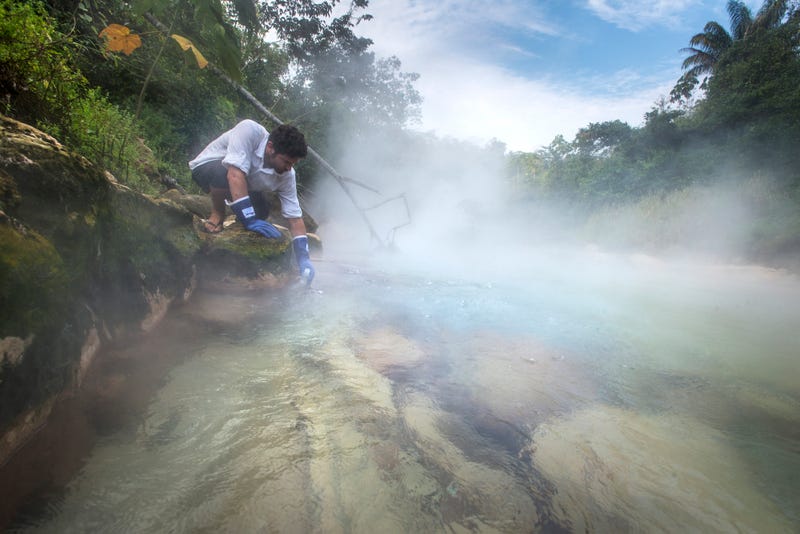
Need proof that we still don't know as much about our own planet as we think we do? Than look no further than this story about a team of researchers that discovered a legendary boiling river located deep in the Amazon.
In a new book entitled The Boiling River: Adventure and Discovery in the Amazon, Peruvian scientist Andrés Ruzo shares the story of the discovery of this river, which he first heard about from his grandfather, who told him that Spanish conquistadors wandered into the jungle, and returned months later with tales of strange animals, endless rainforest, and a river that was so hot that it boiled from below.
That story stuck with Ruzo, even as an adult, and when he became a graduate student at Southern Methodists University in Texas, he decided to do his PhD project on creating the first geothermal map of Peru. He hoped to discover the boiling river, and show how it would be possible for it to actually boil from geothermal activity.
He didn't exactly find support from the faculty and other students. Most told him his pursuit was futile and went against all of the principles of science that we knew up until this point. For a river to actually be so hot that it boiled, the forces at work underneath it would have to be tremendous.
After spending months researching the possibilities and looking for answers, Ruzo discovered an unlikely ally – his aunt. She claimed to have actually visited such a river, and told her nephew where to find it. It was located near Mayantuyacu, a site held sacred by the local people.
The river itself isn't large. It runs for just 4 miles (6.4 km), and ranges up to 82 feet (25 meters) wide and 20 feet (6 meters) deep. It is described as being hot enough to make cup of tea, with certain sections actually boiling as described.
Now, Ruzo's discovery is making headlines, and his theories don't seem to absurd. He even gave an interview to Nat Geo about his research and quest to find this legendary stretch of water. Unsurprisingly, now he's working to protect the site to ensure that it remains sacred and pure.
This story makes you wonder what other "legendary" stories that have emerged from the jungles, deserts, and mountains of the world have some basis in truth. Hopefully we'll always have scientists and explores like Andrés to keep looking for them.
In a new book entitled The Boiling River: Adventure and Discovery in the Amazon, Peruvian scientist Andrés Ruzo shares the story of the discovery of this river, which he first heard about from his grandfather, who told him that Spanish conquistadors wandered into the jungle, and returned months later with tales of strange animals, endless rainforest, and a river that was so hot that it boiled from below.
That story stuck with Ruzo, even as an adult, and when he became a graduate student at Southern Methodists University in Texas, he decided to do his PhD project on creating the first geothermal map of Peru. He hoped to discover the boiling river, and show how it would be possible for it to actually boil from geothermal activity.
He didn't exactly find support from the faculty and other students. Most told him his pursuit was futile and went against all of the principles of science that we knew up until this point. For a river to actually be so hot that it boiled, the forces at work underneath it would have to be tremendous.
After spending months researching the possibilities and looking for answers, Ruzo discovered an unlikely ally – his aunt. She claimed to have actually visited such a river, and told her nephew where to find it. It was located near Mayantuyacu, a site held sacred by the local people.
The river itself isn't large. It runs for just 4 miles (6.4 km), and ranges up to 82 feet (25 meters) wide and 20 feet (6 meters) deep. It is described as being hot enough to make cup of tea, with certain sections actually boiling as described.
Now, Ruzo's discovery is making headlines, and his theories don't seem to absurd. He even gave an interview to Nat Geo about his research and quest to find this legendary stretch of water. Unsurprisingly, now he's working to protect the site to ensure that it remains sacred and pure.
This story makes you wonder what other "legendary" stories that have emerged from the jungles, deserts, and mountains of the world have some basis in truth. Hopefully we'll always have scientists and explores like Andrés to keep looking for them.
3/09/2015
New Farthest Source Of The Amazon Discovered
Researchers say they have located a new source for the Amazon River and possibly adding an additional 47-57 miles to its overall length, which already extends beyond 4000 miles. But, with all things exploration related in the 21st century, there is some controversy as to whether or not this new location should actually be considered as a tributary for the longest river on the planet.
Since 1971, the Apurimac River has been considered the furthest source of the Amazon, and many explorers and adventurers have operated in the region under that assumption. According to this new report however, the Mantaro River, located in southwest Peru, now holds that distinction.
The researchers who have asserted that the Mantaro is the new source used satellite imagery and topographic maps to study the Amazon and it's numerous tributaries. With GPS tracking points, the team determined that the Mantaro is actually about 10% longer than the Apurimac, which would make the furthest source.
But as I mentioned, there is some controversy afoot. The Mantaro doesn't flow for parts of the year, thanks to a dam that was built in 1974. When defining a "source," most geographers feel that a river must flow uninterrupted. The researchers behind this new finding say that the Mantaro would flow all year if it wasn't for the dam.
Does it really matter where the true source is located? Most would probably say no. But if you're one of the many adventurers who has attempted to travel the length of the river, or explored the Amazon Basin, it means quite a lot. This revelation could invalidate certain past expeditions that paddled the entire river for instance.
Personally, I happen to enjoy that we're still discovering things about our own planet. It is stories like this one that remind us that exploration is important, even in the 21st century. Now, who wants to be the first to go upstream and actually visit the source? I'm in!
Since 1971, the Apurimac River has been considered the furthest source of the Amazon, and many explorers and adventurers have operated in the region under that assumption. According to this new report however, the Mantaro River, located in southwest Peru, now holds that distinction.
The researchers who have asserted that the Mantaro is the new source used satellite imagery and topographic maps to study the Amazon and it's numerous tributaries. With GPS tracking points, the team determined that the Mantaro is actually about 10% longer than the Apurimac, which would make the furthest source.
But as I mentioned, there is some controversy afoot. The Mantaro doesn't flow for parts of the year, thanks to a dam that was built in 1974. When defining a "source," most geographers feel that a river must flow uninterrupted. The researchers behind this new finding say that the Mantaro would flow all year if it wasn't for the dam.
Does it really matter where the true source is located? Most would probably say no. But if you're one of the many adventurers who has attempted to travel the length of the river, or explored the Amazon Basin, it means quite a lot. This revelation could invalidate certain past expeditions that paddled the entire river for instance.
Personally, I happen to enjoy that we're still discovering things about our own planet. It is stories like this one that remind us that exploration is important, even in the 21st century. Now, who wants to be the first to go upstream and actually visit the source? I'm in!
8/18/2014
Massive Reef Discovered at the Mouth of the Amazon River
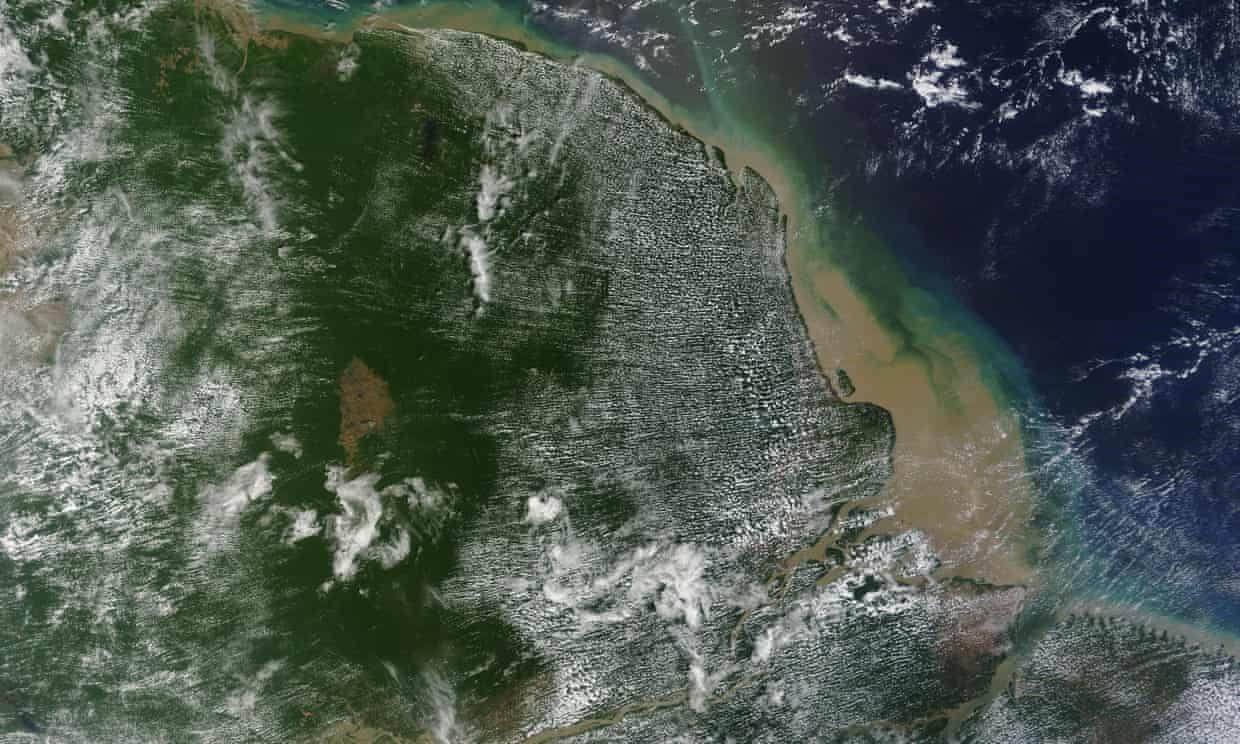
Here's a story that is further proof that our world still has a lot of mysteries and surprises to share with us. Scientists have discovered a massive coral reef hidden under the muddy waters at the mouth of the Amazon River in South America. The discovery comes at a crucial stage however, as the region has already been charted by petroleum companies looking to plumb its depth for oil.
Indications that the reef might exist first appeared back in the 1970's when fishermen began catching fish that were more commonly found on and around reefs in other parts of the world. But confirmation of the existence of this particular reef didn't come until recently, when researchers were finally able to prove that against all our knowledge and understanding of the ocean that it was hidden away along the coast of Brazil.
The reef stretches for nearly 700 miles (1126 km), and is more than 3600 sq. miles (9300 sq. km) in size. It is also said to be home to at least 60 species of sponges and 73 species of fish. Even more surprising is the fact that unlike other reefs found around the world, this one appears to be very healthy, and even growing. Climate change has begun to warm the oceans, which is causing coral reefs to die at an alarming rate. But this one is not displaying those same symptoms.
What makes this new reef so amazing is that it exists in a place that it was previously believed one shouldn't be able to survive. While it is submerged in ocean waters, the surface of the Atlantic is covered in fresh water that is dumped in from the might Amazon River. The river also deposits plenty of mud and sentiment into the water, which is typically not conducive to the growth of coral either. On top of that, oceanographers typically find reefs in shallower waters that are warmer and clearer than where this one exists. This has left some scientists to wonder if other reefs are out there in our oceans, just waiting to be found.
But the good news over the discovery of this reef – and the fact that it is thriving – is tempered somewhat due to the fact that it is already being threatened by man. It seems that the Brazilian government has already sold 80 parcels of ocean to oil companies to start drilling at the mouth of the Amazon. 20 of those blocks are already in operation, some of which are believed to be right on top of the reef itself. How that will impact the life of the reef moving forward remains to be seen.
Coral reefs play an important role in the keeping the ocean healthy as they often form protective barriers for ecosystems both along the coast line and living within the waters themselves. As those reefs recede, ocean storms, hurricanes, and typhoons could have a larger impact on certain regions of the planet. The Earth's coral reefs are also seen as the canary in the coal mine in terms of indicating the impact of climate change on an area too.
Still, finding this particular reef is amazing, especially since it shouldn't exist at all. Hopefully it will be well protected moving forward.
Indications that the reef might exist first appeared back in the 1970's when fishermen began catching fish that were more commonly found on and around reefs in other parts of the world. But confirmation of the existence of this particular reef didn't come until recently, when researchers were finally able to prove that against all our knowledge and understanding of the ocean that it was hidden away along the coast of Brazil.
The reef stretches for nearly 700 miles (1126 km), and is more than 3600 sq. miles (9300 sq. km) in size. It is also said to be home to at least 60 species of sponges and 73 species of fish. Even more surprising is the fact that unlike other reefs found around the world, this one appears to be very healthy, and even growing. Climate change has begun to warm the oceans, which is causing coral reefs to die at an alarming rate. But this one is not displaying those same symptoms.
What makes this new reef so amazing is that it exists in a place that it was previously believed one shouldn't be able to survive. While it is submerged in ocean waters, the surface of the Atlantic is covered in fresh water that is dumped in from the might Amazon River. The river also deposits plenty of mud and sentiment into the water, which is typically not conducive to the growth of coral either. On top of that, oceanographers typically find reefs in shallower waters that are warmer and clearer than where this one exists. This has left some scientists to wonder if other reefs are out there in our oceans, just waiting to be found.
But the good news over the discovery of this reef – and the fact that it is thriving – is tempered somewhat due to the fact that it is already being threatened by man. It seems that the Brazilian government has already sold 80 parcels of ocean to oil companies to start drilling at the mouth of the Amazon. 20 of those blocks are already in operation, some of which are believed to be right on top of the reef itself. How that will impact the life of the reef moving forward remains to be seen.
Coral reefs play an important role in the keeping the ocean healthy as they often form protective barriers for ecosystems both along the coast line and living within the waters themselves. As those reefs recede, ocean storms, hurricanes, and typhoons could have a larger impact on certain regions of the planet. The Earth's coral reefs are also seen as the canary in the coal mine in terms of indicating the impact of climate change on an area too.
Still, finding this particular reef is amazing, especially since it shouldn't exist at all. Hopefully it will be well protected moving forward.
2/02/2014
Adventurers to Attempt Atlantic to the Pacific Crossing of Amazon
We've seen some pretty impressive expeditions through the Amazon Rainforest over the years, and it looks like we can soon add another interesting one to the list. Filmmaker Reza Pakravan is joining forces with journalist Pip Stewart on an epic adventure that will take them across the Amazon starting at it's Atlantic coast and ending in the Pacific Ocean. Along the way, they'll pass through remote sections of Brazil and Peru, while spending time living with the indigenous tribes that still inhabit this part of the world.
The duo, who are planning on starting the expedition today, hope to create a four-part documentary series about their journey, which will look at the way various changes to their environment is impacting the lives of the Amazon people. Severe deforestation, climate change, and other factors have become a severe threat to the lifestyle of these tribes, potentially ending a way of life that has existed relatively unchanged for centuries.
Reza and Pip will be traveling by bike and boat across the Amazon. They'll start at the mouth of the mighty Amazon River in Belem in Brazil and eventually ending in Lima, Peru. Most of the journey will be done on bike (both are accomplished adventure cyclists), but they will take a boat up the Purus River in order to cross one very remote section of the route.
Dubbed the Transamazonica expedition, the plan is to follow a road of the same name that was built in the 70's to help open travel and commercialization of the rainforest. That road covers some 4000 km (2485 miles), and has been a major boon for companies who have logged and developed the Amazon Rainforest. The hope is that this expedition will help raise awareness of the challenges that are currently faced by the people living in the rainforest basin, which is undergoing significant changes.
It should certainly be interesting to follow Reza and Pip's adventure, which you can do on both of their websites linked above.
Transamazonica ver Crowdfunding from Samarcanda Film on Vimeo.
The duo, who are planning on starting the expedition today, hope to create a four-part documentary series about their journey, which will look at the way various changes to their environment is impacting the lives of the Amazon people. Severe deforestation, climate change, and other factors have become a severe threat to the lifestyle of these tribes, potentially ending a way of life that has existed relatively unchanged for centuries.
Reza and Pip will be traveling by bike and boat across the Amazon. They'll start at the mouth of the mighty Amazon River in Belem in Brazil and eventually ending in Lima, Peru. Most of the journey will be done on bike (both are accomplished adventure cyclists), but they will take a boat up the Purus River in order to cross one very remote section of the route.
Dubbed the Transamazonica expedition, the plan is to follow a road of the same name that was built in the 70's to help open travel and commercialization of the rainforest. That road covers some 4000 km (2485 miles), and has been a major boon for companies who have logged and developed the Amazon Rainforest. The hope is that this expedition will help raise awareness of the challenges that are currently faced by the people living in the rainforest basin, which is undergoing significant changes.
It should certainly be interesting to follow Reza and Pip's adventure, which you can do on both of their websites linked above.
Subscribe to:
Comments (Atom)