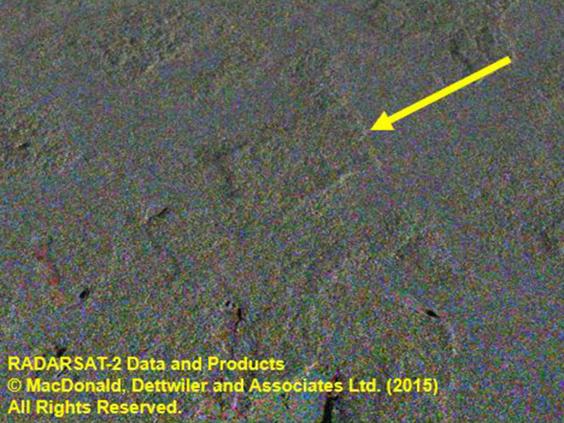
One of the more fascinating stories that we've been following over the past year was the possibility of hidden chambers inside King Tut's tomb in Egypt. The story first broke when an archeologist by the name of Nicholas Reeves proposed the theory that such hidden rooms might exist after making laser scans of Tut's burial chambers. He then postulated that those hidden areas could belong to the lost queen of Nefertiti, who was Tut's step mother and may have ruled Egypt before him.
Fuel was added to the fire last fall when it was announced that ground penetrating radar has been used at the ancient site, and those scans had revealed that there indeed blank spaces hidden behind Tut's walls. This seemed to show that Reeve's theories were proving accurate, and that archaeologists were on the verge of making a major discovery.
But now it has been revealed that those scans may not have been accurate at all, and that there really isn't anything hidden in Tut's tomb as first thought. A second scan of the tomb, funded by National Geographic earlier this year, reportedly found no evidence of hidden chambers. Furthermore, there are Egyptologists who are claiming that the Egyptian government is suppressing the news as long as they can in order to maintain the illusion that a discovery may be imminent for as long as possible. The idea of finding Nefertiti's remains was seen as a major find, and could potentially be a boost to the country's flagging tourism sector.
Apparently, Nat Geo's second scanning operation is wrapped up in non-disclosure agreement, which means no one can officially confirm the story at this time. We'll have to wait for the Egyptian Ministry of Antiquities to make a statement before we know for sure, but those close to the story say that Egyptian officials are in a bit of a panic over the lack of a new discovery and are looking for alternate opinions and evidence before proceeding.
This story made headlines just a few months ago, but now seems to be completely without merit. That's a bit depressing considering how much hype surrounded the potential discovery. Hopefully we'll get the real story soon so we can either move ahead with learning more about what's in Tut's tomb, or put in behind us altogether.
Showing posts with label Archeology. Show all posts
10/09/2017
9/25/2017
15-Year Old Canadian Boy Discovers Lost City in Mexico
A 15-year old boy from Quebec is making headlines today for discovering a lost Mayan city in Mexico. The boy used knowledge of ancient astronomy and Google Earth to locate what appears to be remnants of the civilization that thrived across Central America 2000 years ago.
While looking at maps of the locations of Mayan cities, William Gadoury learned that those cities lined up with the constellations in the sky as they appeared when the Mayan civilization was flourishing. Using that knowledge, he then began searching satellite imagery on Google Earth looking for structures in specific locations, discovering that one city that should have lined up with a specific star was missing. But after careful examination of a spot in the Yucatan Peninsula, he was able to identify what appears to be man-made object hidden under the dense jungle there.
The actual existence of the lost city has yet to be confirmed on the ground, but other researchers are hailing the discovery as a significant one, and are giving William the credit. Experts say that it appears that there are quite a few man-made structures hidden under a thick canopy of vegetation, including buildings, a road, a town square, and possibly even a pyramid.
The teenager has named the city K'aak Chi, which means "Mouth of Fire," and he will present his findings at a scientific gathering in Brazil next year. Meanwhile, archaeologists are already applying his technique of matching star charts to maps in hopes of finding other lost cities as well.
This is another amazing story that reminds us that there are some things that are still hidden away from us, even in the 21st century. It's hard not to be impressed with this young man and his ingenuity. It's a wonder that no one else has discovered the connection between the stars and the Mayan cities before.
12/25/2016
Excavation of Lost City Begins in Honduras
Last February a team of explorers and archaeologists traveled deep into the jungles of Honduras in search of a lost city. They had spotted what looked like the remains of ancient structures on satellite photos back in 2012, and after months of planning had finally set off to find what could be an important archaeological site. They spent days in the dense rainforest, facing numerous challenges that include picking up a nasty local parasite that left their health in jeopardy. But at long last they found the site they were looking for, and their hard work seemed justified.
But exhausted, low on supplies, and in failing health, they were forced to retreat. The plan was to return with more supplies and better equipment to begin excavation of the site. They team of researchers kept the location of the ruins hidden, and the Honduran government dispatched a military detail to guard it day and night to ensure that it remained undisturbed until a proper archaeological dig could begin.
Last week the team of explorers who discovered the hidden city returned at long last, and the excavation is now underway. According to National Geographic, Honduran President Juan Orlando Hernández was on hand this past Tuesday to remove the first stone sculpture from its ancient resting place, even as other archaeologists uncovered other artifacts all around him.
According to Nat Geo, the ancient relic that Hernández uncovered is an impressive piece. It is described as a jar that has been carved out of basalt, and painted ornamentally. The sides of the container show two animals, one of which is believed to be a vulture that is commonly seen in the area. The artifact is one of 52 that were originally found at the foot of an earthen pyramid that is just one small part of a larger city that mostly remains covered by the dense jungle.
The lost city, which is in the Valley of the Jaguars in Honduras, is believed to be between 500 and 800 years old, but who built it remains a mystery. The fact that it is in such a remote area, far from almost any other signs of human habitation, is also interesting. The archeologists hope to learn more about the civilization that lived there as they uncover the artifacts that they left behind.
Using the same satellite imagery that was used to locate this site, the research team believes it has found a second, even larger city nearby. No one has visited that location yet however, although a preliminary scouting mission is expected to take place next week. That place could hold even more clues about this mysterious civilization that was living in this remote region of Honduras.
These stories continue to fascinate me. I personally can't wait to hear more about what these archeologists find in the jungle. I also can't help but wonder what else is out there, just waiting for us to find it. Are there sites as impressive as Machu Picchu or Chichen Itza that have yet to be identified? I'd like to think there are, and that they hold important clues about the people that inhabited the Americas hundreds of years ago.
This story is also a good reminder of why exploration is still important, even in the 21st century.
But exhausted, low on supplies, and in failing health, they were forced to retreat. The plan was to return with more supplies and better equipment to begin excavation of the site. They team of researchers kept the location of the ruins hidden, and the Honduran government dispatched a military detail to guard it day and night to ensure that it remained undisturbed until a proper archaeological dig could begin.
Last week the team of explorers who discovered the hidden city returned at long last, and the excavation is now underway. According to National Geographic, Honduran President Juan Orlando Hernández was on hand this past Tuesday to remove the first stone sculpture from its ancient resting place, even as other archaeologists uncovered other artifacts all around him.
According to Nat Geo, the ancient relic that Hernández uncovered is an impressive piece. It is described as a jar that has been carved out of basalt, and painted ornamentally. The sides of the container show two animals, one of which is believed to be a vulture that is commonly seen in the area. The artifact is one of 52 that were originally found at the foot of an earthen pyramid that is just one small part of a larger city that mostly remains covered by the dense jungle.
The lost city, which is in the Valley of the Jaguars in Honduras, is believed to be between 500 and 800 years old, but who built it remains a mystery. The fact that it is in such a remote area, far from almost any other signs of human habitation, is also interesting. The archeologists hope to learn more about the civilization that lived there as they uncover the artifacts that they left behind.
Using the same satellite imagery that was used to locate this site, the research team believes it has found a second, even larger city nearby. No one has visited that location yet however, although a preliminary scouting mission is expected to take place next week. That place could hold even more clues about this mysterious civilization that was living in this remote region of Honduras.
These stories continue to fascinate me. I personally can't wait to hear more about what these archeologists find in the jungle. I also can't help but wonder what else is out there, just waiting for us to find it. Are there sites as impressive as Machu Picchu or Chichen Itza that have yet to be identified? I'd like to think there are, and that they hold important clues about the people that inhabited the Americas hundreds of years ago.
This story is also a good reminder of why exploration is still important, even in the 21st century.
4/16/2016
Did Canadian Teen Really Discover a Lost Mayan City?
We have an update today on that fascinating story that I posted yesterday about a 15-year old Canadian boy who claimed to have discovered a lost Mayan city in the Yucatan Peninsula. It seems that experts are poking holes in the young man's theories, saying that he didn't find a missing city at all, but instead spotted an overgrown agricultural field instead.
The original story was that school boy William Gadoury noticed that Mayan cities were located on a map in the same shape as several constellations in the sky. Looking at old star maps, the then overlaid the constellations on terrestrial maps and noticed that there were locations where cities should have lined up with the stars, but there were no known settlements there. So, William broke out Google Earth and started pouring over the images in search of manmade structures, discovering what looked like the remnants of a prior civilization.
Naturally, the story has struck a chord with the public, many of whom have been fascinated by this narrative, while also wondering why no one else had noticed this placement of Mayan cities in the past. Well, it turns out that there may be some basic issues with the teenager's general premise, as National Geographic explains, and the structures that he spotted in the satellite images may not be as old as he suspects or possibly not even man-made at all.
Archaeologist Ivan Šprajc says that the square shape spotted on the map is really an abandoned field that probably isn't any more than 20 or 30 years old. He also says that other potential structures are most likely natural shapes, and include a clearing in the jungle, which probably doesn't have anything to do with a lost Mayan city.
The original story was that school boy William Gadoury noticed that Mayan cities were located on a map in the same shape as several constellations in the sky. Looking at old star maps, the then overlaid the constellations on terrestrial maps and noticed that there were locations where cities should have lined up with the stars, but there were no known settlements there. So, William broke out Google Earth and started pouring over the images in search of manmade structures, discovering what looked like the remnants of a prior civilization.
Naturally, the story has struck a chord with the public, many of whom have been fascinated by this narrative, while also wondering why no one else had noticed this placement of Mayan cities in the past. Well, it turns out that there may be some basic issues with the teenager's general premise, as National Geographic explains, and the structures that he spotted in the satellite images may not be as old as he suspects or possibly not even man-made at all.
Archaeologist Ivan Šprajc says that the square shape spotted on the map is really an abandoned field that probably isn't any more than 20 or 30 years old. He also says that other potential structures are most likely natural shapes, and include a clearing in the jungle, which probably doesn't have anything to do with a lost Mayan city.
As I mentioned in my original story yesterday, the only real way to confirm the existence of a lost city is to send a team of archaeologists out to examine the site. Considering the skepticism that is being raised from others in the field, it seems unlikely that that will happen soon. Of course, there are some who believe that trained archaeologists have also been caught with egg on their face by being upstaged by a teenager, so they have reason to cast doubt on his findings. Only time will tell at this point.
2/25/2015
Researchers Discover Two Hidden Chambers Inside Egypt's Great Pyramid
It seems the discoveries just keep coming in Egypt, a civilization thousands of years old with plenty of monuments to prove it. Researchers in Cairo now say that they have discovered "cavities" inside one of the most well known and iconic structures on Earth – the Great Pyramid itself.
The discovery was made using imaging technology called muography. This technique uses special equipment to analyze radioactive particles known as muons. Analysts can detect where the particles are most dense or least dense to help create an image of the interior of spaces. In this way, it works much like ground penetrating radar, providing a map of the interior of the pyramid itself.
According to reports, the team conducting the study says that they are "now able to confirm the existence of a ‘void’ hidden behind the North Face, that could have the form of at least one corridor going inside the Great Pyramid.” The team added that “The precise shape, size, and exact position of this void is now under further investigation. It should be done with the help of 12 new Muon Emulsion plates that are installed in the descending corridor, and will be collected by the end of October 2016.”
The same researchers say that they have also located a second "void" in the structure that is located behind the descending corridor inside the pyramid as well. This corridor is the one that leads directly down into the structure to the tomb of the pharaoh Khufu, who had the pyramid constructed as his burial chamber some 4500 years ago.
What does all of this mean? We'll just have to wait for further information to know for sure, but it could confirm the existence of hidden chambers inside the Great Pyramid. What those chambers could contain would be open to speculation of course, but anyone who has ever been inside these structures can tell you that they are unimpressive other than from an architectural/construction sense. Unlike the tombs in the Valley of the Kings and Queens, the walls are not covered in hieroglyphs or painted in ornamental styles. Instead, they are bare, smooth, and colorless. The corridor and chambers are relatively small, and even a bit claustrophobic. But, it is possible that important items for Khufu were stashed in these spaces to prevent them from being looted by thieves.
Of course, it is also hard to get too excited about these "discoveries" considering the hype that was made last year about possibly finding the tomb of Nefertiti hidden inside that of the boy-king Tut. Those claims later seemed to have been proved false, although archaeologists continue to research the findings. Will this be a similar story? If these chambers inside the Pyramid are real, will they hold anything of value? Or are they just part of how the structure was made? It will likely be months before we know for sure, but it is definitely intriguing to think about.
Subscribe to:
Posts (Atom)