Showing posts with label Aircraft. Show all posts
Showing posts with label Aircraft. Show all posts
5/03/2017
Video: Exploring Alaska from Above with Paraglider Paul Guschlbauer
Paul Guschlbauer is an Austrian paraglider who traveled to Alaska – one of the world's last great frontiers – to explore the region from above. What he found there was an epic wilderness that remains remote and untamed, even in the 21st century. Paul flew across this amazing place in a 60-year old airplane, finding beautiful landscapes and amazing adventures along the way. This short video takes us along for the ride, and will leave you wanting more. See Alaska the way the famous bush pilots do, and marvel and just how spectacularly beautiful the state truly is.

1/04/2017
Video: Meet The Bush Pilots of Ketchikan
Even in the 21st century there are plenty of places in Alaska that remain cut-off from the rest of the world. The wild and expansive landscapes of that state makes it impossible to build a road system that can accommodate everyone. That's why so many people own airplanes there and use them to fly between destinations. In this video, we meet some of the bush pilots of Ketchikan, which have a reputation for being able to fly anywhere, anytime, and do it with style. This short documentary tells their story, and offers some amazing looks at the great scenery that is so common in Alaska. Get comfortable for this one, you're going to want to watch it all the way through.
Ketchikan: The Bush Pilots from Ketchikan Visitors Bureau on Vimeo.
7/11/2015
Video: Watch a Helicopter Pilot Land on the Summit of Everest
Back in 2005, French helicopter pilot Didier Delsalle did something that most people thought was impossible – he landed a helicopter on the summit of Mt. Everest. And when people questioned if he was actually able to pull of that stunt, he did it again for good measure. In this video, we see one of those landings, in footage that I hadn't ever come across before. Considering the fact that most helicopters won't go much higher than Base Camp, this remains an impressive bit of flying indeed.
5/19/2015
Meet the First Men to Fly Over Everest

Mashable recently posted a story and some great photos from that epic adventure that was called the Houston Everest Expedition because it was sponsored by a wealthy British philanthropist known as Lady Houston. She put up the money that allowed RAF pilot Douglas Douglas-Hamilton (aka Lord Clydesdale) and Colonel Stewart Blacker to attempt to fly a Westland PV-3 biplane over the top of the world's highest mountain, something that seemed incredibly dangerous at the time.
The two men took off from an airstrip near Purnea, India on the morning of April 3, 1933. They were accompanied by a second aircraft flown by Flight Lieutenant David McIntyre and a photographer named S.R. Bonnett. The second plane was there to record the event for posterity and get some fantastic images of this daring flight. The photographer did not disappoint.
As it turns out, the mission was a test for both pilots and aircraft, as there was indeed no pressurized cabins. The four men who were aboard the two planes had to rely on oxygen masks to keep their wits about them and help them breathe at such an altitude. On top of that, it was rare for any airplane to fly at such heights at that point in history, and the small biplane struggled in the thin air just as much as her crew.
When the two planes approached Everest, high winds caused even more problems, forcing the planes to drop 1500 feet (457 meters). But in the end, they were able to climb back up to 29,029 feet (8848 meters) and pass over the top of the summit for the very first time. All four men were given high accolades with Lord Clydesdale earning the Air Force Cross for his leadership. Bonnett's photos and video footage were also used to create an Academy Award winning film called Wings Over Everest as well. You can watch that film below.
The story of this expedition is an amazing one. Today we take it for granted that we fly at such a height, but back in 1933 it was almost as if they were trying to go to the moon. Fortunately, they proved that aircraft are sturdier than was believed and that man can go to higher heights that was previously believed. It would be 20 years before Edmund Hillary and Tenzing Norgay would actually climb to the summit, but this intrepid crew helped lead the way.
10/17/2014
Did Amelia Earhart Survive Her Crash in the Pacific?

One of the most compelling missing person's stories of the 20th century may have just gotten even more interesting. A member of The International Group for Historic Aircraft Recovery (TIGHAR) now claims that aviator Amelia Earhart not only survived her crash in South Pacific back in 1937, but she lived for days on a remote island, where she continuously called for help from her aircraft's radio, with those calls being picked up by amateur radio operators all over the world at the time.
In recent years, TIGHAR has put considerable effort into searching for the remains of Earhart, her navigator Fred Noonan, and their aircraft. The group has made several expeditions to islands in the Pacific searching for evidence of what may have happened to her. They have found some compelling clues, but nothing that definitively says whether or not she or Noonan survived the crash, or even made it to one of the sites they have examined at all.
But according to Ric Gillespie, a member of TIGHAR, Earhart's calls for help were heard by a woman in Melbourne, Australia; a housewife in Texas who claims to have recognized her voice, and perhaps most intriguing of all – a teenager in Florida.
What makes the Florida teen's story so fascinating is that she scribbled notes based on what she was hearing, transcribing what was allegedly Earhart's broadcast. The teen wrote several times "New York, New York," seemingly referencing the city. But Gillespie believes that Earhart was actually saying "SS Norwich City," which was a ship that was abandoned on Nikumaroro island in 1929, the place that TIGHAR believes the aviator set down.
Today, we take flying around the world for granted, as thousands of aircraft take off from airports all over the globe each day. But back in 1937, it was still difficult to imagine circumnavigating the globe in a small aircraft. That was exactly what Earhart and Noonan were trying to do when they went missing. The pilot and navigator had set out from Lae Airfield in New Guinea the plan was to fly to Howland Island. But somewhere along the way they got off track, and couldn't find their destination.
Eventually they ran out of fuel and crashed somewhere int he Pacific, but exactly where has long been a mystery. After examining the flight plan, listening to radio broadcasts, and plotting potential courses, TIGHAR has come to believe that Earhart and Noonan landed in a shallow bay off the shore of Nikumaroro, which has been the subject of their searches in recent years. So far, they've come up with nothing, but they hope to return next July – the 80th anniversary of Earhart's disappearance – to look for her Electra aircraft. The group believes that the tide has carried it out to sea, and that they'll be able to find it using a submersible.
Over the years, here at The Adventure Blog we've followed various attempts to locate the missing aircraft that Earhart was flying when she went missing. So far, it has remained elusive, as finding an 80 year old aircraft in the middle of the Pacific is not going to be easy. But, I have to admit TIGHAR has made some interesting finds over the years, including a piece of scrap metal that has been positively linked to the aircraft she was flying. Will they be able to finally substantiate their claims? We'll just have to wait until next summer to find out.
3/27/2014
Solar Impulse 2 Resumes Round--the-World Flight
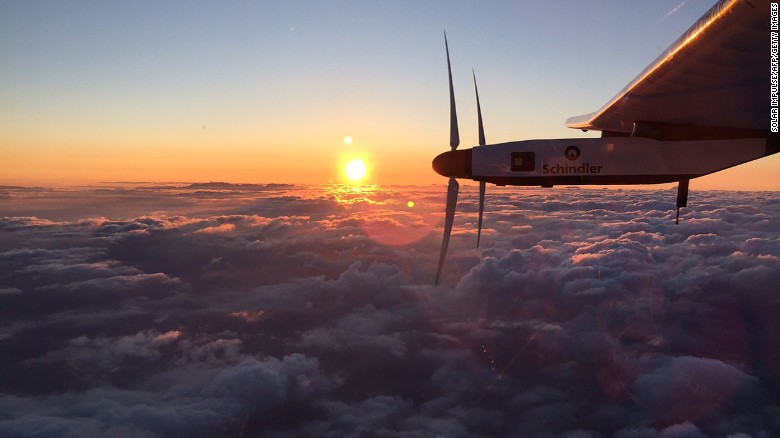
The innovative plane features a wingspan as large as a 747, yet it has a very small and cramped cockpit. Most of those large winds are covered in solar panels, with large batteries onboard that cover the rays of the sun into energy and store it for use while inflight. The aircraft carries absolutely no fuel, which is why flying it around the world is such a major achievement.
The Solar Impulse 2 took off from Abu Dhabi in March of last year, flying on to China with few problems. Once there however, poor weather kept the plane on the ground for several weeks, and when it did take off it was forced to land in Japan, where it suffered damage on the ground. The crew repaired that damage, and Swiss adventurer/pilot Bertrand Piccard pressed on to Hawaii.
But while on that leg of the journey, the plane's batteries overheated, damaging the electrical system en route. Safely on the ground in Hawaii, the team reviewed the issue and discovered that it would take some time to repair the Solar Impulse and get it back in the air. The aircraft needed two new batteries and an improved cooling system, which took some time to get in place. It remained in Hawaii until yesterday, when a weather window opened that allowed the plane to take off and resume its journey at long last.
Over the next few days the solar-powered aircraft will make its way to San Francisco, before continuing across the U.S., making several stops along the way. From there, it'll fly across the North Atlantic, visit Europe and North Africa, before proceeding back to Abu Dhabi sometime in the summer. If successful, the Solar Impulse will be the first aircraft to circumnavigate the globe using nothing but solar power.
Hopefully this is the last of the delays, and the airplane can now continue along on its journey without any further delays. There is still a long way to go, and it is far from out of danger, but the team behind this project is happy to see its aircraft back in the air once again.
Subscribe to:
Posts (Atom)