This week intrepid men and women from all over the world are putting the finishing touches on their preparation and planning for a slew of upcoming ski expeditions to the South Pole. In a matter of days they'll be jetting off to Punta Arenas, Chile or Cape Town, South Africa where they'll then catch a flight to Antarctica to begin a journey that will take them weeks to complete. Most will begin at Hercules Inlet and will cover approximately 1130 km (702 miles) on their way to 90ºS. But others will take alternate routes that offer different levels of difficult and unique paths to that same goal. Now, on the eve of the start of the new Antarctic season, we have an interactive map that shows all of the various routes that are used to ski across the frozen continent.
The map is hosted at ExplorersHouse.com and includes 9 different paths that explorers use when traveling to the the South Pole as well as 1 path to reach the Pole of Inaccessibility. Clicking on any of the routes will provide information about its length, who first pioneered it, and the year in which it was traveled. For instance, both Amundsen and Scott Routes are marked on the map, which were first opened back in 1911-1912, when the two legendary explorers were battling one another to be the first to reach the South Pole.
Explorer House included some text with the map that provides context on what exactly a "valid" expedition truly means. In this case, that is defined as starting anywhere along the Antarctic coast and skiing all the way to the South Pole. This rules out a "last degree" journey of course, which is exactly what it sounds like – a short ski expedition from 89ºS to 90ºS. Those "tourist trips" are typically only about 100 km (62 miles) in length, while a full expedition covers more than 1000 km (620 miles).
As we head into the start of a new Antarctic season, you'll find that the vast majority of the skiers are using the Hercules Inlet Route, which has become the standard for these types of expeditions. They'll fly out of Punta Arenas and land at the ice camp that is built and maintained by ALE at Union Glacier. From there, they'll catch another short flight to ferry them out to their starting point. If they are going solo and unsupported, they'll all be dropped off at unique locations to begin the journey, as the rules for adventure state that they can't have any contact with another individual along the way in order to maintain that status.
Later this week – weather permitting – the first teams will begin their march to the Pole. Once they're underway, we'll provide regular updates on their progress. There are a number of goods stories to follow, so it should be an interesting year in the Antarctic.
Showing posts with label Antarctic. Show all posts
12/12/2017
9/08/2017
Antarctica 2016: Two More Skiers Complete Their Antarctic Expeditions
The final days of the 2016 Antarctic season are truly upon us now, as the last plane scheduled to leave the frozen continent – weather permitting of course – will fly out today or tomorrow, bringing an end to an eventful few months there. As the final days tick away, two more skiers have completed their expeditions at long last, and are now preparing to head home.
Finnish adventurer Risto Hallikainen has finished his return journey to Hercules Inlet, arriving back at that point on January 24, 71 days after he began his round-trip journey via the South Pole. Along the way, he covered 2260 km (1404 miles), becoming the first Finn to make the there-and-back-again Antarctic trip. After camping at Hercules briefly, he was picked up and flown back to Union Glacier, where he should be on the last flight out to Punta Arenas, Chile.
Similarly, ExWeb is reporting that Polish solo skier Malgorzata Wojtaczka has reached the South Pole as well, brining an end to her expedition, which also began at Hercules Inlet. She started on November 18, and reached 90ºS on yesterday, on January 25. Her expedition took 69 days.
I tried to follow Malgorzata throughout her journey, but didn't end up reporting on her progress much, mostly because updates were few and far between. It is good to know that she has now arrived safely, and will be flying back to Union Glacier from the Pole as well.
Also awaiting the final flight out is the British Military Team, which also completed a traverse of the Antarctic continent. The boys arrived back at Union Glacier a few days ago, and are now eager to start making their way home. They spent 67 days out on the ice, covering the journey to the South Pole and the return trip across the Shackleton Glacier. After resting up, they're eager to return to the U.K.
Finally, Mike Horn will soon be the last of the skiers out on the ice. As everyone else prepares to leave aboard an ALE aircraft, he continues to kite-ski across the continent to meet his waiting ship. The winds have returned to help push him along, but he still has some miles yet to cover before he's done. From there, he'll sail into the South Pacific where other adventures await. Eventually he'll make his way north though, where he hopes to traverse the Arctic icecap in similar fashion. You know we'll be following that adventure closely too.
That's all for today. More updates over the next few days as the news warrants.
Finnish adventurer Risto Hallikainen has finished his return journey to Hercules Inlet, arriving back at that point on January 24, 71 days after he began his round-trip journey via the South Pole. Along the way, he covered 2260 km (1404 miles), becoming the first Finn to make the there-and-back-again Antarctic trip. After camping at Hercules briefly, he was picked up and flown back to Union Glacier, where he should be on the last flight out to Punta Arenas, Chile.
Similarly, ExWeb is reporting that Polish solo skier Malgorzata Wojtaczka has reached the South Pole as well, brining an end to her expedition, which also began at Hercules Inlet. She started on November 18, and reached 90ºS on yesterday, on January 25. Her expedition took 69 days.
I tried to follow Malgorzata throughout her journey, but didn't end up reporting on her progress much, mostly because updates were few and far between. It is good to know that she has now arrived safely, and will be flying back to Union Glacier from the Pole as well.
Also awaiting the final flight out is the British Military Team, which also completed a traverse of the Antarctic continent. The boys arrived back at Union Glacier a few days ago, and are now eager to start making their way home. They spent 67 days out on the ice, covering the journey to the South Pole and the return trip across the Shackleton Glacier. After resting up, they're eager to return to the U.K.
Finally, Mike Horn will soon be the last of the skiers out on the ice. As everyone else prepares to leave aboard an ALE aircraft, he continues to kite-ski across the continent to meet his waiting ship. The winds have returned to help push him along, but he still has some miles yet to cover before he's done. From there, he'll sail into the South Pacific where other adventures await. Eventually he'll make his way north though, where he hopes to traverse the Arctic icecap in similar fashion. You know we'll be following that adventure closely too.
That's all for today. More updates over the next few days as the news warrants.
9/01/2017
Antarctica 2015: Emma Kelty at the Pole
It wasn't easy, and it took longer than expected, but South Pole skier Emma Kelty has finally reached her goal. The British adventurer skied the last 12.5 nautical miles (23 km/14.3 miles) yesterday, capping a 700+ mile (1126 km) journey that began back in November. Over that period of time she has traveled with a teammate who came and went, and two different guides, but her focus, determination, and persistence eventually paid off. Congratulations to Emma on a job well done. She'll now hop a flight back to Union Glacier before proceed to Punta Arenas, and then home.
I'd been saying for a couple of weeks now that her arrival at the Pole would pretty much drop the curtain on the current Antarctic season but as we learned a few days ago, there is yet one more expedition to come. Australian Charles Werb will set out from Brisbane tomorrow on his way to Cape Town, where he'll have a brief stop over before leaving for Novo Station. His plan is to drive part of the way to the South Pole, and then use a specially designed sled with a sail to propel him the final leg of the trip. It should only take him about 7-14 days to make the journey, and if everything goes as expected, he'll get underway on Sunday of this week.
It has certainly been a very long, and at times eventful, season in the Antarctic. Of course, it will mostly be remembered for the tragic death of Henry Worsley, who succumbed to illness that he picked up on his long journey. He will not soon be forgotten.
I'll be keeping an eye on Charles' progress over the next few weeks as well. While not quite as long and grueling as some of the others we've followed this year, it should be interesting nonetheless.
I'd been saying for a couple of weeks now that her arrival at the Pole would pretty much drop the curtain on the current Antarctic season but as we learned a few days ago, there is yet one more expedition to come. Australian Charles Werb will set out from Brisbane tomorrow on his way to Cape Town, where he'll have a brief stop over before leaving for Novo Station. His plan is to drive part of the way to the South Pole, and then use a specially designed sled with a sail to propel him the final leg of the trip. It should only take him about 7-14 days to make the journey, and if everything goes as expected, he'll get underway on Sunday of this week.
It has certainly been a very long, and at times eventful, season in the Antarctic. Of course, it will mostly be remembered for the tragic death of Henry Worsley, who succumbed to illness that he picked up on his long journey. He will not soon be forgotten.
I'll be keeping an eye on Charles' progress over the next few weeks as well. While not quite as long and grueling as some of the others we've followed this year, it should be interesting nonetheless.
8/18/2017
Antarctica 2015: British Explorer Henry Worsley Dies Following Evacuation From the Antarctic
There is very sad news to report from Punta Arenas, Chile today. British polar explorer Henry Worsley has passed away from exhaustion and other ailments as a result of his attempt to complete a solo and unsupported crossing of Antarctica. He was 55 years old.
Worsley set out on his journey back in early November with the goal of becoming to the first to traverse the frozen continent alone and without assistance. He was out on the ice for more than 71 days, and had covered over 900 miles (1448 km) completely on his own. He was just 30 miles (48 km) shy of reaching his goal when he called for evacuation last Friday, January 22. At that point he was exhausted beyond measure, and couldn't find the strength to push on any longer. A flight was dispatched to retrieve him, and he was flown back to the Union Glacier camp before continuing on to Punta Arenas.
Once he arrived back in Chile, Worsley was taken to a hospital where he was diagnosed with peritonitis, which is an inflammation of the peritoneum, a thin later of tissue that lines the inside of the abdomen. The condition is generally caused by a bacterial infection in another part of the body.
Henry's wife Joanna flew from the U.K. to join him, and doctors performed surgery in an attempt to save his life, but the condition was too advanced and his exhausted body had no strength to fight off the attack. Joanna released a statement saying she was "heartbroken with sadness" and that her husband had passes away due to "complete organ failure."
We've been following Henry's progress in the Antarctic here at The Adventure Blog since before he even set out on his journey. It was a difficult endeavor to say the least, but when he reached the South Pole back on January 4th he seemed strong and in good spirits. In recent days it became evident that he was struggling however, as the long journey truly took its toll. He skied in near whiteout conditions his last few days on the ice, and photos of him in his tent showed a man who was gaunt and weary beyond measure.
I never met Henry in person, but I followed his expeditions closely and cheered him on in his adventures. With this Antarctic crossing I read his expedition updates nearly every day, and wrote numerous times about his progress. When I read the news that he had passed away I felt incredibly sad. He was strong, adventurous spirit who challenged himself to amazing things, and he will continue to serve as an inspiration to many of us.
Worsley's story will also serve as a reminder. Despite what we might think, we haven' quite conquered the planet just yet. There are still some tasks that remain incredibly difficult, and Mother Nature is the most formidable opponent of all.
I want to express my sincerest condolences to Henry's wife Joanna, and all of his friends and family. We lost a great man today, and he will be missed.
7/20/2017
Antarctica 2016: Johanna Davidsson at the Pole and in Record Time!
Before taking a hiatus for the holidays last Friday, I posted a story about Swedish adventurer Johanna Davidsson, who was on the verge of reaching the South Pole, and breaking the speed record for a female skier to reach that point on the planet. Now, we can confirm that she has indeed completed that stage of her journey, and has established a new mark for the fastest time from Hercules Inlet to 90ºS by a woman.
In the original story that I posted, I wrote that Johanna was aiming to reach the South Pole by December 25 – Christmas Day. Instead, she crossed the finish line on December 24, which mean that her journey took 38 days, 23 hours, and 5 minutes. That's 10 full hours faster than Hannah McKeand did it back in 2006.
ExWeb reports that for Johanna, this was a completely unexpected record. It was never part of her plan to set a ski to the Pole in such a quick time, and had originally told the website that she planned on a 50 day journey. Instead, she found that her training and gear were more than up to the task, and while conditions were challenging at times, she was able to cover further distances than she had originally intended on daily basis.
The final stretch wasn't an easy one however. Whiteout conditions made skiing a challenge, and the snow was soft enough that it slowed Johanna's progress. But, she pushed on with her goal in sight, and was able to finish one very long day of skiing to make it the research station located at the bottom of the world, where she was welcomed by the staff there with a hot meal and champaign.
The journey isn't quite done just yet however. She'll rest briefly at the Pole before turning around and heading back to her starting point at Hercules Inlet. If she's successful, she'll become the first Swede to complete the round-trip journey.
Congrats to Johanna on an amazing job setting a new speed record. We'll be following along as you head back to the coast.
In the original story that I posted, I wrote that Johanna was aiming to reach the South Pole by December 25 – Christmas Day. Instead, she crossed the finish line on December 24, which mean that her journey took 38 days, 23 hours, and 5 minutes. That's 10 full hours faster than Hannah McKeand did it back in 2006.
ExWeb reports that for Johanna, this was a completely unexpected record. It was never part of her plan to set a ski to the Pole in such a quick time, and had originally told the website that she planned on a 50 day journey. Instead, she found that her training and gear were more than up to the task, and while conditions were challenging at times, she was able to cover further distances than she had originally intended on daily basis.
The final stretch wasn't an easy one however. Whiteout conditions made skiing a challenge, and the snow was soft enough that it slowed Johanna's progress. But, she pushed on with her goal in sight, and was able to finish one very long day of skiing to make it the research station located at the bottom of the world, where she was welcomed by the staff there with a hot meal and champaign.
The journey isn't quite done just yet however. She'll rest briefly at the Pole before turning around and heading back to her starting point at Hercules Inlet. If she's successful, she'll become the first Swede to complete the round-trip journey.
Congrats to Johanna on an amazing job setting a new speed record. We'll be following along as you head back to the coast.
7/19/2017
Antarctica 2016: And Then There Was One...
The 2016 Antarctic season is all but over. Only one skier remains out on the ice, as everyone else has wrapped up their expeditions and headed home. And true to form, the frozen continent has already started to make things more difficult, with colder temperatures, blizzard-like conditions, and thankfully for this explorer, howling winds.
Mike Horn is still working on completing his traverse of the Antarctic continent. He reports that the winds returned with a vengeance yesterday, saying they are the strongest he's encountered yet. Considering the fact that he is kite skiing, having strong winds is better than no winds at all. Propelled along by these gusts, he's now 92 km (57 miles) closer to his goal, but he still has 430 km (267 miles) yet to go before he reaches the coastline, and the safety of his ship, the Pangaea.
In his most recent update, Horn says that he has been facing a constant battle with the winds, which have helped get his kites in the air, but haven't always been cooperative. Any kite-skier will tell you that you want strong winds, but not too strong, as they can be unruly and difficult to maneuver in. That's what the Swiss explorer has been dealing with over the past few days, coupled with large sastrugi on the surface that have made things interesting as well.
As you may recall, Mike is attempting to circumnavigate the globe via the poles, and this is just the first of his major ice cap crossings. Once he reaches his ship, he'll actually set sail for New Zealand and Australia, before heading north to the Arctic. But, there is still plenty of work to be done before he leaves the Antarctic.
Depending on wind conditions and how well he can work the kite, Horn could reach the coast line in as few as two days. But, if he manages to maintain the pace he has had over the past couple of days, he's more likely to finish around the end of the week. Should the winds disappear however, that time could extend further.
We'll continue to follow Mike's progress until he's off the ice. That shouldn't be too much longer, but his adventure isn't over just yet. The Antarctic summer is quickly coming to an end though, and he'll be departing just in the nick of time it seems.
Mike Horn is still working on completing his traverse of the Antarctic continent. He reports that the winds returned with a vengeance yesterday, saying they are the strongest he's encountered yet. Considering the fact that he is kite skiing, having strong winds is better than no winds at all. Propelled along by these gusts, he's now 92 km (57 miles) closer to his goal, but he still has 430 km (267 miles) yet to go before he reaches the coastline, and the safety of his ship, the Pangaea.
In his most recent update, Horn says that he has been facing a constant battle with the winds, which have helped get his kites in the air, but haven't always been cooperative. Any kite-skier will tell you that you want strong winds, but not too strong, as they can be unruly and difficult to maneuver in. That's what the Swiss explorer has been dealing with over the past few days, coupled with large sastrugi on the surface that have made things interesting as well.
As you may recall, Mike is attempting to circumnavigate the globe via the poles, and this is just the first of his major ice cap crossings. Once he reaches his ship, he'll actually set sail for New Zealand and Australia, before heading north to the Arctic. But, there is still plenty of work to be done before he leaves the Antarctic.
Depending on wind conditions and how well he can work the kite, Horn could reach the coast line in as few as two days. But, if he manages to maintain the pace he has had over the past couple of days, he's more likely to finish around the end of the week. Should the winds disappear however, that time could extend further.
We'll continue to follow Mike's progress until he's off the ice. That shouldn't be too much longer, but his adventure isn't over just yet. The Antarctic summer is quickly coming to an end though, and he'll be departing just in the nick of time it seems.
3/26/2017
Antarctica 2016: Mike Horn Completes Longest Kite Ski Expedition Ever
As reported a few days back, Mike Horn has completed his traverse of the Antarctic continent by kite ski, and is now waiting for pick-up by his ship the Pangaea. It has been a very long couple of months out on the ice, but the first leg of his epic Pole 2 Pole expedition is done, although he is not safely off the frozen continent just yet, and it is unclear as to when exactly he'll be able to depart.
According to ExWeb, Mike covered approximately 5100 km (3168 miles) over the course of his 57 day journey. Of that, 2215 km (1376 miles) were just spent reaching the South Pole, while the other 2885 km (1792 miles) were covered continuing on to the far coast. If those distances are accurate – and there is no reason to believe they aren't – Horn's expedition will mark the longest kite ski journey across the Antarctic ever. ExWeb does point out however that Mike received some meals while at the South Pole, so his journey isn't considered solo or unassisted, even though both legs coming and going from the Pole fall into those categories.
The final few days of the journey were not easy ones. Whiteout conditions persisted throughout and massive sastrugi – hard ridges on the ice – made it tough to make progress. At times, Mike's kite would pull him along at a rapid pace, but his sled would get caught on the sastrugi, creating a tug-of-war situation with Horn in the middle. There were also points where his kite would suddenly come to a stop, and the heavy sled would barrel into the back of the skier, knocking him to the ground. Those must have been very frustrating moments to say the least.
Now, Mike is believed to be at Dumon d'Urville, a French science station along the coast. He is waiting for Pangaea to pick him up, but at this point it is unclear as to when that will happen. As reported earlier in the week, the ship experienced electrical failure and was forced to set sail for Tasmania for repairs. There is no word yet on when those repairs will be completed and how long it will take to return to get Horn. One thing is for certain however, the austral winter is on its way, and it will become much more challenging to come and go from the Antarctic in the days ahead.
Once he is retrieved from the ice, the original plan was to sail to Australia and New Zealand for some exploration and adventures there before turning north to the Arctic and the second phase of the Pole 2 Pole expedition. That will involve a crossing of the Arctic Icecap in much the same fashion as the Antarctic. We'll have to wait to see if those plans change in any way, but the Arctic season will be up on us soon enough, and that season has already gotten shorter and more dangerous than years past.
I'll post more updates when we have further news of the Pangaea and Mike's situation.
According to ExWeb, Mike covered approximately 5100 km (3168 miles) over the course of his 57 day journey. Of that, 2215 km (1376 miles) were just spent reaching the South Pole, while the other 2885 km (1792 miles) were covered continuing on to the far coast. If those distances are accurate – and there is no reason to believe they aren't – Horn's expedition will mark the longest kite ski journey across the Antarctic ever. ExWeb does point out however that Mike received some meals while at the South Pole, so his journey isn't considered solo or unassisted, even though both legs coming and going from the Pole fall into those categories.
The final few days of the journey were not easy ones. Whiteout conditions persisted throughout and massive sastrugi – hard ridges on the ice – made it tough to make progress. At times, Mike's kite would pull him along at a rapid pace, but his sled would get caught on the sastrugi, creating a tug-of-war situation with Horn in the middle. There were also points where his kite would suddenly come to a stop, and the heavy sled would barrel into the back of the skier, knocking him to the ground. Those must have been very frustrating moments to say the least.
Now, Mike is believed to be at Dumon d'Urville, a French science station along the coast. He is waiting for Pangaea to pick him up, but at this point it is unclear as to when that will happen. As reported earlier in the week, the ship experienced electrical failure and was forced to set sail for Tasmania for repairs. There is no word yet on when those repairs will be completed and how long it will take to return to get Horn. One thing is for certain however, the austral winter is on its way, and it will become much more challenging to come and go from the Antarctic in the days ahead.
Once he is retrieved from the ice, the original plan was to sail to Australia and New Zealand for some exploration and adventures there before turning north to the Arctic and the second phase of the Pole 2 Pole expedition. That will involve a crossing of the Arctic Icecap in much the same fashion as the Antarctic. We'll have to wait to see if those plans change in any way, but the Arctic season will be up on us soon enough, and that season has already gotten shorter and more dangerous than years past.
I'll post more updates when we have further news of the Pangaea and Mike's situation.
Labels:
Antarctic,
Expedition,
Kiting,
Mike Horn,
South Pole
1/22/2017
Antarctica 2015: Running Out of Time
Following the sad news of the passing of Henry Worsley yesterday, there are still two teams out on the ice in the Antarctic, struggling to reach their respective finish lines. But the clock is most definitely ticking as the season grinds to a halt later this week. The last flight out is scheduled for Thursday – weather permitting of course. But depending on conditions, that deadline could get extended, although once this weather window closes, it doesn't open again for 10 months.
At the Union Glacier camp the staff and crew are busy packing up and preparing to leave the Antarctic once again. It has been another long and challenging season as they support the teams out on the ice, and no doubt more than a few of them are feeling the loss of Henry. But they are also a very professional team, and they know that there is a job to do before they head home once again.
South Pole skier Emma Kelty is still trudging ahead, slowly but surely making her way towards her goal. She's running a bit behind schedule, and feeling the pinch of time slipping away, but is also doing her best to reach 90ºS before the season runs out. As of her most recent update, posted on Friday of last week, she still had two degrees to cover before she reaches her goal. That equates to 222 km (138 miles) which is an awful long way to cover with such little time left on the clock. Personally, I'm not sure how she gets it done before the deadline, but we'll watch closely and hope for the best.
At the end of last week she not only received a resupply, complete with all kinds of goodies to help get her to the finish line, but she is now skiing with a new guide too. Apparently her pervious guide – Carl Alvy – had to depart Antarctica, so a new guide – named Patchi – has stepped in to take his place. The duo are now pushing hard to reach the finish line, and we'll just have to wait to see if they make it.
Meanwhile, elsewhere Devon McDiarmid and Stew Edge arrived back at Union Glacier earlier today. You may recall, the two men skied to the South Pole along with Mostafa Salameh, and Shahrom Abdullah, reaching that point back on January 17. While their companions hopped a flight back home, Dev and Stew used kites to travel back to their starting point. Their final push was an 18-hour day that ended with their arrival at the ice camp, which means they managed to ski the full distance back in less than 9 days. That's pretty impressive to say the least. They'll now get a few days rest before flying out to Punta Arenas, Chile.
As you can see, the 2015 Antarctic season is quickly coming to an end. In another day or two things will be wrapping up for the season, with everyone heading home. Hopefully Emma gets a chance at reaching the South Pole. She's worked very hard to get there, but time is definitely no on her side.
At the Union Glacier camp the staff and crew are busy packing up and preparing to leave the Antarctic once again. It has been another long and challenging season as they support the teams out on the ice, and no doubt more than a few of them are feeling the loss of Henry. But they are also a very professional team, and they know that there is a job to do before they head home once again.
South Pole skier Emma Kelty is still trudging ahead, slowly but surely making her way towards her goal. She's running a bit behind schedule, and feeling the pinch of time slipping away, but is also doing her best to reach 90ºS before the season runs out. As of her most recent update, posted on Friday of last week, she still had two degrees to cover before she reaches her goal. That equates to 222 km (138 miles) which is an awful long way to cover with such little time left on the clock. Personally, I'm not sure how she gets it done before the deadline, but we'll watch closely and hope for the best.
At the end of last week she not only received a resupply, complete with all kinds of goodies to help get her to the finish line, but she is now skiing with a new guide too. Apparently her pervious guide – Carl Alvy – had to depart Antarctica, so a new guide – named Patchi – has stepped in to take his place. The duo are now pushing hard to reach the finish line, and we'll just have to wait to see if they make it.
Meanwhile, elsewhere Devon McDiarmid and Stew Edge arrived back at Union Glacier earlier today. You may recall, the two men skied to the South Pole along with Mostafa Salameh, and Shahrom Abdullah, reaching that point back on January 17. While their companions hopped a flight back home, Dev and Stew used kites to travel back to their starting point. Their final push was an 18-hour day that ended with their arrival at the ice camp, which means they managed to ski the full distance back in less than 9 days. That's pretty impressive to say the least. They'll now get a few days rest before flying out to Punta Arenas, Chile.
As you can see, the 2015 Antarctic season is quickly coming to an end. In another day or two things will be wrapping up for the season, with everyone heading home. Hopefully Emma gets a chance at reaching the South Pole. She's worked very hard to get there, but time is definitely no on her side.
12/16/2016
Outside Probes False South Pole Ski Record Claims
Last January the world of outdoor adventure and exploration was shocked to learn that a little-known German Antarctic skier had set a new record for covering the distance from Hercules Inlet to the South Pole. The old record had been set back in 2011 by a Norwegian explorer by the name of Christian Eide. He managed to cover the 1175 km (730 mile) route in a blazingly fast 24 days, 1 hour, and 13 minutes. But a man by the name of Martin Szwed seemingly came out of nowhere to claim that he had shattered that record by nearly 10 days, skiing to the South Pole in just 14 days, 18 hours, and 43 minutes. It was heralded as a triumph at the time, with Szwed's sponsors and social media trumpeting his accomplishment.
But then, something funny happened on the way to the South Pole. It all started to fall apart as holes appeared in Szwed's stories of where he was at certain times, and how he managed to get there. His photographic evidence of reaching 90ºS appeared to be photoshopped, and his claims of previously summiting Mt. Vinson were also proven false. Just as quickly as he had shot to the top, Szwed came tumbling back down.
Now, Outside magazine is taking a look at the controversial story, with none other than Eric Larsen writing a piece about the whole affair. Larsen probes into Szwed's claims using flight manifestos from Antarctic Logistics and Expeditions, the company that supports most expeditions to the frozen continent, to further discredit his story. Eric, who is an accomplished polar explorer himself, even talks to other members of the close-knit community to get their take on the situation, with most saying they knew it was a false story from the beginning.
The article is an extensive one, with lots of details on how the situation unfolded, the reaction from the media, and Szwed's own denials. Within a few days the disgraced explorer's sponsors started to backtrack, and in-depth examinations of his claims started to punch holes in the story. There was even a public exchange between Szwed and Eide.
When writing the piece for Outside, Larsen when directly to the source, contacting Szwed himself. The German says that he has GPS tracking information that will serve as proof of his claims, but if he releases it he could face jail time and a substantial fine in his home country. The one-time mountain guide is under investigation for claims of fraud and possibly visiting Antarctica without proper authorization.
The whole story is a sordid one, but well worth a read. For my part, I wrote about the controversy last year and at the time thought that the story was suspicious from the start. For one thing, as someone who follows the Antarctic ski season closely, Szwed hadn't even shown up on my radar in the reports I was writing. That isn't necessarily proof that his claims are false of course, but it is a bit unusual to not know about a speed-record attempt of this kind.
The sad thing is, that Szwed's story isn't the only one like this. There have been others who have also falsified reports and records. This probably won't be the last time it happens either.
But then, something funny happened on the way to the South Pole. It all started to fall apart as holes appeared in Szwed's stories of where he was at certain times, and how he managed to get there. His photographic evidence of reaching 90ºS appeared to be photoshopped, and his claims of previously summiting Mt. Vinson were also proven false. Just as quickly as he had shot to the top, Szwed came tumbling back down.
Now, Outside magazine is taking a look at the controversial story, with none other than Eric Larsen writing a piece about the whole affair. Larsen probes into Szwed's claims using flight manifestos from Antarctic Logistics and Expeditions, the company that supports most expeditions to the frozen continent, to further discredit his story. Eric, who is an accomplished polar explorer himself, even talks to other members of the close-knit community to get their take on the situation, with most saying they knew it was a false story from the beginning.
The article is an extensive one, with lots of details on how the situation unfolded, the reaction from the media, and Szwed's own denials. Within a few days the disgraced explorer's sponsors started to backtrack, and in-depth examinations of his claims started to punch holes in the story. There was even a public exchange between Szwed and Eide.
When writing the piece for Outside, Larsen when directly to the source, contacting Szwed himself. The German says that he has GPS tracking information that will serve as proof of his claims, but if he releases it he could face jail time and a substantial fine in his home country. The one-time mountain guide is under investigation for claims of fraud and possibly visiting Antarctica without proper authorization.
The whole story is a sordid one, but well worth a read. For my part, I wrote about the controversy last year and at the time thought that the story was suspicious from the start. For one thing, as someone who follows the Antarctic ski season closely, Szwed hadn't even shown up on my radar in the reports I was writing. That isn't necessarily proof that his claims are false of course, but it is a bit unusual to not know about a speed-record attempt of this kind.
The sad thing is, that Szwed's story isn't the only one like this. There have been others who have also falsified reports and records. This probably won't be the last time it happens either.
12/12/2016
Antarctica 2013: No Rest For The Weary
The agonizing march to the South Pole continues for several of the teams that we've been following this Antarctic season, and while the end is in sight for most of them, there is still a lot of work to be done before they can rest. Right now, the grind continues, with day after day of tedium with just the counting down of mileage to record their progress. This is probably the toughest part of the expedition for these folks, who are ready to be done after weeks out on the ice.
Ben Saunders and Tarka L'Herpiniere, the two men who make up the Scott Expedition are most definitely in the midst of their grind. Having rounded the Pole, the duo are on their way back to the coast where they started, although it has been far from easy as today's blog post will attest. They are at the physical and mental limits after 75 days out on the ice, and it appears that tempers have flared a bit more quickly in recent days. That seems pretty understandable considering everything they've been through over the past two and a half months. Now, they're rushing to get off the polar plateau, with the hopes of picking up speed on their return journey. With just under 700 miles (1126 km) to go until they're done, the end is still quite a long way off. Hopefully their spirits and bodies will hold out until the end.
Similarly struggling is Daniel Burton, who is riding his fat tire bike to the South Pole. This morning he should have retrieved his final supply cache and he is now set to make the final push to 90ºS. Daniel estimates he has about 10 days of riding left before he crosses the finish line and he believes things will get somewhat easier once he passes the 88th degree. He is currently wading through the nasty sastrugi field that is found inside 87ºS, which is slowing his progress and making it extremely difficult to ride at times. Some of those sastrugi are reportedly as much as 4-5 feet (1.5 meters) in height, forcing him to go around the snow-dunes, or even get off his bike and push for a time. On top of that, he is also currently passing through an area with several large crevasses, which aren't exactly helping the pace either.
Lewis Clarke is forging ahead as expected and is now working his way through the same sastrugi field, although in his case it is on skis. He has now been on the trail for 36 days and is knocking off solid chunks of mileage each day. He and his guide, Carl Alvey, now have about 176 miles (283 km) to go until they are done, which at their current pace means they should finish sometime around the end of next week. If successful, Lewis will become the youngest person to ski to the South Pole at just 16-years of age.
For some real insights into what it is like to travel in the Antarctic, check out the guest blog post on Lewis' website that was written by Jon Bradshaw, who made the same journey back in 2008. He shares some interesting thoughts on what it is like to be so far into an expedition but still not quite being able to see the end. He discusses the physical and mental challenges that the skiers are facing and talks about his own experiences on the way to the South Pole. It is quite an interesting perspective.
Polar veteran Antony Jinman continues his march to the South Pole. He has quietly been going about his business as usual, and is now nearing the 88th degree. He has just 140 nautical miles (260 km) left to cross, and seems happy to be heading into the homestretch. Like the rest of the skiers however, he is still dealing with the dreaded sastrugi as well.
Also closing in on the end are Chris and Marty Fagan. They did cross 88º yesterday and now have a mere 134 miles (215 km) to go before they are done. The toll of the expedition has really started to wear on them, but they continue to press ahead as best they can. With just ten days of food left, they can feel the clock ticking. They need to reach the Pole before they run out of rations. That would put them at the finish line by Friday, January 17.
Finally, an update on kite skier Geoff Wilson. When we last checked in on him, he was waiting for a flight off of the ice at Hercules Inlet that would take him back to Union Glacier. At that point, he was stuck in his tent and out of food, but the weather was keeping him locked in place there. The weather did clear however, and is now safely back at camp, waiting for a flight to Punta Arenas. I'm sure he is enjoying the food and relative comforts of Union Glacier, but more than ready to start the journey home.
That's it for today. More updates soon.
Ben Saunders and Tarka L'Herpiniere, the two men who make up the Scott Expedition are most definitely in the midst of their grind. Having rounded the Pole, the duo are on their way back to the coast where they started, although it has been far from easy as today's blog post will attest. They are at the physical and mental limits after 75 days out on the ice, and it appears that tempers have flared a bit more quickly in recent days. That seems pretty understandable considering everything they've been through over the past two and a half months. Now, they're rushing to get off the polar plateau, with the hopes of picking up speed on their return journey. With just under 700 miles (1126 km) to go until they're done, the end is still quite a long way off. Hopefully their spirits and bodies will hold out until the end.
Similarly struggling is Daniel Burton, who is riding his fat tire bike to the South Pole. This morning he should have retrieved his final supply cache and he is now set to make the final push to 90ºS. Daniel estimates he has about 10 days of riding left before he crosses the finish line and he believes things will get somewhat easier once he passes the 88th degree. He is currently wading through the nasty sastrugi field that is found inside 87ºS, which is slowing his progress and making it extremely difficult to ride at times. Some of those sastrugi are reportedly as much as 4-5 feet (1.5 meters) in height, forcing him to go around the snow-dunes, or even get off his bike and push for a time. On top of that, he is also currently passing through an area with several large crevasses, which aren't exactly helping the pace either.
Lewis Clarke is forging ahead as expected and is now working his way through the same sastrugi field, although in his case it is on skis. He has now been on the trail for 36 days and is knocking off solid chunks of mileage each day. He and his guide, Carl Alvey, now have about 176 miles (283 km) to go until they are done, which at their current pace means they should finish sometime around the end of next week. If successful, Lewis will become the youngest person to ski to the South Pole at just 16-years of age.
For some real insights into what it is like to travel in the Antarctic, check out the guest blog post on Lewis' website that was written by Jon Bradshaw, who made the same journey back in 2008. He shares some interesting thoughts on what it is like to be so far into an expedition but still not quite being able to see the end. He discusses the physical and mental challenges that the skiers are facing and talks about his own experiences on the way to the South Pole. It is quite an interesting perspective.
Polar veteran Antony Jinman continues his march to the South Pole. He has quietly been going about his business as usual, and is now nearing the 88th degree. He has just 140 nautical miles (260 km) left to cross, and seems happy to be heading into the homestretch. Like the rest of the skiers however, he is still dealing with the dreaded sastrugi as well.
Also closing in on the end are Chris and Marty Fagan. They did cross 88º yesterday and now have a mere 134 miles (215 km) to go before they are done. The toll of the expedition has really started to wear on them, but they continue to press ahead as best they can. With just ten days of food left, they can feel the clock ticking. They need to reach the Pole before they run out of rations. That would put them at the finish line by Friday, January 17.
Finally, an update on kite skier Geoff Wilson. When we last checked in on him, he was waiting for a flight off of the ice at Hercules Inlet that would take him back to Union Glacier. At that point, he was stuck in his tent and out of food, but the weather was keeping him locked in place there. The weather did clear however, and is now safely back at camp, waiting for a flight to Punta Arenas. I'm sure he is enjoying the food and relative comforts of Union Glacier, but more than ready to start the journey home.
That's it for today. More updates soon.
11/26/2016
100 Years Ago Shackleton's Men Were Rescued From the Ice
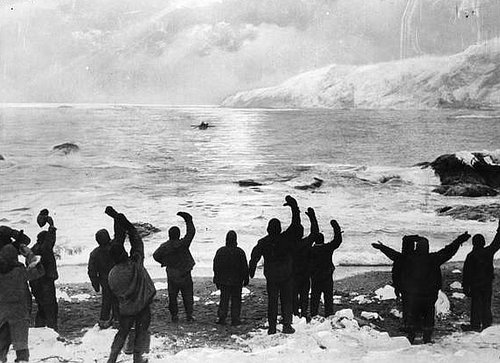
Yesterday marked an auspicious day in the annals of exploration. It was exactly 100 years to the day since Ernest Shackleton's men were rescued from the ice in the Antarctic after a months-long ordeal that would eventually go down as one of the greatest tales of survival ever. The rescue brought and end to their struggles on that particular expedition, but returned them to a world gone mad by war.
Shackleton's tale is a well known one at this point. In August of 1914, he and his men set sail from London for the Antarctic where he and several of his men had hoped to launch an attempt to cross the frozen continent. As they left Europe behind, the first shots of what would become World War I were just taking place on that continent as well.
In December of 1914, Shackleton's ship – the aptly named Endurance – departed South Georgia Island for the Weddell Sea off the coast of Antarctica. Once there, the crew discovered more ice than they had expected, and by January 19, 1915 the ship was fully enveloped in ice, not allowing it to move forward or backward. For months, the Endurance and her crew were stuck in place, until the ship finally succumbed to the pressures being applied to its hull and sunk beneath the waters on November 21, 1915.
But the ordeal for Shackleton and is men were far from over. For weeks they camped on an ice floe before it cracked and broke up, forcing them into the Endurance's lifeboats in a desperate attempt to reach Elephant Island. They reached that point and stepped foot on solid ground for the first time in 497 days.
Knowing that he and his men couldn't hold out forever, Shackleton came up with a desperate plan to make an open water crossing to reach South Georgia again. On April 24, 1916 he and a few hand-picked men set out once again, surviving high seas, storms, and frigid conditions to reach their destination on May 8. They then made a harrowing trip across the island on foot to reach a whaling station on the other side where they could begin mounting a rescue operation at long last.
But once again the conditions in the Southern Ocean thwarted their plans and poor weather prevented them from going back to Elephant Island. On two separate occasions rescue missions were forced to abandon their attempts, although Shackleton persisted in his efforts to save his men. It took until August 30, 1916 to complete the rescue operation, retrieving 22 men who had remained in that desolate place for five more months. But in the end, not a single man perished on that expedition, which remains a remarkable feat to this day.
It took until May of 1917 for Shackleton to return to England, but but that point the war was at its most brutal. A small conflict that was breaking out when he and his men left for the Antarctic had turned into the bloodiest and most costly war that the world had ever seen. Millions had lost their lives since the Endurance had set sail, and hundreds of thousands more would perish before it was through. Some of them were men who had survived all those months on the ice.
I've said it before and I'll say it again. The story of Shackleton and his crew is one of the greatest stories of adventure and survival that we've ever seen. It is a testament to his leadership skills that they managed to stay alive at all, and I can't even imagine what it was like to be stranded under those conditions for so long.
Major thanks goes out to the Adventure Journal for reminding me of this important date in history.
Shackleton's tale is a well known one at this point. In August of 1914, he and his men set sail from London for the Antarctic where he and several of his men had hoped to launch an attempt to cross the frozen continent. As they left Europe behind, the first shots of what would become World War I were just taking place on that continent as well.
In December of 1914, Shackleton's ship – the aptly named Endurance – departed South Georgia Island for the Weddell Sea off the coast of Antarctica. Once there, the crew discovered more ice than they had expected, and by January 19, 1915 the ship was fully enveloped in ice, not allowing it to move forward or backward. For months, the Endurance and her crew were stuck in place, until the ship finally succumbed to the pressures being applied to its hull and sunk beneath the waters on November 21, 1915.
But the ordeal for Shackleton and is men were far from over. For weeks they camped on an ice floe before it cracked and broke up, forcing them into the Endurance's lifeboats in a desperate attempt to reach Elephant Island. They reached that point and stepped foot on solid ground for the first time in 497 days.
Knowing that he and his men couldn't hold out forever, Shackleton came up with a desperate plan to make an open water crossing to reach South Georgia again. On April 24, 1916 he and a few hand-picked men set out once again, surviving high seas, storms, and frigid conditions to reach their destination on May 8. They then made a harrowing trip across the island on foot to reach a whaling station on the other side where they could begin mounting a rescue operation at long last.
But once again the conditions in the Southern Ocean thwarted their plans and poor weather prevented them from going back to Elephant Island. On two separate occasions rescue missions were forced to abandon their attempts, although Shackleton persisted in his efforts to save his men. It took until August 30, 1916 to complete the rescue operation, retrieving 22 men who had remained in that desolate place for five more months. But in the end, not a single man perished on that expedition, which remains a remarkable feat to this day.
It took until May of 1917 for Shackleton to return to England, but but that point the war was at its most brutal. A small conflict that was breaking out when he and his men left for the Antarctic had turned into the bloodiest and most costly war that the world had ever seen. Millions had lost their lives since the Endurance had set sail, and hundreds of thousands more would perish before it was through. Some of them were men who had survived all those months on the ice.
I've said it before and I'll say it again. The story of Shackleton and his crew is one of the greatest stories of adventure and survival that we've ever seen. It is a testament to his leadership skills that they managed to stay alive at all, and I can't even imagine what it was like to be stranded under those conditions for so long.
Major thanks goes out to the Adventure Journal for reminding me of this important date in history.
8/21/2016
Antarctica 2015: Outer Edge Challenge Team En Route to the South Pole
It has been a very long season in Antarctica, where all of the South Pole skiers have now packed up and gone home for the season. That typically drops the curtain on operations there for the year, but there is still one ongoing expedition that is taking place at the moment. Last week, Australian adventurer Charles Werb launched his Outer Edge Challenge, during which he will be is using a specially designed, wind-driven sled that allows him to sail over the ice. His ultimate goal is to reach the South Pole in just a few days time, and while things are going well in his preparations, the wind hasn't exactly been cooperative so far.
Were arrived at the Novo station in Antarctica last week, and has spent his time since then getting ready to officially launch the expedition. He has been organizing his gear, preparing the sled, and training with it under actual polar conditions. So far, he has found that the winds haven't been as strong as he'd like, but that is expected to change over the next day or two. Storms are predicted for his route, which will make things a bit challenging, but higher winds will help propel the Aussie along at a faster clip.
Charles is expected to cover the complete distance to the South Pole in about a week or so, depending on conditions. Things are looking good for his official start in the next day or two, and from there he'l be off to the Pole. He'll travel with a support team in tow to keep an eye on his progress and lend a hand as needed. That team will also carry all of the extra gear and supplies needed for such a journey.
While this expedition should be fairly brief, there are obstacles to be concerned with. For instance, typically by now most people have left the Antarctic for the season as the weather starts to take a turn for the worse. The Austral Summer is nearing an end, and harsh conditions soon follow afterwards. Charles and his team will have to watch the weather very carefully, as it could potentially turn dangerous. The plan is to make a dash for the finish the line, then head back to the coast, getting out before things get really bad. But as unpredictable as the weather is, you just never know what Mother Nature will throw at you.
More updates on the expeditions progress as we know more.
Were arrived at the Novo station in Antarctica last week, and has spent his time since then getting ready to officially launch the expedition. He has been organizing his gear, preparing the sled, and training with it under actual polar conditions. So far, he has found that the winds haven't been as strong as he'd like, but that is expected to change over the next day or two. Storms are predicted for his route, which will make things a bit challenging, but higher winds will help propel the Aussie along at a faster clip.
Charles is expected to cover the complete distance to the South Pole in about a week or so, depending on conditions. Things are looking good for his official start in the next day or two, and from there he'l be off to the Pole. He'll travel with a support team in tow to keep an eye on his progress and lend a hand as needed. That team will also carry all of the extra gear and supplies needed for such a journey.
While this expedition should be fairly brief, there are obstacles to be concerned with. For instance, typically by now most people have left the Antarctic for the season as the weather starts to take a turn for the worse. The Austral Summer is nearing an end, and harsh conditions soon follow afterwards. Charles and his team will have to watch the weather very carefully, as it could potentially turn dangerous. The plan is to make a dash for the finish the line, then head back to the coast, getting out before things get really bad. But as unpredictable as the weather is, you just never know what Mother Nature will throw at you.
More updates on the expeditions progress as we know more.
7/12/2016
Stunning Photo Gallery Highlights the Beauty of Antarctica
When ever we think about Antarctica, images of frozen, windswept landscapes stretching from horizon to horizon usually come to mind. While that isn't altogether completely inaccurate, the icy continent can also be a place of unspeakable beauty as well. It is a wild, remote, and spectacular place that remains largely untouched by man, and while few of us will ever get the chance to actually see it, it is a memorable place nonetheless.
Recently, the website Mashable posted a gallery of jaw-dropping photos that were shot in the Antarctic. Each image was taken by Alasdair Turner, who spends three months each year living at McMurdo Station on the Ross Ice Shelf, working with scientists and researchers who are conducting a wide variety of experiments.
While there, Alasdair gets a chance to experience the Antarctic that is unlike what adventurous travelers see along the coastline. Instead, he gets to travel into the interior of the continent, which is the highest, driest, and coldest place on Earth. The landscapes that are found there are indeed often covered in snow and ice, and they can be vast and forbidding. But, as you'll see in the photos, they can also be incredibly gorgeous too.
I haven't had the chance to visit Antarctica yet. It is the only continent I haven't been to, and it his extremely high on my bucket list. One day, I'll get there. But for now, I'll have to settle for these photos, which only serve to increase my desire to see this amazing place. I think they'll probably have a similar effect on you.
Recently, the website Mashable posted a gallery of jaw-dropping photos that were shot in the Antarctic. Each image was taken by Alasdair Turner, who spends three months each year living at McMurdo Station on the Ross Ice Shelf, working with scientists and researchers who are conducting a wide variety of experiments.
While there, Alasdair gets a chance to experience the Antarctic that is unlike what adventurous travelers see along the coastline. Instead, he gets to travel into the interior of the continent, which is the highest, driest, and coldest place on Earth. The landscapes that are found there are indeed often covered in snow and ice, and they can be vast and forbidding. But, as you'll see in the photos, they can also be incredibly gorgeous too.
I haven't had the chance to visit Antarctica yet. It is the only continent I haven't been to, and it his extremely high on my bucket list. One day, I'll get there. But for now, I'll have to settle for these photos, which only serve to increase my desire to see this amazing place. I think they'll probably have a similar effect on you.
7/07/2016
Antarctica 2013: The End Is Nigh For Scott Expedition
Today is the day that the 2013-2014 Antarctic season comes to an end at last. With most of the team already long gone, the Scott Expedition continues to labor towards their finish line. But the boys are now just 15 km (9.3 miles) from their end point and they are more than ready to wrap up what has been an excruciatingly long and difficult journey.
Over the past week or so, Ben Saunders and Tarka L'Herpiniere have been averaging about 24 miles (38 km) per day. That means they have a relatively short leg to complete today, before reaching a research station located on the Ross Ice Shelf. With that in mind, they have elected to sleep in a little late today and take their time on these final miles. They'll savor as much of the last day as possible, considering they have found little joy in their exhausting trip to the South Pole and back.
Spirits are high for both men as the near the end, but they are definitely weary and ready to go home. The tale of the tape says that when they are finished they'll have covered 2875 km (1786 miles) over 105 days. That is an incredible amount of time to spend out on the ice and it has clearly taken its toll. Still, the team would have made their namesake proud, as they complete Robert Falcon Scott's route to the Pole and back. That alone is an accomplishment worth celebrating.
I'll post an update when Ben and Tarka are done. They were the first out on the ice, and they'll be the last to go home. A much deserved rest is waiting for them.
Over the past week or so, Ben Saunders and Tarka L'Herpiniere have been averaging about 24 miles (38 km) per day. That means they have a relatively short leg to complete today, before reaching a research station located on the Ross Ice Shelf. With that in mind, they have elected to sleep in a little late today and take their time on these final miles. They'll savor as much of the last day as possible, considering they have found little joy in their exhausting trip to the South Pole and back.
Spirits are high for both men as the near the end, but they are definitely weary and ready to go home. The tale of the tape says that when they are finished they'll have covered 2875 km (1786 miles) over 105 days. That is an incredible amount of time to spend out on the ice and it has clearly taken its toll. Still, the team would have made their namesake proud, as they complete Robert Falcon Scott's route to the Pole and back. That alone is an accomplishment worth celebrating.
I'll post an update when Ben and Tarka are done. They were the first out on the ice, and they'll be the last to go home. A much deserved rest is waiting for them.
7/03/2016
Antarctica 2016: One Skier Abandons South Pole Attempt, Another Gets Underway
As we approach the first full day of winter here in the Northern Hemisphere, down south the Antarctic skiers continue to press on towards their goals. The current South Pole ski season has been underway for more than six weeks, and the faster teams are now starting to near the finish line, although there is still some miles yet to be covered before they are through. But the big news this week is that one skier has abandon his attempt to ski to 90ºS, while another is now on his way to that point.
One of the expeditions that we've been following closely this season is that of sit-skier Aron Anderson, a paraplegic who was attempting to travel to the South Pole. But unfortunately, Aron was forced to abort that attempt last week when he took ill. He had been suffering from a stomach bug that was zapping his strength, and after 20 days of struggle, he finally felt it was best to end the full distance expedition. ExWeb says that he may still try to reach the South Pole however, but will ski the last degree instead, provided his health allows.
Meanwhile, Mike Horn is now officially underway on his kite-ski expedition to the South Pole. So far, the winds have been favorable, helping him to cover solid distances in a relatively short period of time. Just yesterday alone he managed to cover 45 km (28 miles), but had a scare when he broke through a snow bridge, which put a bit of a scare into him. For now, he is proceeding with caution as he makes his way through the early stages of the journey. Remember, Horn will be traversing the continent as he continues his attempt to circumnavigate the world via the Poles.
Elsewhere, the six-man British Military team is now closing in on the South Pole. They estimate they could be just one week away from reaching that point. After 34 days out on the ice, the squad is now nearing the top of the Polar Plateau, and even though they've been covering excellent distances, they expect the pace to pick up nicely over the next few days as well. Yesterday, the group crossed the 88th degree, which means just two degrees remain until they are at the bottom of the world.
Emma Kelty continues to press on towards the Pole as well, and now she is racing a deadline. She has said that if she doesn't reach the Pole by the New Year she might not be able to complete her return journey back to the coast. Right now, that looks like it could be tough, although it isn't out of reach just yet. First, she'll need to get past the 86th and 87th degrees, which are home to a large sastrugi field, which will obviously test her strength and commitment.
Johanna Davidsson reports that temperatures have dropped dramatically as she has climbed higher in altitude. At the moment, she says that it is -35ºC (-31ºF), although inside the tent is is quite warm. She has now been out on the ice for 36 days, and while it has been a challenge, she seems to be enjoying herself quite a bit. When she reaches the South Pole, she also intends to kite-ski back to Hercules Inlet, so she is racing the clock to a degree as well.
One of the expeditions that we've been following closely this season is that of sit-skier Aron Anderson, a paraplegic who was attempting to travel to the South Pole. But unfortunately, Aron was forced to abort that attempt last week when he took ill. He had been suffering from a stomach bug that was zapping his strength, and after 20 days of struggle, he finally felt it was best to end the full distance expedition. ExWeb says that he may still try to reach the South Pole however, but will ski the last degree instead, provided his health allows.
Meanwhile, Mike Horn is now officially underway on his kite-ski expedition to the South Pole. So far, the winds have been favorable, helping him to cover solid distances in a relatively short period of time. Just yesterday alone he managed to cover 45 km (28 miles), but had a scare when he broke through a snow bridge, which put a bit of a scare into him. For now, he is proceeding with caution as he makes his way through the early stages of the journey. Remember, Horn will be traversing the continent as he continues his attempt to circumnavigate the world via the Poles.
Elsewhere, the six-man British Military team is now closing in on the South Pole. They estimate they could be just one week away from reaching that point. After 34 days out on the ice, the squad is now nearing the top of the Polar Plateau, and even though they've been covering excellent distances, they expect the pace to pick up nicely over the next few days as well. Yesterday, the group crossed the 88th degree, which means just two degrees remain until they are at the bottom of the world.
Emma Kelty continues to press on towards the Pole as well, and now she is racing a deadline. She has said that if she doesn't reach the Pole by the New Year she might not be able to complete her return journey back to the coast. Right now, that looks like it could be tough, although it isn't out of reach just yet. First, she'll need to get past the 86th and 87th degrees, which are home to a large sastrugi field, which will obviously test her strength and commitment.
Johanna Davidsson reports that temperatures have dropped dramatically as she has climbed higher in altitude. At the moment, she says that it is -35ºC (-31ºF), although inside the tent is is quite warm. She has now been out on the ice for 36 days, and while it has been a challenge, she seems to be enjoying herself quite a bit. When she reaches the South Pole, she also intends to kite-ski back to Hercules Inlet, so she is racing the clock to a degree as well.
The other skiers currently on the ice are making good progress in a variety of weather conditions. Most are still lagging a bit behind these skiers, but they are on track to reach 90ºS well before the end of the season in January. For now though, the press forward each day, and will soon celebrate the holidays on the frozen continent.
More updates to follow as we learn more.
4/28/2016
Aussie Woman to Attempt Solo Sailing Circumnavigation of Antarctica
Aussie sailor Lisa Blair is about to set out on a very difficult sailing expedition. So much so, that no woman has ever accomplished it solo before. Next week, she will attempt to become the first female – and only third person ever – to sail solo and unassisted around Antarctica, navigating the challenging Southern Ocean, which remains treacherous even in the 21st century.
The journey is expected to take about three months to complete. She'll first depart from Albany in Western Australia, and will head south into the waters off the coast of the Antarctic. In order to maintain her solo and unassisted status, she'll need to spend the entire voyage onboard her ship, without making land stops of any kind, nor having personal contact with another person. She'll also have to sail completely without assistance.
In order to write her name in the history books, Blair must keep her ship below 45ºS latitude at all times. She'll also have to pass three of the most treacherous spots of land on Earth in the form of Cape Leeuwin, Cape Horn, and Cape Agulhas. Along the way, she hopes to set a new speed record for the Antarctic circumnavigation, besting the time set by Russian adventurer Fedor Konyukhov back in 2008. He managed to sail around the frozen continent in 102 days, 56 minutes, 50 seconds, covering some 16,400 miles (26,393 km) in the process.
Blair had intended to set out by now, but weather and upgrades to her ship have caused a few delays to the start of the expedition. The countdown clock on her website indicates that she will now get underway on Tuesday or Wednesday of next week, provided there are no more unexpected interruptions. When she does depart, she'll also be taking part in the Antarctica Cup Ocean Race as the lone competitor. The race is actually between Lisa and the clock, although she will try to stay in one of three electronically mapped "lanes," each of which have 18 individual "gates" that she'll pass through along the course.
Hopefully all will go according to plan, and Blair will start her epic voyage next week. You'll be able to follow Lisa's progress on her website as she makes her way through this wild and uncharted part of the world. It should be an amazing trip.
The journey is expected to take about three months to complete. She'll first depart from Albany in Western Australia, and will head south into the waters off the coast of the Antarctic. In order to maintain her solo and unassisted status, she'll need to spend the entire voyage onboard her ship, without making land stops of any kind, nor having personal contact with another person. She'll also have to sail completely without assistance.
In order to write her name in the history books, Blair must keep her ship below 45ºS latitude at all times. She'll also have to pass three of the most treacherous spots of land on Earth in the form of Cape Leeuwin, Cape Horn, and Cape Agulhas. Along the way, she hopes to set a new speed record for the Antarctic circumnavigation, besting the time set by Russian adventurer Fedor Konyukhov back in 2008. He managed to sail around the frozen continent in 102 days, 56 minutes, 50 seconds, covering some 16,400 miles (26,393 km) in the process.
Blair had intended to set out by now, but weather and upgrades to her ship have caused a few delays to the start of the expedition. The countdown clock on her website indicates that she will now get underway on Tuesday or Wednesday of next week, provided there are no more unexpected interruptions. When she does depart, she'll also be taking part in the Antarctica Cup Ocean Race as the lone competitor. The race is actually between Lisa and the clock, although she will try to stay in one of three electronically mapped "lanes," each of which have 18 individual "gates" that she'll pass through along the course.
Hopefully all will go according to plan, and Blair will start her epic voyage next week. You'll be able to follow Lisa's progress on her website as she makes her way through this wild and uncharted part of the world. It should be an amazing trip.
4/09/2016
Antarctica 2015: End of the Trail for One Skier, Others Close in on the Pole
The 2015 Antarctic season is quickly drawing to a close. With only a few more weeks to go, most of the South Pole skiers are now squarely focused on reaching their destination and ending the difficult challenge they have set for themselves. It has been a long and difficult couple of months at the bottom of the world where weather and surface conditions have tried the patience of just about everyone. But now, with the end in sight, one skier has decided to call it quits, while others are closing in on the Pole at long last.
We'll start our round-up of Antarctic activities with an update on Doug Tumminello, the American who was attempting a solo journey to the South Pole from Hercules Inlet. Doug has struggled some on his journey, as he developed painful blisters on his feet early in the expedition which made progress slow at times. So much so, that by last week he had only reached the 85th parallel, which leaves a lot of ground to cover with time quickly running out. On Sunday, Doug made the tough choice to pull the plug on his attempt to reach the Pole. He had managed to ski to a place called Thiels Corner – near the Thiels Mountains – where ALE maintains a landing strip. Once there, he thought it best to maintain his position and wait for someone to come pick him up. There hasn't been any updates since the Sunday announcement, but it is possible that he has already been retrieved from the ice, and is starting the journey home.
Elsewhere, Henry Worsley is forging ahead with his attempt to become the first person to make a solo and unsupported journey across the Antarctic continent. He is now 60 days into the expedition, and after two months out on the ice he is ready to begin his descent to the Shackleton Glacier and the Ross Iceshelf. That hasn't started yet however, as Henry continues to climb. He's now at an altitude of about 3170 meters (10,403 ft) as he makes his way up and over the Titan Dome. After that, he should start to descend at last, which should make for easier going. He is racing the clock now however, as the last plane out of Antarctica is scheduled for January 28, and he still has a long way to go before he is done. That means extra time out on the trail each day in an attempt to cover longer distances. This looks good on the map of course, but is tough on an already exhausted body.
Solo skier Luke Robertson is closing in on the South Pole. He now has less than one degree to go, and reports improved surface conditions as he nears 90ºS. He should reach the finish line in the next couple of days, at which point he will become the first Scotsman to reach the Polo solo.
The team of Devon McDiarmid, Stew Edge, Mostafa Salameh, and Shahrom Abdullah have now begun the countdown until they reach the South Pole as well. They crossed the last degree yesterday, and now believe they'll wrap up their expedition in six days. That would put them at 90ºS next Sunday, provided everything goes according to plan.
Finally, Emma Kelty and guide Carl Alvy are still forging ahead, although conditions have been very challenging for the duo. They have now passed the 86th degree, which leaves more to cross before they are done. With the number of days growing short at this point, that will be a tall order and they'll definitely need to pick up the pace if they hope to reach the Pole on time. At this point, it isn't looking good, but perhaps they can still pull it off.
Stay tuned for more updates as the news warrants.
We'll start our round-up of Antarctic activities with an update on Doug Tumminello, the American who was attempting a solo journey to the South Pole from Hercules Inlet. Doug has struggled some on his journey, as he developed painful blisters on his feet early in the expedition which made progress slow at times. So much so, that by last week he had only reached the 85th parallel, which leaves a lot of ground to cover with time quickly running out. On Sunday, Doug made the tough choice to pull the plug on his attempt to reach the Pole. He had managed to ski to a place called Thiels Corner – near the Thiels Mountains – where ALE maintains a landing strip. Once there, he thought it best to maintain his position and wait for someone to come pick him up. There hasn't been any updates since the Sunday announcement, but it is possible that he has already been retrieved from the ice, and is starting the journey home.
Elsewhere, Henry Worsley is forging ahead with his attempt to become the first person to make a solo and unsupported journey across the Antarctic continent. He is now 60 days into the expedition, and after two months out on the ice he is ready to begin his descent to the Shackleton Glacier and the Ross Iceshelf. That hasn't started yet however, as Henry continues to climb. He's now at an altitude of about 3170 meters (10,403 ft) as he makes his way up and over the Titan Dome. After that, he should start to descend at last, which should make for easier going. He is racing the clock now however, as the last plane out of Antarctica is scheduled for January 28, and he still has a long way to go before he is done. That means extra time out on the trail each day in an attempt to cover longer distances. This looks good on the map of course, but is tough on an already exhausted body.
Solo skier Luke Robertson is closing in on the South Pole. He now has less than one degree to go, and reports improved surface conditions as he nears 90ºS. He should reach the finish line in the next couple of days, at which point he will become the first Scotsman to reach the Polo solo.
The team of Devon McDiarmid, Stew Edge, Mostafa Salameh, and Shahrom Abdullah have now begun the countdown until they reach the South Pole as well. They crossed the last degree yesterday, and now believe they'll wrap up their expedition in six days. That would put them at 90ºS next Sunday, provided everything goes according to plan.
Finally, Emma Kelty and guide Carl Alvy are still forging ahead, although conditions have been very challenging for the duo. They have now passed the 86th degree, which leaves more to cross before they are done. With the number of days growing short at this point, that will be a tall order and they'll definitely need to pick up the pace if they hope to reach the Pole on time. At this point, it isn't looking good, but perhaps they can still pull it off.
Stay tuned for more updates as the news warrants.
3/28/2016
Antarctica 2013: Teams Close In On 90ºS
It is shaping up to be a busy week at the South Pole as a number of teams should wrap up their expeditions late in the week. It has been a long, tough season at the bottom of the world, and it will rapidly come to an end in a matter of a few weeks. For the skiers who are still pushing themselves across the ice, there are many miles to go before they rest. But with the end now in sight, most are finding a last bit of strength to get them to the finish line, where they can rest at last.
One team that has already visited the Pole and is now on their return trip is the Scott Expedition. Ben and Tarka continue to push forward despite the fact that they have now been enduring the Antarctic conditions for 80 days. Things are looking up for them a bit however, as they have now almost completely descended off the Antarctic Plateau and are starting to move faster as a result. Yesterday they covered nearly 25 miles (40 km) and they've now reduced their distance to 585 miles (941 km). That is still an awful lot of ground to cover, but hopefully things should start to get a little easier, despite their overwhelming fatigue. They'll pick up a supply cache at the top of the Beardmore Glacier at the end of the day today, which will fill the sleds once again but provide them with much needed supplies. From there, they'll continue on across the frozen expanse of a continent that I'm sure both men are ready to put behind them. At their pace however, they'll still have a few weeks to go before they are done.
Meanwhile, the husband and wife team of Chris and Marty Fagan are pushing towards the Pole with high spirits, even as they enter their 43rd day on the ice. With their food supplies starting to run low, they have now targeted Saturday as the day they hope to reach the South Pole. The weather is reportedly good there at the moment and hopefully it will stay that way. They'll need all of the conditions in their favor in order to finish on schedule.
Also hoping to wrap up his expedition on Saturday is South Pole cyclist Daniel Burton. After taking a rest day yesterday to recharge his own batteries, as well as that of his gear, he should be back on the trail today and heading south once again. He has passed the 88th degree and is closing in on 89, but the riding remains physically and mentally challenging for sure. Still, if all goes according to plan, Daniel will reach his goal of becoming the first person to ride their bike the full distance to the South Pole by next weekend.
Lewis Clarke and his guide Carl Alvey have reached another major milestone. They now have less than 100 miles to go until they reach 90ºS. After knocking off 19 miles (30.5 km) yesterday, they're now on track to reach the Pole by Saturday as well. Weather conditions have improved for the duo, but temperatures are still hovering around -39ºC/-38ºF, which is about how it was in much of the northern U.S. last week, the difference being that most of us don't have polar suits to keep us warm. If Lewis is able to complete these final 100 miles, and I don't see any reason he won't, he'll become the youngest person to ski the full distance to the South Pole, completing that journey at the age of 16.
Finally, Antony Jinman is closing in on the 89th degree, and as of yesterday he had just 78 nautical miles (144 km) to go until he is done. If he is able to maintain his current pace, that should put him into the Pole sometime on Friday. He has climbed to the top of the Antarctic Plateau, which means that the surface is flatter, but also that winds have increased and the altitude is higher as well. He is in good spirits, anxious to reach the end, but enjoying his time in the Antarctic none the less.
That'll wrap things up from the Antarctic today. Expect more updates throughout the week as the teams near the end of the trail.
One team that has already visited the Pole and is now on their return trip is the Scott Expedition. Ben and Tarka continue to push forward despite the fact that they have now been enduring the Antarctic conditions for 80 days. Things are looking up for them a bit however, as they have now almost completely descended off the Antarctic Plateau and are starting to move faster as a result. Yesterday they covered nearly 25 miles (40 km) and they've now reduced their distance to 585 miles (941 km). That is still an awful lot of ground to cover, but hopefully things should start to get a little easier, despite their overwhelming fatigue. They'll pick up a supply cache at the top of the Beardmore Glacier at the end of the day today, which will fill the sleds once again but provide them with much needed supplies. From there, they'll continue on across the frozen expanse of a continent that I'm sure both men are ready to put behind them. At their pace however, they'll still have a few weeks to go before they are done.
Meanwhile, the husband and wife team of Chris and Marty Fagan are pushing towards the Pole with high spirits, even as they enter their 43rd day on the ice. With their food supplies starting to run low, they have now targeted Saturday as the day they hope to reach the South Pole. The weather is reportedly good there at the moment and hopefully it will stay that way. They'll need all of the conditions in their favor in order to finish on schedule.
Also hoping to wrap up his expedition on Saturday is South Pole cyclist Daniel Burton. After taking a rest day yesterday to recharge his own batteries, as well as that of his gear, he should be back on the trail today and heading south once again. He has passed the 88th degree and is closing in on 89, but the riding remains physically and mentally challenging for sure. Still, if all goes according to plan, Daniel will reach his goal of becoming the first person to ride their bike the full distance to the South Pole by next weekend.
Lewis Clarke and his guide Carl Alvey have reached another major milestone. They now have less than 100 miles to go until they reach 90ºS. After knocking off 19 miles (30.5 km) yesterday, they're now on track to reach the Pole by Saturday as well. Weather conditions have improved for the duo, but temperatures are still hovering around -39ºC/-38ºF, which is about how it was in much of the northern U.S. last week, the difference being that most of us don't have polar suits to keep us warm. If Lewis is able to complete these final 100 miles, and I don't see any reason he won't, he'll become the youngest person to ski the full distance to the South Pole, completing that journey at the age of 16.
Finally, Antony Jinman is closing in on the 89th degree, and as of yesterday he had just 78 nautical miles (144 km) to go until he is done. If he is able to maintain his current pace, that should put him into the Pole sometime on Friday. He has climbed to the top of the Antarctic Plateau, which means that the surface is flatter, but also that winds have increased and the altitude is higher as well. He is in good spirits, anxious to reach the end, but enjoying his time in the Antarctic none the less.
That'll wrap things up from the Antarctic today. Expect more updates throughout the week as the teams near the end of the trail.
2/10/2016
Antarctica 2015: Another Team at the Pole, Worsley Heads Downhill at Last
It has been another couple of busy days in Antarctica, where the remaining teams continue to press ahead with their expeditions. For one squad, this weekend marked the end of the line, while others soldier on with the end of the season starting to loom.
The four-person team of Devon McDiarmid, Stew Edge, Mostafa Salameh, and Shahrom Abdullah completed their journey to the South Pole yesterday. It took them a total of 50 days to cross Antarctica along the Messner Route. The squad was one of the last to start this year, but once they found their rhythm they managed to make solid time and wrapped up the journey with plenty of time to catch the last flight off the frozen continent next week.
For Salameh completing the expedition was especially sweet. Not only is he now the first Jordanian to summit Everest, he's also the first to ski to the South Pole as well. Congratulations to Mostafa and the entire team on a job well done.
Elsewhere, skier Emma Kelty and guide Carl Alvy have started to pick up speed. The duo are reportedly in good spirits and are feeling great physically too. They're now skiing nine hours a day to make up some time, and have managed to cross their most recent degree in just four days time. If they can keep up that pace, they have a good shot of reaching the Pole before the January 28 deadline. Hight winds and whiteout conditions aren't going to make it easy on them however, although the clock is the real enemy at the moment.
For Brit Henry Worsley it is quite literally all downhill from here. The solo-skier making the first unsupported traverse of the continent crested the Titan Dome last week, and has at long last started do descend towards the Shackleton Glacier and the Ross Iceshelf. That doesn't mean things have gotten easy however, as today he reports that soft snow is making it tough to make progress.
Henry has now been out on the ice for 66 days, and still has 228 km (142 miles) to go until he reaches the end of his journey. In order to get to the finish line on time, he needs to ski a minimum of 25 km (16 miles) per day, which is incredibly tough after already pushing his body to the limit for more than two months. Still, he is skiing longer hours every day in order to achieve his goal and at the moment it looks like he should be able to finish on time however, it jus isn't going to be very easy.
Finally, there have been no updates on the location of Doug Tumminello and Luke Robertson, but presumably they are either back in Union Glacier or have flown to Punta Arenas to begin the journey home. Doug put an end to his expedition after 35 days when he reached Thiels Corner, but Luke completed his solo-crossing of Antarctica late last week, reaching the South Pole in 39 days. Both should be on already off the continent or departing soon, but it is unclear where they are at right now.
As you can see, the number of teams still out on the ice is diminishing rapidly. We'll wrap up another season next week. But until then, I'll continue to keep any eye on the progress of the remaining skiers and share news as it it warranted.
The four-person team of Devon McDiarmid, Stew Edge, Mostafa Salameh, and Shahrom Abdullah completed their journey to the South Pole yesterday. It took them a total of 50 days to cross Antarctica along the Messner Route. The squad was one of the last to start this year, but once they found their rhythm they managed to make solid time and wrapped up the journey with plenty of time to catch the last flight off the frozen continent next week.
For Salameh completing the expedition was especially sweet. Not only is he now the first Jordanian to summit Everest, he's also the first to ski to the South Pole as well. Congratulations to Mostafa and the entire team on a job well done.
Elsewhere, skier Emma Kelty and guide Carl Alvy have started to pick up speed. The duo are reportedly in good spirits and are feeling great physically too. They're now skiing nine hours a day to make up some time, and have managed to cross their most recent degree in just four days time. If they can keep up that pace, they have a good shot of reaching the Pole before the January 28 deadline. Hight winds and whiteout conditions aren't going to make it easy on them however, although the clock is the real enemy at the moment.
For Brit Henry Worsley it is quite literally all downhill from here. The solo-skier making the first unsupported traverse of the continent crested the Titan Dome last week, and has at long last started do descend towards the Shackleton Glacier and the Ross Iceshelf. That doesn't mean things have gotten easy however, as today he reports that soft snow is making it tough to make progress.
Henry has now been out on the ice for 66 days, and still has 228 km (142 miles) to go until he reaches the end of his journey. In order to get to the finish line on time, he needs to ski a minimum of 25 km (16 miles) per day, which is incredibly tough after already pushing his body to the limit for more than two months. Still, he is skiing longer hours every day in order to achieve his goal and at the moment it looks like he should be able to finish on time however, it jus isn't going to be very easy.
Finally, there have been no updates on the location of Doug Tumminello and Luke Robertson, but presumably they are either back in Union Glacier or have flown to Punta Arenas to begin the journey home. Doug put an end to his expedition after 35 days when he reached Thiels Corner, but Luke completed his solo-crossing of Antarctica late last week, reaching the South Pole in 39 days. Both should be on already off the continent or departing soon, but it is unclear where they are at right now.
As you can see, the number of teams still out on the ice is diminishing rapidly. We'll wrap up another season next week. But until then, I'll continue to keep any eye on the progress of the remaining skiers and share news as it it warranted.
1/16/2016
Antarctica 2015: Season Extended as Final Team Nears the Pole
The 2015 Antarctic season has now entered its final days. Weeks ago the last flight off the frozen continent was scheduled to take place yesterday – January 28, but it seems that deadline as been extended. With one team still out on the ice, that last plane out has been delayed by a few days in order to let them finish.
A few days back, Devon McDiarmid and Stew Edge completed their return trip to the Union Glacier camp. They had skied the full distance from Hercules Inlet to the South Pole along with two other explorers, but rather than hop a flight back to the coast they elected to kite-ski instead. They made good time, wrapping up their journey in less than 9 days. They've now departed Antarctica however, which leaves just Emma Kelty, and her guide Pachi Ibarra still out on the ice.
Emma has been making daily updates on her progress, and according to her dispatches she and Pachi crossed the 89th degree on Wednesday. She now estimates that they will reach the South Pole on Tuesday of next week, which is February 2. No doubt they'll find a plane waiting for them ready to whisk them back to Union Glacier, and eventually Punta Arenas.
It has been a very long, and difficult slog for Emma who started off with guide Carl Alvy and another skier. That skier was forced to pull the plug on his expedition, leaving Emma and Carl to push on without him. Last week, Carl had to depart due to other commitments, so Pachi stepped in to escort the British adventurer across the final couple of degrees to the Pole. Now, they're closing in on that point, but it hasn't been easy. They're covering approximately 12 nautical miles (22 km/13.8 miles) each day in order to wrap up the expedition early next week, and considering how exhausted Emma is at this point, that can't be easy. Fortunately, the sleds are a lot lighter than they were when they started, which makes it a bit easier to make progress.
When Kelty reaches the Pole next week, the curtain will drop on what has been a long – and tragic – season at the bottom of the world. Hopefully she reaches her goal safe and sound, and gets off the continent safely. Until then, we'll be keeping a close eye on her progress.
A few days back, Devon McDiarmid and Stew Edge completed their return trip to the Union Glacier camp. They had skied the full distance from Hercules Inlet to the South Pole along with two other explorers, but rather than hop a flight back to the coast they elected to kite-ski instead. They made good time, wrapping up their journey in less than 9 days. They've now departed Antarctica however, which leaves just Emma Kelty, and her guide Pachi Ibarra still out on the ice.
Emma has been making daily updates on her progress, and according to her dispatches she and Pachi crossed the 89th degree on Wednesday. She now estimates that they will reach the South Pole on Tuesday of next week, which is February 2. No doubt they'll find a plane waiting for them ready to whisk them back to Union Glacier, and eventually Punta Arenas.
It has been a very long, and difficult slog for Emma who started off with guide Carl Alvy and another skier. That skier was forced to pull the plug on his expedition, leaving Emma and Carl to push on without him. Last week, Carl had to depart due to other commitments, so Pachi stepped in to escort the British adventurer across the final couple of degrees to the Pole. Now, they're closing in on that point, but it hasn't been easy. They're covering approximately 12 nautical miles (22 km/13.8 miles) each day in order to wrap up the expedition early next week, and considering how exhausted Emma is at this point, that can't be easy. Fortunately, the sleds are a lot lighter than they were when they started, which makes it a bit easier to make progress.
When Kelty reaches the Pole next week, the curtain will drop on what has been a long – and tragic – season at the bottom of the world. Hopefully she reaches her goal safe and sound, and gets off the continent safely. Until then, we'll be keeping a close eye on her progress.
Subscribe to:
Comments (Atom)