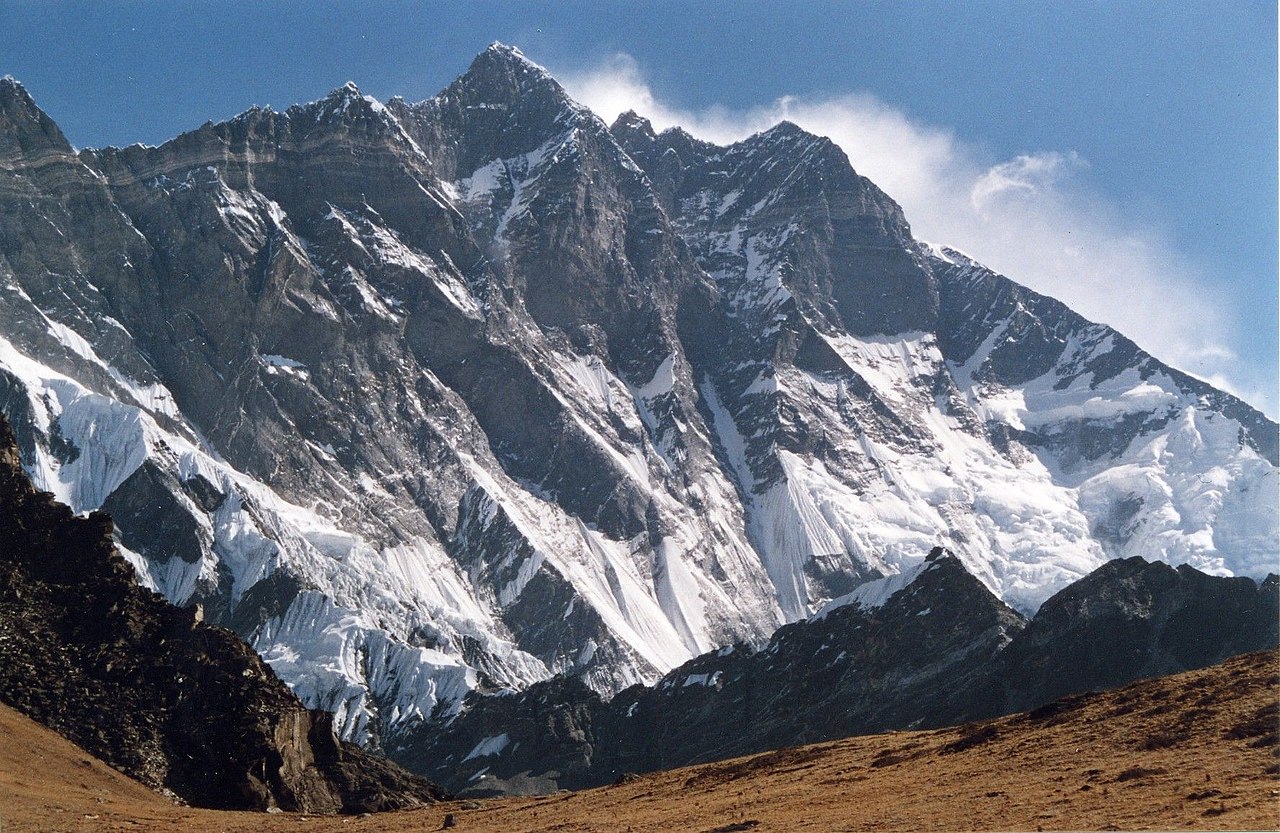
It has been a very busy month and a half in the Himalaya for Spanish climber Alex Txikon. He has worked extremely hard since his arrival in Everest Base Camp in early January, and now all of that hard work is about to come to a head. According to reports, Txikon will set off on his summit bid tomorrow, with an eye on topping out sometime next week.
At the moment, the weather on Everest is still a bit dicey, but that is expected to change early next week when a period of relative calm is expected to settle in across the area. To take advantage of this rare winter weather window, Alex, along with Nurbu and Cheppal Sherpa, will leave Base Camp on Saturday, Feb. 11. The following day, the trio will be joined Nuri, Pemba, and Furba Sherpa, and the entire team will progress up the mountain together.
If they are able to stick to a typical Everest schedule, they should be in Camp 4 by next Tuesday, just as the weather window is set to appear. That would give them the opportunity to summit on Wednesday and get back down the following day. However, the current conditions may not allow them to reach C4 at 7950 meters (26,082 ft), so that schedule may be a bit too optimistic. That said, good weather conditions are expected to arrive early in the week and extend until next Saturday.
A winter summit of Everest is rare enough these days, but Alex is making an even rarer attempt by going to the top without the use of bottled oxygen. That has only been accomplished one time in the past, when Ang Rita Sherpa did it back in 1987. That summit was made on the first full day of winter however, and not in the heart of the season.
It appears that this may be the one and only summit bid however. In the article linked to above, Alex is quoted as saying, "The die is thrown, there will only be one attack on the summit." If that is accurate, than this truly is it. We'll all know how it turns out in a few short days.
Good luck to Alex and the entire team.
9/27/2014
9/24/2014
Himalaya Fall 2016: Season in Full Swing as Teams Move to Manaslu, Cho Oyu, and Lhotse
The fall climbing season in the Himalaya is now full steam ahead as teams continue to gather in Kathmandu and make their way out to their respective mountains. We have already discussed Kilian Jornet's speed record attempt on Everest multiple times and checked in with Japanese climber Nobukazu Kuriki a couple of times as well. Both of those men should now be in Base Camp on the North Side of the mountain, and have started their acclimatization process as well. But elsewhere in the region other teams are getting settled too, and now it appears that it should be quite an interesting few months in Nepal and Tibet.
On Lhotse, South Korean climber Sung-Taek Hong is back on the mountain for the fourth time in as many years, and his fifth attempt overall. He'll be having a go at Everest's neighbor in the coming weeks as he attempts to go solo and in alpine style to the summit. Last year he made four individual summit pushes, reaching as high as 8200 meters (26,902 ft) but couldn't top out due to poor weather and deep snow on the route. He's hoping to have more luck this year.
Meanwhile, the Base Camp on Cho Oyu is starting to get crowded as commercial teams have arrived there in the past few days. Most of the squads, which include the Adventure Consultants and IMG, are still getting settled as they begin to get acclimatized. Soon, they'll start their first rotations up the mountain as they start to get accustomed to the altitude.
Interestingly enough, climber/journalist Billi Bierling is on Cho Oyu this fall and she reports that the road leading to BC has been extended further into the region. So now, what was once a quiet and peaceful place, has trucks rolling through all night long, causing the setting in camp to be very different. It is likely something the climbers will get use to in time, but for now it is a bit different.
Another popular climbing destination this fall is Manaslu, where the commercial teams started to arrive more than a week ago. It is a very crowded Base Camp as Alan Arnette reports that the Seven Summits Treks squad is more than 130 people, while large western guide company Himex is also there as well. Alan says that the most successful year on the mountain came back in 2011, when there were 140 total summits. This year, one company nearly has that many clients alone.
Cho Oyu and Manaslu are both very popular warm-up climbs for Everest. They are both fairly straight forward climbs for an 8000 meter peak, and are considered good places to get experience before going higher. Some of the climbers that are on these two peaks right now will almost certainly return to the Himalaya in the spring to have a go at Everest too.
The Altitude Junkies are now en route to Dhaulagiri, where it appears they'll be the only team on the mountain this fall. Flight delays and logistical challenges have caused a bit of a later start, but all is good and everyone has started the acclimatization process while driving to BC. They should get there in another couple of days.
That's it for today. We'll have more updates as the teams continue to get settled and the climbing operations begin.
Labels:
Cho Oyu,
Dhaulagiri,
Everest,
Himalaya,
Lhotse,
Manaslu,
Mountaineering,
Nepal,
Tibet
Video: Free Skiing Through A Mountain Glacier
It takes a lot to get met o post a ski video, mostly because there are a ton of them out there, they often do very little to distinguish themselves from one another. But, this one is special, so it was definitely worth sharing. It features pro skier Sam Favret as he free skis through the legendary Mer de Glace in the Mont-Blanc region of France. At a bit over three minutes in length, it is pure ski porn, with amazing visuals and some of the best skiing I've seen in a clip in a long time. Really an amazing way to take advantage of the terrain and create something special.
Ice Call - Sam Favret / Backyards Project from PVS COMPANY on Vimeo.
9/20/2014
Gear Closet: Tryton Drylite Dive Flashlight
Scuba divers listen up! I've found the next piece of gear that you need to add to your arsenal. The Drylite from Tryton is an innovative, incredibly well built flashlight designed to meet the specific needs of divers, although it is also so good that it will come in just as handy on dry land too.
Tryton has clearly put a great deal of thought into the design of this flashlight and that shows from the moment you get one in your hands. Everything about the Drylite screams quality, and the entire unit feels incredibly solid to the touch. The handle is made of soft, rubberized material that is ribbed to make it easy to grip, while the the aluminum head not only looks great, but serves as a heat sink for the incredibly bright light contained inside.
The Drylite was built to be completely waterproof and is guaranteed not to leak. Tryton pulled off that feat by creating a completely new charging system that doesn't require the device to be opened in any way. That charging system uses an inductive charging coil to transfer a charge without actually touching the battery itself. It takes roughly 10-12 hours to fully charge the light, which results in a 5 hour burn time with a brightness of 135 lumens. Thats pretty impressive for a light that bright. And when the battery falls below 20% battery life, the light will blink once ever minute to indicate that it is getting low.
In real world testing, the Drylite was able to actually last more than 6 hours on a single charge. Although the light slowly diminished in brightness over that final hour. It was still bright enough to be useful almost all the way up to the end. In this day and age, when many companies exaggerate the battery life of their devices, it was refreshing to find one that exceeded those estimates by a sizable amount.
I was sent the Drylite Nautilus kit, which includes a durable and lightweight custom case. That case makes it a breeze to take the flashlight along when you hit the road, whether you're going camping or a dive trip to the other side of the planet. The box can securely hold the Drylight and its charging system, as well as all the necessary cables. The device even comes with a charger for your car, which makes it incredibly useful just about anywhere. A durable wrist lanyard is also included.
While the flashlight works great above the surface, it was most definitely design with divers in mind. It has been rated to function down to 250 feet (76 meters) beneath the surface and its sealed-tight design will keep the water out. Its narrow 8º beam gives divers a very focused light that allows them to explore more safely.
As impressive as the Drylite package is, the price tag might be the most impressive thing of all. The flashlight alone costs $99.99, which is a great price for such a solid piece of technology. If you want the more robust Nautilus kit, it will set you back $149.99. Personally, I think it's worth the extra $50 to get the kit, as the included extras are quite nice.
If your'e a diver who has need of a flashlight on your adventures, it's tough to beat the Drylite. It is an impressive piece of gear that I can't recommend highly enough.
Video: 4 Hours - A Timelapse of Iceland's Winter Days
During the winter, Iceland receives just four hours of daylight each day, which makes it difficult to enjoy the snow covered landscapes to any degree. This video gives us a timelapse of one four hour stretch, showing us just how beautiful a single winter day can be there, even if the light is fleeting.
Four Hours from Zangs Films on Vimeo.
9/17/2014
Video: The Scott Expedition Celebrates 90 Days In Antarctica
Speaking of the Scott Expedition, here's a video they released to commemorate passing three months out on the ice. It is a series of still photos that they've taken over the course of their journey, and it gives us all a good idea of what conditions are like in the Antarctic. Three months is a long time to be spent traveling anywhere, but on the frozen continent, that has to be an eternity.
Antarctica 2015: Worsley at the Pole!
While the rest of us have been enjoying the holidays over the past few weeks, the Antarctic explorers have continued to toil away on the frozen continent. There is now roughly three weeks left in the ski season, and it has been a difficult one to say the least. But each day brings them closer to their ultimate destination, which for most is the very bottom of the world.
Yesterday, Henry Worsley became the first skier of the season to reach the South Pole. It is the third time that he has skied across Antarctica to stand at 90ºS. It took him 51 days to get there, which means he is about a day behind his intended schedule. The British polar explorer enjoyed a bit of down time at the research station there, but due to his "solo and unassisted" status, he didn't interact with anyone or receive any kind of aid. Today, he is already back on the trail, as he looks to complete a traverse of the continent.
Now that the Pole is behind him, Henry will continue on towards his finish line at the Ross Ice Shelf. From here on out, the skiing should be a bit easier, although he is no doubt exhausted and his muscles are sore. He'll continue to race the clock however, as the last plane off the continent is scheduled for January 28, and he'll need to be on that flight one way or another.
Elsewhere, American solo-skier Doug Tumminello continues to make progress as well, although he still has a long way to go. Yesterday he crossed the 84th degree, leaving him six more to go until the Pole. He's spent a full month on the ice now, and his sled is getting lighter as a result, which typically translates to going faster too. But Dough has struggled with sore feet and blisters since early on in the expedition, and that continues to be a problem now. He's about three or four days from Thiels Corner – an important milestone on the journey – at which point he intends to reevaluate his position and pace. It is possible he could pull the plug altogether and head home, but we'll just have to wait to see.
Scotsman Luke Robertson is making better time on his solo journey. On day 30 he has now passed the 87th degree and is narrowing in on the South Pole. He expect to reach that point in about ten days, and is counting down the miles now.
Carl Alvy and Emma Kelty have not updated their progress since New Year's Eve, but it sounds like they are in good spirits and making headway towards the Pole as well. It has been a difficult journey for Emma in particular, but the duo are picking up the pace as the get closer to 90ºS. Both weather and surface conditions have been better over the past few days, which has improved their spirits too. There is no word yet on when they expect to wrap up their expedition however.
Finally, the team of Devon McDiarmid, Stew Edge, Mostafa Salameh, and Shahrom Abdullah have achieved the 87th degree as well. It took them 25 days to get to that milestone, leaving them just three degrees to cross before the Pole. They'll likely get there sometime in the next ten days as well, as they are moving quickly and efficiently now despite whiteout conditions along their route. They just reached their final resupply point, and should now be set for the push to the finish line. Despite their late start, this group looks like it'll have no problems reaching the South Pole on schedule.
Over on Mt. Vinson, it has been a busy couple of weeks as well. A number of teams summited during the holiday time frame, which is a popular period on the mountain. While not everyone has finished their expeditions to the tallest peak in Antarctica, climbing operations are starting to wind down there for another season.
More to come soon.
Subscribe to:
Posts (Atom)