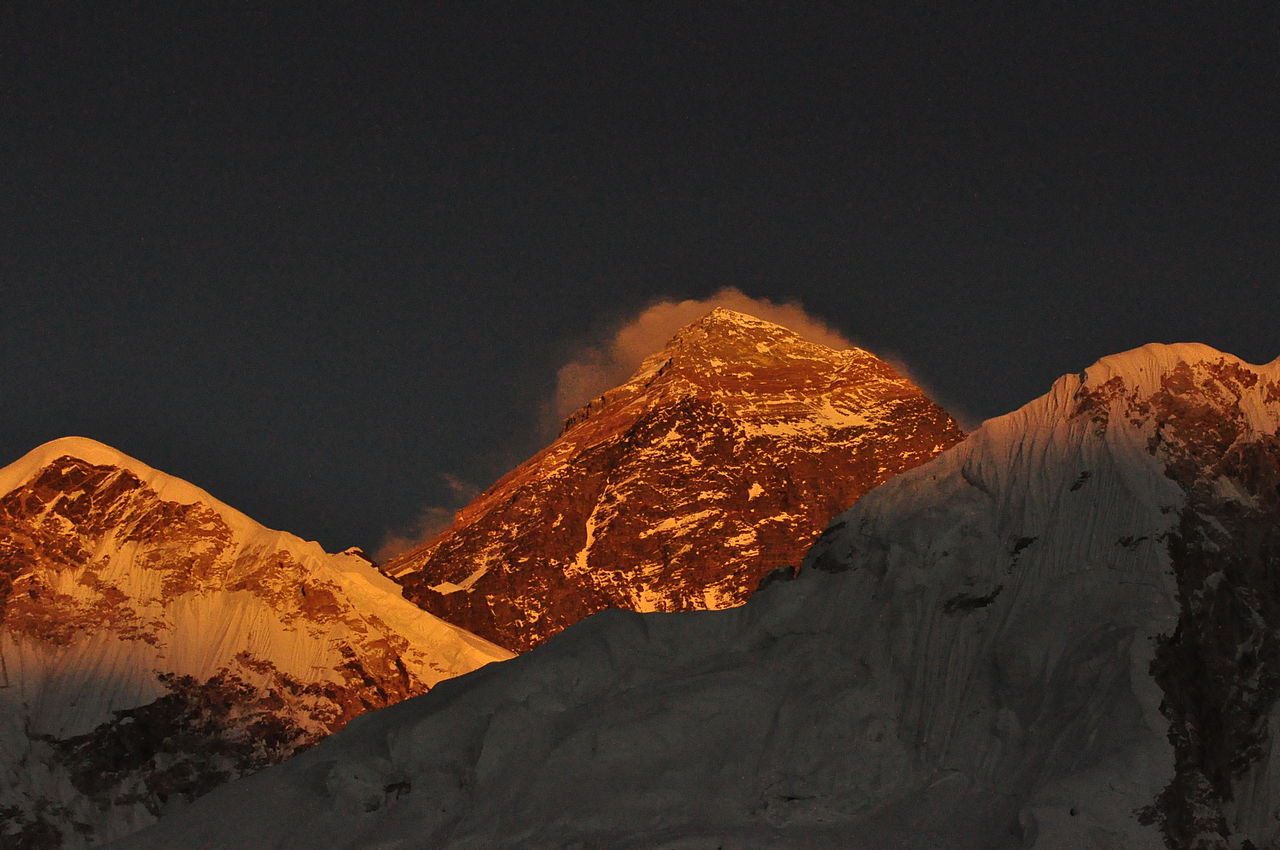
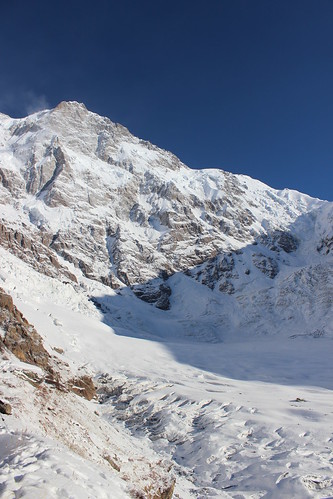
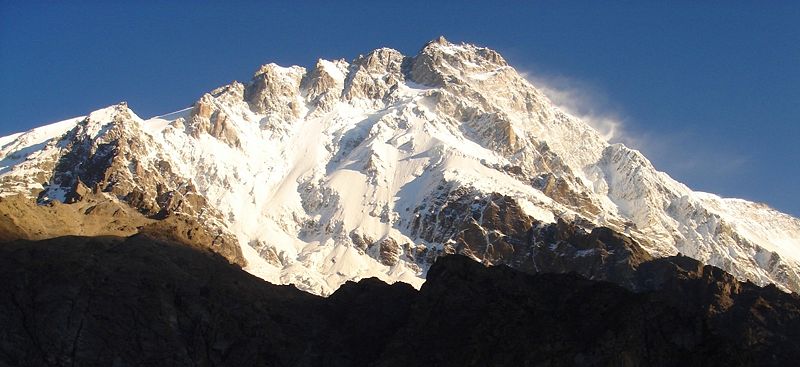
The focus of the winter climbing season in the Himalaya remains squarely on Nanga Parbat this year, with several teams attempting to complete the first winter ascent of that mountain. While conditions were less than favorable around the start of the New Year, things have improved somewhat now and acclimatization rotations have begun. The mountaineers have a considerable amount of work ahead of them in the weeks ahead, although one team narrowly averted disaster already and have had their decision to leave the mountain reaffirmed.
Last week I reported that German climber Ralf Dujmovits had decided to abandon his attempt at a solo summit on Nanga. While surveying the route, he noticed that there were two ice towers hanging over his intended path and he realized he would spend more than a day and a half climbing in their shadow. The two towers looked very precarious, as if they could collapse at any time, so Ralf decided he risk just wasn't worth the effort and decided to pack up his things and go home. Just a day after making that decision, Dujmovits and Polish climber Darek Zaluski narroly avoided an avalanche on the Diamir Face. Ralf wrote to Stefan Nestler about the incident saying that the duo were "very lucky" to have escaped unharmed. The two men descended to BC safely and are now presumably on their way back home.
Over on the Rupal Face, the team of Simone Moro, Emilio Previtali and David Gottler have been in BC for a bit over a week now. Simone and David have both spent a night at Camp 1 as they begin their acclimatization process, while also shuttling gear up the slope. In a recent update to their blog, they reported on the journey to BC, where they indicated that security on the road leading to the mountain is quite high. Following a high profile attack by terrorists in the Nanga Parbat Base Camp this past summer – during which 3 Pakistani soldiers and 10 foreign climbers were killed – officials in Pakistan are keen to make sure everyone is safe moving forward. To that end, the climbers received a military escort to the mountain, and a guard station with ten soldiers now sits along the road that leads to the peak. That level of security will hopefully allow the teams to climb without fear of another attack and simply concentrate on the mountain itself.
There have been few updates from the Polish "Justice For All" team in the past week. In the last report, they were preparing to fix ropes up to 6000 meters (19,685 ft), with several team members already acclimatizing above 5000 meters (16,404 ft). Whether or not those rope fixing efforts have been successful has yet to be determined, but it seems likely that they would have completed the task by now, provided the weather has been cooperative.
Finally, Italian climber Daniele Nardi is preparing to arrive on Nanga Parbat soon. He'll attempt a solo summit along the Diamir Face starting in late January. After properly acclimatizing, he intends to climb in alpine style, while avoiding any sense of competition with any of the other teams.
It interesting to see so much attention focused on a single mountain this winter. With all of the other 8000 meter peaks now climbed in winter – save K2 – it seems Nanga is the prize that most are interested in. Considering the number of fatalities during the winter season in recent years, it would appear that unless there is a potential first ascent to be had, most climbers have decided the risks just aren't worth the rewards. If Nanga Parbat is finally climbed in the winter, the same level of attention could then be focused on K2, a mountain that is far more treacherous to climb at any time of the year.
Stay tuned for more updates as warranted.
Showing posts with label Himalaya. Show all posts
12/25/2017
12/23/2017
What's it Like to Climb Everest Without Oxygen?
For most climber hoping to summit the world's highest peak, donning a tank of oxygen is simply the only way to get to the top. Without supplemental oxygen, most of the more than 4000 people who have topped out on Everest wouldn't have made it, including Edmund Hillary and Tenzing Norgay, who first climbed the mountain back in 1953. But it would be two other legendary climbers who would follow in their footsteps 25 years later who would show the mountaineering community that there was another way to scale the Big Hill, and n the process they shocked the world.
Back in 1978 most people thought that the idea of climbing Everest without oxygen was ludicrous. In fact, there may have just been two men on the entire planet that thought it was possible. They were Reinhold Messner and Peter Habeler, who traveled to the North Side of the mountain that year to attempt the impossible. They faced a myriad of challenges along the way, including food poisoning, and winds that reached 125 mph (201 km/h), on top of the usual difficulties. And all of that came before their historic summit push without using bottled O's.
National Geographic Adventure has shared a great story about that historic ascent, including a video of Messner recalling what it was like for them on that climb. Today, a summit without supplemental oxygen remains somewhat rare, but back in 1978 Messner and Habeler might as well have been going to the moon. But their success changed the face of modern mountaineering, to the point that there are some who now believe using oxygen on Everest takes away from the purity of the climb, and is almost a form of cheating.
Read the story in its entirety here, and not only learn about Messner and Habeler's climb, but two other alpinists who are hoping to repeat the feat this year.
12/20/2017
Himalaya Spring 2016: Slovak Climbers Stranded on Everest, Summit Push Begins
The time is now on Everest, where a number of teams are now on the move with the hopes of making a final push to the summit later this week. Meanwhile, we get word today that a pair of climbers are stranded on the mountain following an avalanche, with rescue operations underway.
According to The Himalayan Times, Slovak climbers Vladimír Štrba and Zoltán Pál were attempting to go up the South-West Face of Everest above Camp 2 when an avalanche hit, injuring one of the men. Which of the two is hurt, and the accident of those injuries is unknown, but it s believed that the other climber is healthy and fine.
Unfortunately, they are unable to descend under their own power, so a group of four Sherpas were sent up to try to help. They reached C2, but have been unable to go up the South-West route due to unstable conditions on the mountain. Rescue helicopters have since been brought in to try to lend a hand, but they have been unable to locate them so far. Poor weather hampered further attempts and for now the rescue effort has stalled until morning.
In other Everest news, the rope fixing teams have now installed the lines up to the South Col and expect to reach the summit tomorrow. Once they do, the first of the guided teams will begin their final push to the top, which means we could see the first summits of the season as early as Thursday or Friday of this week. That is a bit ahead of schedule, and considering the weather forecasts indicate good weather well into next week, we could see summits coming at a slow, steady pace. That will be good for the safety of the climbers, and will hopefully prevent traffic jams on the Hillary Step or higher.
On the North Side of the mountain in Tibet, the story is a similar one. Ropes have been fixed nearly all the way to the summit, with work expected to wrap up there in the next day or two. After that, the teams on that side of the mountain will launch their summit bids as well, and since there are fewer teams climbing from Tibet, the fear of large crowds is greatly reduced. Those squads are acclimated and ready to go, and have already started getting themselves into position.
Finally, ExWeb is reporting that a summit bid is well underway on Manaslu as well, with the team of Peter Hámor and Horia Colibasanu head up to the summit tonight. The weather is reportedly favorable, and the duo are climbing without oxygen or Sherpa support as they make their final bid. If successful, it will be Hámor's 13th 8000-meter peak.
Good luck to everyone as they set off to their respective summits.
Update: Success on Manaslu confirmed on Manaslu. ExWeb is also now reporting that Peter and Horia have now topped out along the standard route, and are now descending along the Japanese route. Hopefully they'll both get back down safely after what was reportedly a very tough ascent.
According to The Himalayan Times, Slovak climbers Vladimír Štrba and Zoltán Pál were attempting to go up the South-West Face of Everest above Camp 2 when an avalanche hit, injuring one of the men. Which of the two is hurt, and the accident of those injuries is unknown, but it s believed that the other climber is healthy and fine.
Unfortunately, they are unable to descend under their own power, so a group of four Sherpas were sent up to try to help. They reached C2, but have been unable to go up the South-West route due to unstable conditions on the mountain. Rescue helicopters have since been brought in to try to lend a hand, but they have been unable to locate them so far. Poor weather hampered further attempts and for now the rescue effort has stalled until morning.
In other Everest news, the rope fixing teams have now installed the lines up to the South Col and expect to reach the summit tomorrow. Once they do, the first of the guided teams will begin their final push to the top, which means we could see the first summits of the season as early as Thursday or Friday of this week. That is a bit ahead of schedule, and considering the weather forecasts indicate good weather well into next week, we could see summits coming at a slow, steady pace. That will be good for the safety of the climbers, and will hopefully prevent traffic jams on the Hillary Step or higher.
On the North Side of the mountain in Tibet, the story is a similar one. Ropes have been fixed nearly all the way to the summit, with work expected to wrap up there in the next day or two. After that, the teams on that side of the mountain will launch their summit bids as well, and since there are fewer teams climbing from Tibet, the fear of large crowds is greatly reduced. Those squads are acclimated and ready to go, and have already started getting themselves into position.
Finally, ExWeb is reporting that a summit bid is well underway on Manaslu as well, with the team of Peter Hámor and Horia Colibasanu head up to the summit tonight. The weather is reportedly favorable, and the duo are climbing without oxygen or Sherpa support as they make their final bid. If successful, it will be Hámor's 13th 8000-meter peak.
Good luck to everyone as they set off to their respective summits.
Update: Success on Manaslu confirmed on Manaslu. ExWeb is also now reporting that Peter and Horia have now topped out along the standard route, and are now descending along the Japanese route. Hopefully they'll both get back down safely after what was reportedly a very tough ascent.
12/14/2017
Himalaya Spring 2016: Alan Arnette Posts Pre-Season Preview
Even though the calendar says that it is only February, the 2016 spring climbing season in the Himalaya really isn't all that far off. In less than two months, climbers from all over the world will be finalizing their travel plans, packing their gear, and saying goodbye to loved ones as they head off to Nepal and Tibet to begin what is sure to be another very interesting year in the tallest mountains on the planet.
By most accounts, it is shaping up to be a quieter year on Everest, where tragedies the past two seasons have put an abrupt end to climbing operations. Several of the leading outfitters that operate on the mountain say that the number of clients they'll be guiding this year are down, as many are taking a wait and see attitude. That said however, I'm sure Everest will still be a very lively place to be this spring, with lots of great stories to follow.
In preparation for the start of the season, Alan Arnette has already kicked off his now legendary coverage of the proceedings on the mountain. Yesterday, Alan posted his preview of the 2016 spring season ahead, which fittingly enough begins with a recap of some of the major stories from the past few years – including a much publicized brawl between Sherpas and prominent climbers, the deaths of 19 Sherpas as a result of the collapse of a serac in 2014, and the devastating aftermath of the deadly earthquake that struck last year.
Each of those events has left its mark on the climbing community on Everest in the past few years, causing some to sour on attempting to summit the tallest mountain on the planet. But many of us believe that these are just temporary setbacks that will be overcome as we move forward.
In his article, Alan takes a look ahead at the 2016 season, which he too expects to have low numbers for several reasons. The lingering impact of the earthquake – at least in terms of public perceptions – is a major one of course, but also because Nepal is in the middle of a significant fuel crisis, with a shortage of gas making its way into the country thanks to a blockade from India. On top of that, expedition companies are being forced to raise their prices too, which of course has an impact on how many people sign up for an expedition as well.
If you're someone who keeps up with the Everest scene each year, you'll definitely want to give this a look. It provides some great insights into what is happening in Nepal presently, and how the currently political culture there is shaping the climbing season ahead. As always, it shouldn't have any shortage of intrigue and surprises.
By most accounts, it is shaping up to be a quieter year on Everest, where tragedies the past two seasons have put an abrupt end to climbing operations. Several of the leading outfitters that operate on the mountain say that the number of clients they'll be guiding this year are down, as many are taking a wait and see attitude. That said however, I'm sure Everest will still be a very lively place to be this spring, with lots of great stories to follow.
In preparation for the start of the season, Alan Arnette has already kicked off his now legendary coverage of the proceedings on the mountain. Yesterday, Alan posted his preview of the 2016 spring season ahead, which fittingly enough begins with a recap of some of the major stories from the past few years – including a much publicized brawl between Sherpas and prominent climbers, the deaths of 19 Sherpas as a result of the collapse of a serac in 2014, and the devastating aftermath of the deadly earthquake that struck last year.
Each of those events has left its mark on the climbing community on Everest in the past few years, causing some to sour on attempting to summit the tallest mountain on the planet. But many of us believe that these are just temporary setbacks that will be overcome as we move forward.
In his article, Alan takes a look ahead at the 2016 season, which he too expects to have low numbers for several reasons. The lingering impact of the earthquake – at least in terms of public perceptions – is a major one of course, but also because Nepal is in the middle of a significant fuel crisis, with a shortage of gas making its way into the country thanks to a blockade from India. On top of that, expedition companies are being forced to raise their prices too, which of course has an impact on how many people sign up for an expedition as well.
If you're someone who keeps up with the Everest scene each year, you'll definitely want to give this a look. It provides some great insights into what is happening in Nepal presently, and how the currently political culture there is shaping the climbing season ahead. As always, it shouldn't have any shortage of intrigue and surprises.
12/08/2017
Winter Climbs 2017: Carlos Rubio Leaves Everest, Elisabeth Revol Departs Manaslu
The list of winter mountaineering expeditions continues to get smaller and smaller this year, as one team has completely abandoned its attempt to summit a Himalayan giant, while another loses one of its climbers due to illness.
We'll begin with an update from Elisabeth Revol, who had been hoping to summit Manaslu this winter. The last we heard from Revol and her teammate Ludovic Giambiasi they had arrived in Base Camp on that mountain, where heavy snow had been falling for the better part of the month of January. It turns out, that snow didn't let up much, and high winds only made the experience worse. According to The Himalayan Times, the duo were able to climb as high as 7300 meters (23,950 ft) as part of their acclimatization efforts, but the weather simply didn't cooperate enough to allow them to continue past that point. Worse yet, the long term forecasts indicate the rest of the winter could very well maintain the current weather pattern, making their attempts fruitless. Revol and Giambiasi have already depart the mountain and are on their way home.
Meanwhile, over on Everest, the team of Alex Txikon and Carlos Rubio have had their own brand of drama. Yesterday, Rubio had to be evacuated from Everest Base Camp due to a severe lung infection. The young ski-mountaineer shared a video update from a hospital in Kathmandu where he assures everyone following the expedition that all is well and that the issue isn't serious. Still, it was bad enough that he did have to seek treatment and abandon his attempt to climb and ski Everest this winter.
While the news of Rubio's departure is a sad one for the team, Txikon has continued climbing at a regular and steady pace. On Sunday, he reached Camp 3 at 7400 meters (24,278 ft) on the mountain, and is acclimatizing nicely so far. Unlike on Manaslu, Everest has been relatively calm thus far, with manageable winds and snowfalls. Txikon is hoping to summit the mountain without the use of supplemental oxygen and so far things are progressing about as well as could be expected.
With Revol's withdraw from Manaslu and Lonnie Dupre's departure from Mt. Hunter in Alaska, Txikon's Everest expedition is the last major winter climb that we're following this season. Hopefully it will continue to unfold in a safe manner, otherwise we'll be waiting for the spring season for any significant news from the Himalaya.
Good luck to Alex and the remainder of his support team as the continue to press forward on the Big Hill.
Labels:
Alex Txikon,
Everest,
Himalaya,
Manaslu,
Mountaineering,
Nepal,
Winter
11/24/2017
Winter Climbs 2016: Playing the Waiting Game on Nanga Parbat
The winter season has arrived in full force on Nanga Parbat, where a handful of teams are still hoping to complete the first winter ascent of that mountain. Unfortunately, their chances don't look good over the next few days, as a massive storm has arrived in the region bringing high winds, extremely cold temperatures, and plenty of snow with it. So for now, the climbers are all stuck in Base Camp, waiting for a weather window open. That isn't expected to happen for another few days at the earliest, but after that another summit push could potentially begin.
Perhaps the biggest news from the mountain is that the Polish Justice For All team has left the Rupal Face and are heading for home. The squad was the first to arrive on Nanga this winter, and had been making steady progress, even reaching as high as 7500 meters (24,606 ft). But upon descending, they team realized that they were running low on essential supplies, and that their time was getting short. With bad weather in the forecast, they knew they wouldn't get another chance, so they elected to leave BC last week.
The Rupal Face hasn't been completely abandoned however, as just as the Poles were departing, another climber arrived. Brazil-born, U.S. citizen Cleo Weidlich reached Base Camp late last week, bringing three Nepali Sherpas along with her. She's hoping to become the first to stand on the summit of Nanga Parbat in winter, but will be doing so in a light and fast fashion. Reportedly, she acclimatized in Nepal before heading to Pakistan, but her late arrival puts the potential for success in question.
Over on the Kinshofer Route, two strong teams have now officially joined forces. A five-person group consisting of Alex Txikon, Daniele Nardi, Ali Sadpara, Simone Moro, and Tamara Lunger are cooperating with one another in an attempt to reach the top. For now though, they are all huddled together in BC, waiting for the weather to clear. Alex, Daniele, and Ali are acclimated and ready to go, although Simone and Tamara may need a bit more time at altitude before they are ready.
For now, each of the teams is sitting, waiting, and watching the weather. The forecasts calls for conditions to remain mostly unchanged until the weekend, but after that things are a bit murky. As you can imagine, conditions have to be right to climb Nanga Parbat during the summer, let alone the harsh winter season. And as of right now, it looks like the first winter ascent is as far off as it has ever been.
Perhaps the biggest news from the mountain is that the Polish Justice For All team has left the Rupal Face and are heading for home. The squad was the first to arrive on Nanga this winter, and had been making steady progress, even reaching as high as 7500 meters (24,606 ft). But upon descending, they team realized that they were running low on essential supplies, and that their time was getting short. With bad weather in the forecast, they knew they wouldn't get another chance, so they elected to leave BC last week.
The Rupal Face hasn't been completely abandoned however, as just as the Poles were departing, another climber arrived. Brazil-born, U.S. citizen Cleo Weidlich reached Base Camp late last week, bringing three Nepali Sherpas along with her. She's hoping to become the first to stand on the summit of Nanga Parbat in winter, but will be doing so in a light and fast fashion. Reportedly, she acclimatized in Nepal before heading to Pakistan, but her late arrival puts the potential for success in question.
Over on the Kinshofer Route, two strong teams have now officially joined forces. A five-person group consisting of Alex Txikon, Daniele Nardi, Ali Sadpara, Simone Moro, and Tamara Lunger are cooperating with one another in an attempt to reach the top. For now though, they are all huddled together in BC, waiting for the weather to clear. Alex, Daniele, and Ali are acclimated and ready to go, although Simone and Tamara may need a bit more time at altitude before they are ready.
For now, each of the teams is sitting, waiting, and watching the weather. The forecasts calls for conditions to remain mostly unchanged until the weekend, but after that things are a bit murky. As you can imagine, conditions have to be right to climb Nanga Parbat during the summer, let alone the harsh winter season. And as of right now, it looks like the first winter ascent is as far off as it has ever been.
Himalaya Fall 2016: Kilian Jornet Cancels Everest Speed Attempt
One of the current Himalayan expeditions that we've been watching closely has come to an end before it ever even had a chance to really get started. It was announced earlier today that Spanish ultrarunner Kilian Jornet has pulled the plug on his attempt at a speed record on Everest due to poor weather on the North Side of the mountain.
In a quote that was sent out via a press release a few hours ago, Jornet says “During the first few weeks we were acclimatising well and the conditions were good. However, when we were getting ready to prepare the attempt the weather began to change. There were some heavy snow storms and a large accumulation of snow. As a result, although we were in good physical shape, there was a high risk of avalanches and in the absence of good safety conditions it was impossible to climb.”
Apparently, the expedition was actually nearing its conclusion when the decision was made to go home instead. There hasn't been a lot of news from Kilian or his team, but it seems acclimatization was going very well, and he was extremely happy with his progress. Unfortunately, heavy snow has been falling on the mountain over the past couple of weeks, and that was making the route much more dangerous. So much so that they made the wise choice of cancelling the summit attempt and going home instead.
Kilian says that he has learned a lot from the experience and will now return to Spain where he'll evaluate how this expedition went, and decide from there how to proceed. He has already indicated that next time around he'll do a few things differently both in preparation and acclimatization once on the mountain. He had spent three weeks training at 6500 meters (21,325 ft) which will give him a better understanding of the Everest environment the next time around.
Honestly, an attempt in the spring would probably provide more stable weather conditions, but Kilian would then have to contend with a lot more people on the mountain. For most of the time that he was there, he had Base Camp all to himself. We do know that Japanese climber Nobukazu Kuriki is also there for a solo bid on the mountain, but he didn't arrive until last week. It is unclear whether or not the heavy snow will impact his attempt to summit Everest, which will be his sixth time trying to accomplish that feat.
For now, we'll have to wait to see how Kilian does on Everest. Remember, he's never climbed an 8000 meter peak before. Hopefully he'll get another crack at it in the future. It will be interesting to see what an athlete of his caliber can accomplish there.
In a quote that was sent out via a press release a few hours ago, Jornet says “During the first few weeks we were acclimatising well and the conditions were good. However, when we were getting ready to prepare the attempt the weather began to change. There were some heavy snow storms and a large accumulation of snow. As a result, although we were in good physical shape, there was a high risk of avalanches and in the absence of good safety conditions it was impossible to climb.”
Apparently, the expedition was actually nearing its conclusion when the decision was made to go home instead. There hasn't been a lot of news from Kilian or his team, but it seems acclimatization was going very well, and he was extremely happy with his progress. Unfortunately, heavy snow has been falling on the mountain over the past couple of weeks, and that was making the route much more dangerous. So much so that they made the wise choice of cancelling the summit attempt and going home instead.
Kilian says that he has learned a lot from the experience and will now return to Spain where he'll evaluate how this expedition went, and decide from there how to proceed. He has already indicated that next time around he'll do a few things differently both in preparation and acclimatization once on the mountain. He had spent three weeks training at 6500 meters (21,325 ft) which will give him a better understanding of the Everest environment the next time around.
Honestly, an attempt in the spring would probably provide more stable weather conditions, but Kilian would then have to contend with a lot more people on the mountain. For most of the time that he was there, he had Base Camp all to himself. We do know that Japanese climber Nobukazu Kuriki is also there for a solo bid on the mountain, but he didn't arrive until last week. It is unclear whether or not the heavy snow will impact his attempt to summit Everest, which will be his sixth time trying to accomplish that feat.
For now, we'll have to wait to see how Kilian does on Everest. Remember, he's never climbed an 8000 meter peak before. Hopefully he'll get another crack at it in the future. It will be interesting to see what an athlete of his caliber can accomplish there.
11/23/2017
Video: High Spirits in Nepal - Climbing Lunag Ri with David Lama and Conrad Anker
This past November, David Lama and Conrad Anker – two of the top mountaineers in the world – traveled to Nepal to attempt the first ascent of Lunag Ri, a 6907 meter (22,660 ft) peak found on the border with Tibet. The duo put in a valiant attempt, becoming the first climbers to reach the mountain's headwall, but ultimately they were turned back by high winds and freezing cold temperatures.
In this video, we get a look at that expedition, and what it was like to attempt this big mountain. You'll see two of the best climbers in the world plying their skills on a formidable Himalayan peak, and while they were thwarted this time out, Lama says they already have plans to return and give it another go. Looking at this beautiful and eye-opening video, you can understand why they are inspired by this challenge.
Labels:
Conrad Anker,
Himalaya,
Lunag Ri,
Mountaineering,
Nepal,
Video
11/21/2017
Winter Climbs 2014: Bad Weather Keeps Teams In BC On Nanga Parbat
It is a new week on Nanga Parbat, but the news largely remains the same. Bad weather is keeping the teams in Base Camp while they await the next weather window. In these anxious times, they find ways to stay busy, while keeping fit and well acclimatized to the altitude. It can be very frustrating, but this is what it is like to climb in the Himalaya in the winter, and these veteran mountaineers are accustomed to it.
On the Rupal Face, both the Polish team and the North Face squad have settled back into BC while they wait. The two teams attempted a summit push late last week, but the window was slammed shut when high winds and cold temperatures enveloped the summit. Those conditions have not dissipated yet, as temperatures on top of Nanaga are said to be in the -70ºC/-94ºF range. That is far too cold for anyone to attempt a summit push, hence the reason they are all waiting for the next opportunity. It is tough to say when that opportunity will come however, as the forecast says that it will get worse before it gets better.
While they are in Base Camp, the climbers have been finding ways to occupy their time. The TNF team has been editing photos and videos, and making back-up copies of their work, while also trekking nearby. They have also been reading, sending emails, and resting too. The Poles have brought a drone to Nanga this winter, and it has provided some diversion during the day. The batteries only last about 20 minutes however, and they are slow to recharge using the generator or solar cells. The little aircraft also crashed hard last week, requiring extensive repairs. Fortunately, a little tape and ingenuity had it back in the air in no time.
Jumping over to the Diamir Face, Daniele Nardi has wrapped up his acclimatizatiton process and is waiting for a summit attempt too. He shared some details of his recent summit of Ganalo Peak, which was a good warm-up for the main event – his solo, alpine style attempt on Nanga. Once he is fully rested from that climb, he'll watch the forecasts and prepare for his push as well.
With nasty weather arriving on the mountain over the next few days, it looks like it will be the weekend, at the earliest, before another summit push can get underway. Stay tuned for updates. I'll post them as they come in.
On the Rupal Face, both the Polish team and the North Face squad have settled back into BC while they wait. The two teams attempted a summit push late last week, but the window was slammed shut when high winds and cold temperatures enveloped the summit. Those conditions have not dissipated yet, as temperatures on top of Nanaga are said to be in the -70ºC/-94ºF range. That is far too cold for anyone to attempt a summit push, hence the reason they are all waiting for the next opportunity. It is tough to say when that opportunity will come however, as the forecast says that it will get worse before it gets better.
While they are in Base Camp, the climbers have been finding ways to occupy their time. The TNF team has been editing photos and videos, and making back-up copies of their work, while also trekking nearby. They have also been reading, sending emails, and resting too. The Poles have brought a drone to Nanga this winter, and it has provided some diversion during the day. The batteries only last about 20 minutes however, and they are slow to recharge using the generator or solar cells. The little aircraft also crashed hard last week, requiring extensive repairs. Fortunately, a little tape and ingenuity had it back in the air in no time.
Jumping over to the Diamir Face, Daniele Nardi has wrapped up his acclimatizatiton process and is waiting for a summit attempt too. He shared some details of his recent summit of Ganalo Peak, which was a good warm-up for the main event – his solo, alpine style attempt on Nanga. Once he is fully rested from that climb, he'll watch the forecasts and prepare for his push as well.
With nasty weather arriving on the mountain over the next few days, it looks like it will be the weekend, at the earliest, before another summit push can get underway. Stay tuned for updates. I'll post them as they come in.
10/26/2017
Video: Climbing the South Face of Annapurna
In terms of pure altitude, Annapurna ranks 10th amongst the 8000 meter peaks, topping out at 8091 meters (26,545 ft). But when it comes to level of difficulty to climb, it ranks second to perhaps only K2. In fact, it is considered the most dangerous mountain on the planet by many thanks to its frequent avalanches and technical challenges, and yet it continues to hold an allure over many climbers who travel to its flanks each spring to have a go at the summit.
This video a short documentary about such a climb. In it, we join famed Swiss mountaineer Jean Troillet as he attempts Annapurna back in 2012. The clips gives us some impressive shots of the mountain, and provides plenty of insights into what it takes to take on such a difficult and dangerous climb. If you're a fan of Himalayan expeditions to the big peaks, you'll definitely want to watch this short-film, which takes us along on one of the toughest climbs of all.
Labels:
Annapurna,
Expedition,
Himalaya,
Mountaineering,
Nepal,
Video
10/24/2017
Video: Take a Tour of a Himalayan Base Camp
Ever wonder what it is like to live in Base Camp on a Himalayan climb? Than you'll definitely want to watch this video. It takes us to 15,000 feet (4572 meters) on Ama Dablam, where Adrian Ballinger of Alpenglow Expeditions takes us on a tour of BC. While obviously located in a remote – and very scenic – location, you might be surprised at how comfortable and accommodating Base Camp life can be.
Labels:
Ama Dablam,
Expedition,
Himalaya,
Mountaineering,
Nepal,
Video
10/17/2017
Himalaya Fall 2016: Everest Permit Denied to 12-Year Old
The age debate on Everest reared its ugly head again this week when 12-year old Tyler Armstrong of California was denied a permit to climb the mountain. Tyler had hoped to attempt the North Side of Everest in Tibet, but the Chinese government turned down his application that would have allowed him to try to become the youngest person to scale the world's highest peak.
China has recently imposed age limits on Everest, requiring mountaineers to be older than 18 and younger than 75 to attempt the climb. Tyler had hoped to get an exception to the rule based on his climbing experience. The young man has already summited Kilimanjaro, Aconcagua, Elbrus. Of course, none of them compares to Everest, which is thousands of feet higher than even Aconcagua, the highest mountain outside of the Himalaya.
Tyler continues to focus on bagging each of the Seven Summits however, and says that he'll travel to Australia in August to climb Kosciusko, shortest and easiest of those mountains. For now, he'll continue to bide his time and wait for an opportunity to attempt Everest. Whether or not that will happen before his 18th birthday remains to be seen, but considering the current climate there, he may have to wait a few years to get his chance.
Meanwhile, teams have been filing into Base Camp on the South Side of Everest all week long. Mountaineering blogger Alan Arnette arrived a few days back as he prepares to summit Lhotse, as did the Adventure Consultant who were joined by Ed Viesturs for a visit. The Altitude Junkies are also in BC and held their Puja Ceremony today in preparation for the start of the climb.
By most reports, BC is quiet so far this year. More teams are arriving, so I'm sure it'll start to pick-up a bit over the next week or so. But since the number of climbers is down over previous years, it'll probably remain somewhat sedate throughout the season.
Over on Annapurna, the ropes are fixed and the teams are in place for a weekend summit push. The weather looks like it'll hold off for another day or two, so the time is right for an early season attempt on the top. I'll be keeping a close eye on those attempts, and hopefully we'll have news of successful summits over the next few days.
China has recently imposed age limits on Everest, requiring mountaineers to be older than 18 and younger than 75 to attempt the climb. Tyler had hoped to get an exception to the rule based on his climbing experience. The young man has already summited Kilimanjaro, Aconcagua, Elbrus. Of course, none of them compares to Everest, which is thousands of feet higher than even Aconcagua, the highest mountain outside of the Himalaya.
Tyler continues to focus on bagging each of the Seven Summits however, and says that he'll travel to Australia in August to climb Kosciusko, shortest and easiest of those mountains. For now, he'll continue to bide his time and wait for an opportunity to attempt Everest. Whether or not that will happen before his 18th birthday remains to be seen, but considering the current climate there, he may have to wait a few years to get his chance.
Meanwhile, teams have been filing into Base Camp on the South Side of Everest all week long. Mountaineering blogger Alan Arnette arrived a few days back as he prepares to summit Lhotse, as did the Adventure Consultant who were joined by Ed Viesturs for a visit. The Altitude Junkies are also in BC and held their Puja Ceremony today in preparation for the start of the climb.
By most reports, BC is quiet so far this year. More teams are arriving, so I'm sure it'll start to pick-up a bit over the next week or so. But since the number of climbers is down over previous years, it'll probably remain somewhat sedate throughout the season.
Over on Annapurna, the ropes are fixed and the teams are in place for a weekend summit push. The weather looks like it'll hold off for another day or two, so the time is right for an early season attempt on the top. I'll be keeping a close eye on those attempts, and hopefully we'll have news of successful summits over the next few days.
10/05/2017
Family Dedicates Website To Climber Lost On Nanga Parbat
Much like this winter climbing season, last year at this time I was posting frequent updates on the teams who were attempting to summit 8000 meter peaks in the coldest, harshest months of the year. One of the climbers that I followed closely was a Joël Wischnewski, a French climber and snowboarder who was attempting a solo summit on Nanga Parbat. Reading his posts from the mountain were both a joy and a challenge. It was clear that he loved being in the mountains, but it was evident that he was struggling physically and emotionally. Eventually those updates from Nanga stopped, and we all feared the worst. For days the mountaineering community held out hope that Joël would appear safe and sound, having lost power to his satellite phone or some other issue. But as time went by, we all acknowledged that the mountain had claimed the life of another climber.
This past fall, Joël's body was discovered on Nanga Parbat by a group of climbers. Eventually, it was brought down the mountain and laid to rest in the Herrligkoffer climber's cemetery, closing the last chapter on his life and hopefully providing some closure for his family too. I'm sure not knowing his ultimate fate was a challenge.
Now, his family has posted a note on Joël's website, dedicating it in his honor. They have also shared a link to the photos that he had taken while climbing on Nanga Parbat. Those images were found on Joël's camera when his body was discovered. The photos are beautiful and serve as a lasting legacy of a young man who loved to climb and was taken from his loved ones at too early an age.
Joël's family asked me to share these links with readers, many of whom no doubt followed his expedition last year. I am happy to do so now, so that we can choose to remember him as the talented and ambitious climber that he was. He perished doing what he loved most, and I continue to offer condolences to his family.
This past fall, Joël's body was discovered on Nanga Parbat by a group of climbers. Eventually, it was brought down the mountain and laid to rest in the Herrligkoffer climber's cemetery, closing the last chapter on his life and hopefully providing some closure for his family too. I'm sure not knowing his ultimate fate was a challenge.
Now, his family has posted a note on Joël's website, dedicating it in his honor. They have also shared a link to the photos that he had taken while climbing on Nanga Parbat. Those images were found on Joël's camera when his body was discovered. The photos are beautiful and serve as a lasting legacy of a young man who loved to climb and was taken from his loved ones at too early an age.
Joël's family asked me to share these links with readers, many of whom no doubt followed his expedition last year. I am happy to do so now, so that we can choose to remember him as the talented and ambitious climber that he was. He perished doing what he loved most, and I continue to offer condolences to his family.
9/25/2017
Winter Climbs 2014: Summit Push Round 2 On Nanga Parbat
The weather continues to be dicey on Nanga Parbat, where the teams have been in Base Camp for most of the week, waiting for a shift in conditions. It seems there may be an opportunity to make a summit bid coming this weekend, so with that in mind, two of the squads are on the move ahead of a potential weather window. If that window opens, we could see the first winter ascents of Nanga on Saturday.
The Polish Justice For All team has sent Tomek Mackiewicz and Pawel Dunaj up the mountain and after safely reaching Camp 1 yesterday, they are now halfway between C1 and C2 today. The same duo were part of the summit push last week, but were turned back due to high winds and extremely cold temperatures. They report that the summit is still shrouded in clouds, but elsewhere around the mountain it is calm. On Saturday, winds on the summit are expected to drop to 30 km/h (18 mph), which is about as quiet as Nanga will get in the winter.
Meanwhile, the North Face team is also on the move and looking to take advantage of this potential weather window. Simone Moro and David Göttler also reached Camp 1 yesterday and are with the Poles at their intermediate camp today. Their reports indicate it took them just 2.5 hours to move from BC to C1, which is a sign that conditions are far better than they were last week and the boys are more acclimatized as well. That bodes well as they continue their push upwards over the next few days, although it should be noted that no one has been above 7100 meters (23,293 ft) yet, so there could be difficult conditions above that point that have yet to be discovered.
Jumping over to the Diamir Face, Italian climber Daniele Nardi is close to wrapping up his acclimatization work on Genalo Peak. If the weather holds out for him, he should complete that process in the next day or two, then return to Base Camp before launching his alpine style summit attempt when the weather permits.
The forecasts indicate that this new weather window will be a narrow one. It will probably only last for two days tops, which is why the climbers are moving into position now. They'll have to make a dash for the summit and get back down as quickly as possible, or risk getting caught in poor conditions on the more exposed portions of the climb. I suspect that if there is a chance at reaching the summit, the Poles and the North Face team will work together on that final go. For now, we'll just have to wait to see what happens. Keep your fingers crossed that these men get back down safely, summit or no.
The Polish Justice For All team has sent Tomek Mackiewicz and Pawel Dunaj up the mountain and after safely reaching Camp 1 yesterday, they are now halfway between C1 and C2 today. The same duo were part of the summit push last week, but were turned back due to high winds and extremely cold temperatures. They report that the summit is still shrouded in clouds, but elsewhere around the mountain it is calm. On Saturday, winds on the summit are expected to drop to 30 km/h (18 mph), which is about as quiet as Nanga will get in the winter.
Meanwhile, the North Face team is also on the move and looking to take advantage of this potential weather window. Simone Moro and David Göttler also reached Camp 1 yesterday and are with the Poles at their intermediate camp today. Their reports indicate it took them just 2.5 hours to move from BC to C1, which is a sign that conditions are far better than they were last week and the boys are more acclimatized as well. That bodes well as they continue their push upwards over the next few days, although it should be noted that no one has been above 7100 meters (23,293 ft) yet, so there could be difficult conditions above that point that have yet to be discovered.
Jumping over to the Diamir Face, Italian climber Daniele Nardi is close to wrapping up his acclimatization work on Genalo Peak. If the weather holds out for him, he should complete that process in the next day or two, then return to Base Camp before launching his alpine style summit attempt when the weather permits.
The forecasts indicate that this new weather window will be a narrow one. It will probably only last for two days tops, which is why the climbers are moving into position now. They'll have to make a dash for the summit and get back down as quickly as possible, or risk getting caught in poor conditions on the more exposed portions of the climb. I suspect that if there is a chance at reaching the summit, the Poles and the North Face team will work together on that final go. For now, we'll just have to wait to see what happens. Keep your fingers crossed that these men get back down safely, summit or no.
9/22/2017
Everest 2014: The Cost Of Climbing Everest
We may be just a week into 2014, but it is never too early to start thinking about the spring Everest climbing season. As many of you already know, year-in and year-out, one of the best sources of information on all things having to do with Everest is Alan Arnette. Each year, Alan provides excellent insights into what it takes to climb the mountain, while providing regular updates on conditions on both the North and South sides, while closely tracking the locations of the numerous teams attempting to scale its impressive slopes. Over the past few years, Alan has kicked off his annual coverage by first giving us a run down of just how much it costs to undertake an Everest expedition, and each year it is an interesting read. Yesterday, he posted the 2014 version of that report, and for those unfamiliar with the expenses of a major climb in the Himalaya, it can sometimes cause sticker shock.
As usual, the costs for climbing Everest have increased on both the North and South side of the mountain this year. But what's different for 2014 is that while the guide services at the high end of the spectrum have mostly held steady, it is the low-end companies that seem to have hiked their rates for 2014. He is also quick to point out that this type of expedition is not one in which you want to go cut-rate, but with prices ranging from $30,000 - $100,000 it can be confusing to decide to who to go with.
Alan breaks down the costs into different categories, giving readers estimates on climbing solo vs. as part of an organized team. He also discusses the differences in teams as well, which include Sherpa supported climbs, Sherpa guided expeditions and Western guided options. Each of those provides a different level of service, with some willing to spend less to do more on their own, while others pay considerably more for a safer, more full-service attempt on the summit.
With guided climbs costing in the neighborhood of $40,000 to $65,000, it is sometimes tough to see where the cost differences come from. Alan points out that sometimes it is just in the form of profit to help pay the overhead required to operate on the mountain, but it also often comes at the expense of services such as Sherpa support on the upper slopes or no bottled oxygen included in the price.
One of the more interesting elements of Alan's report is his comparison chart of the companies that operate on Everest. It gives the name of the organization, average team size, types of guides, previous summit success and of course the costs. The prices range from as low as $28,450 for an expedition on the North Side with Summit Climb, to $89,000 with AlpenGlow on the South Side that includes Western guides.
If you've ever considered climbing Everest yourself, then Alan's Cost to Climb guide is a must read. It'll give you all the information you need for selecting the right guide service for your own climb, while weighing in all the factors to think about, including safety considering, which route to take, which company to go with and much more.
It also serves to get the adrenaline flowing for a new Everest climbing season. For fans of the mountain, April can't come fast enough!
As usual, the costs for climbing Everest have increased on both the North and South side of the mountain this year. But what's different for 2014 is that while the guide services at the high end of the spectrum have mostly held steady, it is the low-end companies that seem to have hiked their rates for 2014. He is also quick to point out that this type of expedition is not one in which you want to go cut-rate, but with prices ranging from $30,000 - $100,000 it can be confusing to decide to who to go with.
Alan breaks down the costs into different categories, giving readers estimates on climbing solo vs. as part of an organized team. He also discusses the differences in teams as well, which include Sherpa supported climbs, Sherpa guided expeditions and Western guided options. Each of those provides a different level of service, with some willing to spend less to do more on their own, while others pay considerably more for a safer, more full-service attempt on the summit.
With guided climbs costing in the neighborhood of $40,000 to $65,000, it is sometimes tough to see where the cost differences come from. Alan points out that sometimes it is just in the form of profit to help pay the overhead required to operate on the mountain, but it also often comes at the expense of services such as Sherpa support on the upper slopes or no bottled oxygen included in the price.
One of the more interesting elements of Alan's report is his comparison chart of the companies that operate on Everest. It gives the name of the organization, average team size, types of guides, previous summit success and of course the costs. The prices range from as low as $28,450 for an expedition on the North Side with Summit Climb, to $89,000 with AlpenGlow on the South Side that includes Western guides.
If you've ever considered climbing Everest yourself, then Alan's Cost to Climb guide is a must read. It'll give you all the information you need for selecting the right guide service for your own climb, while weighing in all the factors to think about, including safety considering, which route to take, which company to go with and much more.
It also serves to get the adrenaline flowing for a new Everest climbing season. For fans of the mountain, April can't come fast enough!
Labels:
Alan Arnette,
Everest,
Himalaya,
Mountaineering,
Nepal,
Tibet
9/18/2017
Video: Ueli Steck's 2015 Year in Review
As usual, Swiss climber Ueli Steck had another busy year in 2015, climbing 82 peaks in the Alps and heading to the Himalaya looking for challenges as well. In this video, we get a visual recap of his accomplishments from last year, including some great footage of Ueli in the mountains doing what he does best. Watching Steck go to work is always amazing, as he makes it look so easy and effortless.
Labels:
Alps,
Europe,
Himalaya,
Mountaineering,
Nepal,
Ueli Steck,
Video
9/17/2017
Video: Jimmy Chin Talks Risk and Responsibility in Climbing
Last week I posted a video from the Nat Geo Live series that feature photographer/climber Jimmy Chin and filmmaker Elizabeth "Chai" Vasarhelyi talking about the making of the film Meru. In that clip they talked about the particular challenges that Jimmy, along with teammates Conrad Anker and Renan Ozturk, faced in capturing footage for the documentary. Today, we have another video from that same session, this time with Jimmy discussing the risks and responsibilities that mountaineers and climbers face when embarking on an expedition. As he says, it is a balance between pushing your own personal ambitions, while maintaining the safety of the entire team. It is an interesting look at where that line falls, from a man who has walked it on more than a few occasions.
9/11/2017
Video: Up to Camp 1 on Everest in Winter
One of the expeditions we're following closely at the moment is Alex Txikon's attempt to summit Everest during the winter without the use of supplemental oxygen. The team has been making good progress so far, and having reached Camp 1, are now back in BC resting. In this video, we join Alex, and his partners Carlos Rubio and Nurbu Sherpa as they pass through the dangerous Khumbu Icefall and up to C1 – a path that the Spaniard calls "the Runner of Death." The footage in this short clip is dramatic and wild, but it gives you a great look at what these climbers are dealing with right now on the highest mountain on the planet.
Labels:
Alex Txikon,
Everest,
Himalaya,
Mountaineering,
Nepal,
Winter
9/08/2017
Himalaya Fall 2016: Summit Push Begins on Ama Dablam
The fall climbing season on the 8000-meter peaks in the Himalaya are all but over, but there is still plenty of action taking place in Nepal on other mountains. Most of the ongoing expeditions are small and relatively off the radar, with some squarely focused on putting up the first ascents on several unclimbed peaks. But, one popular mountain is about to get extremely busy as a large number of climbers launch their summit push.
Yesterday, the rope-fixing Sherpas on Ama Dablam reached the summit after waiting out poor weather conditions all of last week. The team of six mountain guides worked from Camp 2 on the mountain all the way to the 6812-meter (22,349 ft) summit in a single push, clearing the way for commercial teams that have been waiting in the wings. Now, with the ropes installed, it looks like there will be a mass summit push will begin in the next few days.
According to The Himalayan Times, more than 400 climbers will now move up from Base Camp to get into position to reach the summit. 200 of those alpinists are foreign climbers, while the others mostly consist of guides, high altitude porters, and the like.
It is unclear at this time exactly when the summit push will be completed, but with good weather in the forecast it seems like it should take place within the next few days. Unlike expeditions on other big Himalayan peaks, it doesn't take weeks to acclimatize on Ama Dablam, nor does it take numerous days to top out. Once the push begins, the summit should be very busy a few days later.
Ama Dablam is one of the most distinct mountains in the Khumbu Valley, with climbers and trekkers passing by on their way to Everest Base Camp. The beautiful peak is a good place for climbers to get valuable experience for what it is like to climb in the Himalaya prior to moving on to one of the 8000-meter peaks. For my money, it is still one of the most beautiful mountains that I have ever personally seen with my own eyes, creating a very memorable view on the trail to EBC.
Good luck to everyone heading up the mountain in the next few days. Get up and down safely and quickly, and enjoy the walk.
8/28/2017
Video: Unclimbed - Reaching the Summit in the Himalaya (Part 4)
In the latest episode of the ongoing YouTube series from Discover Canada entitled "Unclimbed" we join mountaineers Gabriel Filippi and Elia Saikaly as they continue to train and prepare for their attempt on three never-before climbed peaks in the Himalaya this fall. In this clip, we learn how the two men prepare for the unexpected and the worst accidents imaginable, something that is a real possibility whenever you venture into the mountains. As usual, this episode provides us with some great insights into what life on an expedition is all about, and the amount of work and planning that goes into an attempt to summit a big peak.
If you haven't watched the previous three episodes in the series, I suggest you do so. They are all excellent, and well worth your time. You'll find them here: Episode 1 - Episode 2 - Episode 3
At the moment, Gabriel and Elia are in Nepal where they are joined by Pasang Kaji Sherpa, as they prepare for their first ascents. We'll be following their progress closely in the days ahead.
If you haven't watched the previous three episodes in the series, I suggest you do so. They are all excellent, and well worth your time. You'll find them here: Episode 1 - Episode 2 - Episode 3
At the moment, Gabriel and Elia are in Nepal where they are joined by Pasang Kaji Sherpa, as they prepare for their first ascents. We'll be following their progress closely in the days ahead.
Labels:
First Ascent,
Himalaya,
Mountaineering,
Nepal,
Video
Subscribe to:
Comments (Atom)