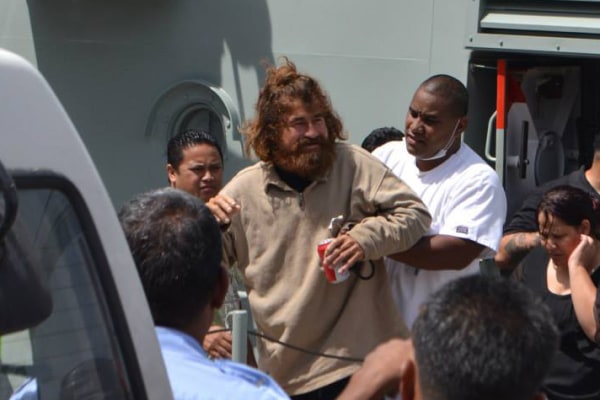
Yesterday I posted the compelling story of Jose Salvador Alvarenga, the El Salvadorian man who lived in Mexico and claims to have been adrift at sea for more than a year, living off fish, small birds, and turtles, while capturing rainwater to drink. That story was accompanied by a healthy dose of skepticism by many, who said that he looked far too fit and healthy to have spent more than 13 months at sea. Now, there is some evidence being presented from his home country that is helping to corroborate the castaway's story.
Some of the speculation against the story came about not just because of the relative health of Alvarenga, but also because his story continued to change as he told the tale. It was also noted that there wasn't any fishing gear aboard his boat when he washed ashore, calling into question his ability to actually catch fish to eat. But doctors have said after so long at sea, his mind wasn't as focused and sharp as it would normally be, which helped to create the inconsistencies in his story. It is also possible that he lost his fishing gear somewhere along the way due to storms or other circumstances.
Back home, there are now reports surfacing about a small boat that went missing in a storm back in November of 2012, which is about the time that Alvarenga says he set out on his ill-timed fishing trip. His name was mentioned in regards to the incident, although the boat belonged to his boss, who originally alerted authorities.
The storm forced the small 24-foot boat out to sea, where the Pacific currents carried it away from shore. With no navigation equipment onboard, there was no way for him, or his teenage companion, to know how to get back home. The boy that was with him reportedly died a month into the ordeal, leaving Alvarenga to drift more than 6000 miles on his own.
Adding more credence to the story, Alvarenga's family says that they were alerted to the fact that he had gone missing, and they had given him up for dead. They were relieved and overjoyed to see his photos from the Marshall Islands in the newspaper, and are looking forward to a long overdue reunion. Jose hasn't seen his parents in more than eight years.
The castaway is due to be released from the hospital today and will soon make his way back to Mexico, before eventually going home to El Salvador. He is said to be suffering from swollen ankles, but other than that, there is little indication of the long journey across the ocean that he endured. That is leaving some still questioning the story, although there hasn't been any other plausible way to explain him turning up on the far side of the Pacific months after he disappeared.
Showing posts with label Pacific Ocean. Show all posts
11/26/2017
6/02/2017
All-Female Rowing Team Completes Pacific Crossing
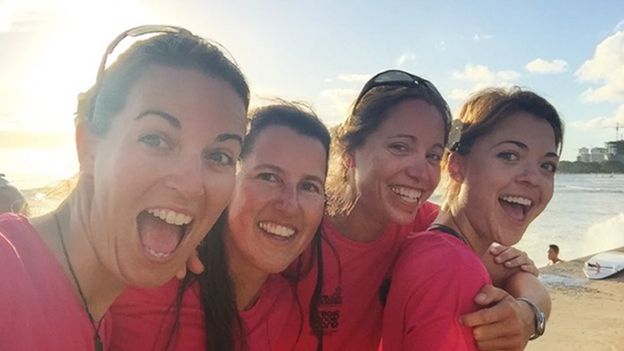
On Monday of this week, a team of women rowers completed an epic crossing of the Pacific Ocean, arriving in Cairns, Australia after spending more than nine months at sea. The Coxless Crew, as they are known, set out from San Francisco back in April of 2015, and although they took longer than expected to complete their journey, they did manage to set a couple of records along the way.
The team's boat – named Doris – was designed for a four-person crew, and three of the members of the team stayed aboard for the entire crossing, while three others rotated in and out three different legs. The permanent members of the crew included Laura Penhaul, Natalia Cohen and Emma Mitchell, with Isabel Burnham, Kizanne van Vuuren, and Meg Dyos, each taking a turn at the oars. Burnham rowed from San Francisco to Hawaii before giving way to van Vuuren, who was part of the team from Hawaii to Samoa. Dyos took over from there, and was with the Coxless Crew when they arrived in Australia this week.
As is typical with a four-person crew, two members were at the oars at all times. In this case, they would row in two-hour shifts, and sleep 90 minutes at a time. In this way, they were able to cover the 14,800 km (9200 mile) journey, although it did take about three months longer than they had anticipated.
I first wrote about the Coxless Crew back in 2012 when they were planning to depart the following year. Obviously they hit a few road bumps along the way, delaying their start and changing their plans a bit. But they stuck with their goals and pushed forward with the challenge they had set for themselves despite adversity. Pernahul in particular was keen to take on the Pacific, and she seems to be the only member of the original crew who made the crossing.
By arriving in Australia on Monday – 257 days after the set out – the ladies became the first all female crew to cross the Pacific, and the first four-person team to do so. Along the way they faced massive storms, crushing waves, encounters with whales, and extreme heat in the South Pacific. Their adventure wasn't just for the challenge however, as they also raised funds for the Walking with the Wounded and Breast Cancer Care charities.
Congratulations to the six ladies who worked together on this fantastic achievement.
4/20/2017
British Explorer to Attempt Solo, Non-Stop Row Across Pacific Ocean
We haven't even reached 2017 yet, and we already have news about a major endurance challenge set to take place in 2018. That's when British adventurer and endurance athlete Ness Knight plans to set out on a solo row across the Pacific Ocean, where she hopes to become the first woman to make that crossing non-stop.
The current plan is to depart from the San Francisco in May and begin the 7000 mile (11,265 km) journey across the Pacific with the goal of finishing in Sydney, Australia. Knight says she expects the entire crossing to take between 180 and 270 days to complete, which means she could be looking at upwards of six months, completely alone out on the water.
Some of the challenges she expects to face along the way include large waves – possibly 40 feet (12 meters) tall or higher – and massive storms. She'll also face the same problem that nearly ever ocean rower has – malfunctioning water makers. Every rower carries more than one of these devices that helps convert salt water to something that is drinkable, but it is a known issue that they break down often. Ness will also have to carry all of her supplies with her on the boat, so she'll have to ration her food to make through the entire journey as well.
Of course, Knight isn't the first woman to cross the Pacific Ocean solo. Roz Savage did that by completing her Pacific Row back in 2010. But, when Roz made the trip she did it in stages over successive years beginning in 2008. Ness plans to push on through in one go, which will indeed be a first for a female rower.
But before this daunting expedition can ever get off the ground – or leave the harbor if you will – Ness first needs to raise funds to help get her out on the water. With that in mind, she has recently launched a campaign to find sponsors to help lend a hand. If anyone out there is interested in assisting her efforts you can find out more about the possibilities by downloading and reading this sponsorship document which is in a .pdf format.
While May of 2018 seems like an awfully long way off at this point, it will likely be here before we know it. At that point, we'll of course be following Ness' Pacific Row closely. But before she ever gets underway, I'm sure we'll have some more updates to report.
Good luck Ness!
3/05/2015
Video: Explore the Underwater Kaleidoscope of Cortes Banks
Located 100 miles off the coast of San Diego, Cortes Banks has become a refuge for a stunning array of wildlife. In this video, we travel to that place, and dive with underwater explorer Brian Skerry, who takes us into this amazing place of vibrant colors and beautiful sea creatures. It is an extraordinary spot that few people ever get the chance to see, but you can spend three minutes there with his video.
10/17/2014
Did Amelia Earhart Survive Her Crash in the Pacific?
One of the most compelling missing person's stories of the 20th century may have just gotten even more interesting. A member of The International Group for Historic Aircraft Recovery (TIGHAR) now claims that aviator Amelia Earhart not only survived her crash in South Pacific back in 1937, but she lived for days on a remote island, where she continuously called for help from her aircraft's radio, with those calls being picked up by amateur radio operators all over the world at the time.
In recent years, TIGHAR has put considerable effort into searching for the remains of Earhart, her navigator Fred Noonan, and their aircraft. The group has made several expeditions to islands in the Pacific searching for evidence of what may have happened to her. They have found some compelling clues, but nothing that definitively says whether or not she or Noonan survived the crash, or even made it to one of the sites they have examined at all.
But according to Ric Gillespie, a member of TIGHAR, Earhart's calls for help were heard by a woman in Melbourne, Australia; a housewife in Texas who claims to have recognized her voice, and perhaps most intriguing of all – a teenager in Florida.
What makes the Florida teen's story so fascinating is that she scribbled notes based on what she was hearing, transcribing what was allegedly Earhart's broadcast. The teen wrote several times "New York, New York," seemingly referencing the city. But Gillespie believes that Earhart was actually saying "SS Norwich City," which was a ship that was abandoned on Nikumaroro island in 1929, the place that TIGHAR believes the aviator set down.
Today, we take flying around the world for granted, as thousands of aircraft take off from airports all over the globe each day. But back in 1937, it was still difficult to imagine circumnavigating the globe in a small aircraft. That was exactly what Earhart and Noonan were trying to do when they went missing. The pilot and navigator had set out from Lae Airfield in New Guinea the plan was to fly to Howland Island. But somewhere along the way they got off track, and couldn't find their destination.
Eventually they ran out of fuel and crashed somewhere int he Pacific, but exactly where has long been a mystery. After examining the flight plan, listening to radio broadcasts, and plotting potential courses, TIGHAR has come to believe that Earhart and Noonan landed in a shallow bay off the shore of Nikumaroro, which has been the subject of their searches in recent years. So far, they've come up with nothing, but they hope to return next July – the 80th anniversary of Earhart's disappearance – to look for her Electra aircraft. The group believes that the tide has carried it out to sea, and that they'll be able to find it using a submersible.
Over the years, here at The Adventure Blog we've followed various attempts to locate the missing aircraft that Earhart was flying when she went missing. So far, it has remained elusive, as finding an 80 year old aircraft in the middle of the Pacific is not going to be easy. But, I have to admit TIGHAR has made some interesting finds over the years, including a piece of scrap metal that has been positively linked to the aircraft she was flying. Will they be able to finally substantiate their claims? We'll just have to wait until next summer to find out.
2/09/2014
Man Survives 16-Months Adrift At Sea
I wrote about this story yesterday at the Wenger Blog, but it is such an interesting tale, that I thought it was worth sharing here as well. Additionally, more details have come to light, shedding some insights into what exactly happened.
Last week, a small boat washed up on the shore of a remote atoll in the South Pacific after spending more than 16 months adrift at sea. Aboard was a man named Jose Salvador Alvarenga, who along with a traveling companion, was fishing off the coast of Mexico in September of 2012. A large storm hit, pushing their 24-foot boat out from shore. Without power, they were at the mercy of the Pacific currents, which carried them further and further from the coast.
With little food onboard, the two castaways were forced to forage for food, eating fish, small birds, and sharks. They collected rainwater to drink but often went for long periods of time without anything eat or drink. In order to survive, they would even drink their own urine. Alvarenga says that his teenage companion was unable to stomach their unusual diet, and slowly starved to death a little more than a month into their voyage. The 37-year old Alvarenga said he pushed the body overboard not long after the young man passed.
The Pacific tides carried the small boat away from North America and into the South Pacific. The weeks turned into months, and still the boat continued to drift. Jose said that at times he contemplated suicide as a way to escape. But he hung on, clinging to life and hoping for a possible rescue.
Last Thursday, Alvarenga's battered little boat washed ashore on the Ebon Atoll, a small island that is part of the Marshall Islands. Over the course of his 16 months at sea, he had drifted more than 6000 miles, and he arrived in an exhausted, malnourished state.
Reportedly he is on the mend now and his family back in Mexico have identified him. But there are some holes in his story, and investigators are trying to verify what they can. The story seems remarkable and difficult to believe, but there doesn't seem to be any other way he would arrive in the Marshall Islands.
I'm sure we'll hear more about this in the days ahead. It is certainly an incredible tale of survival. Jose will probably have book deals and movie contracts waiting for him when he gets back home.
Thanks to Lou-Phi for sharing the original story.
Subscribe to:
Posts (Atom)