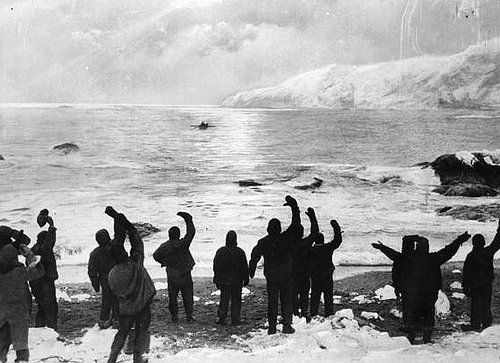
Yesterday marked an auspicious day in the annals of exploration. It was exactly 100 years to the day since Ernest Shackleton's men were rescued from the ice in the Antarctic after a months-long ordeal that would eventually go down as one of the greatest tales of survival ever. The rescue brought and end to their struggles on that particular expedition, but returned them to a world gone mad by war.
Shackleton's tale is a well known one at this point. In August of 1914, he and his men set sail from London for the Antarctic where he and several of his men had hoped to launch an attempt to cross the frozen continent. As they left Europe behind, the first shots of what would become World War I were just taking place on that continent as well.
In December of 1914, Shackleton's ship – the aptly named Endurance – departed South Georgia Island for the Weddell Sea off the coast of Antarctica. Once there, the crew discovered more ice than they had expected, and by January 19, 1915 the ship was fully enveloped in ice, not allowing it to move forward or backward. For months, the Endurance and her crew were stuck in place, until the ship finally succumbed to the pressures being applied to its hull and sunk beneath the waters on November 21, 1915.
But the ordeal for Shackleton and is men were far from over. For weeks they camped on an ice floe before it cracked and broke up, forcing them into the Endurance's lifeboats in a desperate attempt to reach Elephant Island. They reached that point and stepped foot on solid ground for the first time in 497 days.
Knowing that he and his men couldn't hold out forever, Shackleton came up with a desperate plan to make an open water crossing to reach South Georgia again. On April 24, 1916 he and a few hand-picked men set out once again, surviving high seas, storms, and frigid conditions to reach their destination on May 8. They then made a harrowing trip across the island on foot to reach a whaling station on the other side where they could begin mounting a rescue operation at long last.
But once again the conditions in the Southern Ocean thwarted their plans and poor weather prevented them from going back to Elephant Island. On two separate occasions rescue missions were forced to abandon their attempts, although Shackleton persisted in his efforts to save his men. It took until August 30, 1916 to complete the rescue operation, retrieving 22 men who had remained in that desolate place for five more months. But in the end, not a single man perished on that expedition, which remains a remarkable feat to this day.
It took until May of 1917 for Shackleton to return to England, but but that point the war was at its most brutal. A small conflict that was breaking out when he and his men left for the Antarctic had turned into the bloodiest and most costly war that the world had ever seen. Millions had lost their lives since the Endurance had set sail, and hundreds of thousands more would perish before it was through. Some of them were men who had survived all those months on the ice.
I've said it before and I'll say it again. The story of Shackleton and his crew is one of the greatest stories of adventure and survival that we've ever seen. It is a testament to his leadership skills that they managed to stay alive at all, and I can't even imagine what it was like to be stranded under those conditions for so long.
Major thanks goes out to the Adventure Journal for reminding me of this important date in history.
Showing posts with label Survival. Show all posts
11/26/2016
12/01/2015
Gear Closet: SOL Traverse Survival Kit
Need a handy little survival kit to carry with you on your outdoor adventures, but don't want to spend a lot of money putting a custom kit together? Then you'll definitely be interested in the new Traverse kit from Survive Outdoors Longer. It has just about everything you could possibly need for your backcountry excursions, and a price tag that makes it one of those products that you can't afford to not have with you.
1 60” x 84” Heatsheets Emergency Blanket
1 Liter, Sterile Water Bag
2 Micropur Purification Tablets
1 Spark-Lite Firestarter
4 Tinder Quik Firestarters
1 Mini Rescue Howler Whislte
1 26” x 2” Mini Roll of Duct Tape
1 Safety Pin
1 Instruction and Tip Manual
Packed in its own tin case, the Traverse covers the most important elements of survival including water, shelter, fire, and signaling. Items found inside the kit take care of all of those needs, allowing you to survive for an extended time should an emergency situation arise.
So just what does the kit include? Here's a complete list of what you'll find side the tin container:
1 Liter, Sterile Water Bag
2 Micropur Purification Tablets
1 Spark-Lite Firestarter
4 Tinder Quik Firestarters
1 Mini Rescue Howler Whislte
1 26” x 2” Mini Roll of Duct Tape
1 Safety Pin
1 Instruction and Tip Manual
As you can see, there are water purification tablets as well a bag to carry water in. There is also an emergency blanket for warmth, a firestarter and tinder, as well as a rescue whistle. SOL has also conveniently thrown in some duct tape and a few other items that can come in handy as well, including an instruction manual with tops for staying alive in challenging circumstances.
If you're familiar with SOL's products, you know that they are always high in quality and well made. The Traverse is no different, as it is a product that is designed for the outdoors and is built to survive in those environments. It is also lightweight, weighing in at a mere 6.1 ounces (173 grams). The entire package is very compact, and is made to slide right into your pack and stay there until you need it.
So how much does this little kit cost? As I said earlier, this is a piece of gear that you almost can't afford to be without when you set out on your travels. The SOL Traverse survival kit is just $20, which makes it almost a no brainer when you consider everything that is inside. It also makes a great gift for other outdoor enthusiasts as well, as its attractive tin case gives it a classic good look that most will appreciate.
If you want to add one of these great little survival kits to your gear, you can find out more at SurviveOutdoorsLonger.com.
Labels:
Adventure Travel,
Backpacking,
Camping,
Gear,
Survival,
Travel
2/22/2015
Gear Closet: SOL Escape Pro Bivvy
As someone who spends a lot of time in the outdoors, and often finds himself traveling to remote places, I'm always on the lookout for innovative new products that can make those experiences safer and more enjoyable. A piece of gear that can pull double duty by providing extra functionality is always a plus too. Recently, I've discovered just such a product in the form of the new Escape Pro Bivvy from SOL, which can serve as an emergency shelter or an extra layer that provides additional warmth for your sleeping bag.
In terms of performance, the Escape Pro Bivvy checks all the right boxes. It is built to be extremely durable, yet offers a high level of breathability as well. It is wind and waterproof, and uses a special material called Sympatex Reflextion to reflect up to 90% of your body heat back at you, helping you to stay much warmer in cold conditions. On top of that, the bivvy weights a mere 8 ounces (240 grams), which make it easy to stuff into your backpack to take with you anywhere.
Because it weighs next to nothing, the Escape Pro Bivvy is a great choice for ultralight hikers who don't want to carry a full sleeping bag on their outdoor adventures. As a stand-alone shelter, it can keep most hikers comfortable in conditions down to 50ºF (10ºC). And when paired with a sleeping bag, it adds as much as 15ºF to the overall temperature rating, while also providing the water and windproof capabilities. That makes it a more sensible choice than even carrying a more basic sleeping bag liner.
Measuring 31" x 84" (78 cm x 213 cm) in width and length, the Escape Pro Bivvy has a 24" (61 cm) zipper than runs along one side that allows for easy access. When unzipped, this also allows the user to more easily stuff their sleeping bag inside. A drawstring closure hood also allows you to cinch the bag up tightly around your head when things get especially chilly.
If you're backpacking with a tent, the wind and waterproof features of the bivvy are nullified somewhat by the shelter you're already sleeping inside. But, as more and more hikers take to the hammock camping trend, this product truly shows its colors, at least in terms of being an extra shell for you sleeping bag. If you prefer to sleep suspended off the ground in a hammock, the Escape Pro Bivvy will be a very useful piece of gear to have at your disposal, not only for its added warmth, but ability to keep wind and moisture at bay too.
Of course, it also comes in very handy as an emergency shelter should you find yourself unexpectedly caught out in bad weather on a mountaineering expedition or backpacking excursion into remote areas. It is easy to pull out and climb inside should the need arise, and it is one of those items that you'll always be glad you have with you, even if you don't need it. And scene it weights so little, there is almost no excuse for taking it along, even if you don't plan to use it an extra layer for your sleeping bag.
Priced at $125, the Escape Pro Bivvy is a bit pricer than a standard sleeping bag liner, so if you're just looking to add a few degrees of warmth to your bag, you might want to look elsewhere. That said, this product does A LOT more than a liner could ever hope to do, providing protection from the elements, and potentially even saving your life in an emergency situation. That makes this not only a far more versatile item – which alone makes it worth the money – but something that should be considered essential gear for those journeys into remote areas. If you're serious about your backcountry adventures, this is definitely an item you'll want to have at your disposal.
Find out more at SurviveOutdoorsLonger.com.
2/09/2014
Man Survives 16-Months Adrift At Sea
I wrote about this story yesterday at the Wenger Blog, but it is such an interesting tale, that I thought it was worth sharing here as well. Additionally, more details have come to light, shedding some insights into what exactly happened.
Last week, a small boat washed up on the shore of a remote atoll in the South Pacific after spending more than 16 months adrift at sea. Aboard was a man named Jose Salvador Alvarenga, who along with a traveling companion, was fishing off the coast of Mexico in September of 2012. A large storm hit, pushing their 24-foot boat out from shore. Without power, they were at the mercy of the Pacific currents, which carried them further and further from the coast.
With little food onboard, the two castaways were forced to forage for food, eating fish, small birds, and sharks. They collected rainwater to drink but often went for long periods of time without anything eat or drink. In order to survive, they would even drink their own urine. Alvarenga says that his teenage companion was unable to stomach their unusual diet, and slowly starved to death a little more than a month into their voyage. The 37-year old Alvarenga said he pushed the body overboard not long after the young man passed.
The Pacific tides carried the small boat away from North America and into the South Pacific. The weeks turned into months, and still the boat continued to drift. Jose said that at times he contemplated suicide as a way to escape. But he hung on, clinging to life and hoping for a possible rescue.
Last Thursday, Alvarenga's battered little boat washed ashore on the Ebon Atoll, a small island that is part of the Marshall Islands. Over the course of his 16 months at sea, he had drifted more than 6000 miles, and he arrived in an exhausted, malnourished state.
Reportedly he is on the mend now and his family back in Mexico have identified him. But there are some holes in his story, and investigators are trying to verify what they can. The story seems remarkable and difficult to believe, but there doesn't seem to be any other way he would arrive in the Marshall Islands.
I'm sure we'll hear more about this in the days ahead. It is certainly an incredible tale of survival. Jose will probably have book deals and movie contracts waiting for him when he gets back home.
Thanks to Lou-Phi for sharing the original story.
1/13/2014
Video: How to Survive an Unexpected Night in the Backcountry
Despite our best laid plans for outdoor adventure, sometimes things don't go as expected. On occasion, this can lead to being stranded in the backcountry overnight, when you had originally planned to just be out for the day. What should you do in these occasions? The video below – hosted by none other than Timmy O'Neill – can help. At a little more than two minutes in length, this clip if filled with good suggestions on how to comfortably survive the night outdoors, even when you haven't planned for it. Some of the information is just good logic, and probably something that many of you already know. But, there are also some solid pieces of advice that could make a difference should you find yourself in this situation in the future.
Subscribe to:
Posts (Atom)