Showing posts with label Environmental. Show all posts
Showing posts with label Environmental. Show all posts
12/19/2017
Video: Meet The Snow Guardian
Meet billy barr (yes, that's how he spells it!), a man who has lived alone in a cabin near Gothic, Colorado for 40 years. Over that time, he has been keeping meticulous records of the weather, how much snow has fallen, what the temperature on any given day is, and so on. Those records are now proving invaluable to climate scientists, who view billy as an invaluable resource. This is his story, as told by National Geographic.

7/18/2017
Nat Geo Gives Us 20 National Park Leaders Under the Age of 30

The celebration will continue throughout the rest of the year, but it is also a time to begin looking forward to the next century. There is still a lot of work to be done to ensure that the national parks will be around for future generations to enjoy as well. To that end, National Geographic has selected 20 scientists, filmmakers, activists, and educators who have dedicated their lives to protecting the parks, both in the U.S. and abroad. Oh yeah, and each of these men and women happen to be under the age of 30 as well.
Amongst those making the list are Ben Masters, a filmmaker and horseman who is working to protect wild mustangs. He's joined by Cassi Knight, an NPS scientist who is searching for dinosaur remains in Denali National Park, and Elizabeth and Cole Donelson who spent the past 12 months visiting all 59 U.S. national parks. Others include Jen Guyton, a scientists helping to protect animals from poachers in Mozambique, and cartographers Ross Donahue and Marty Schnure, who are mapping remote areas of Patagonia.
As you can see, this is a diverse and interesting group of individuals, each of which is playing a vital role to help promote national parks both at home in the U.S. and in other countries around the world. The concept of creating public lands that are set aside for future generations to enjoy too has been called "America's Best Idea," and these young men and women are helping to spread that idea further. Hopefully in another hundred years we'll be continuing to celebrate the National Park Service, and the effort that these individuals have made along the way.
3/01/2017
Video: The 17-Million Year Old Grand Canyon is Still Teaching Us New Things
In this video, we join 17-year old Katie Winkelman as she takes part in a youth group that is exploring the Grand Canyon on foot and by raft. While in the Canyon, she learns a lot more about how it was formed and its continued importance in the lives of more than 40 million people who depend upon the Colorado River – which carved the dramatic landscapes there – for fresh water. The health of this place, and the waters that pass through it, are incredibly important, which is why we must continue to strive to protect it.
11/02/2016
Couple Completes a Year of Living in the Wilderness

Last Friday, September 23, Dave and Amy paddled their canoe up the Kawisihiwi River in Minnesota, finishing their epic 12-month journey near a sulfide-ore copper mining operation, which is exactly the threat they've been battling. Those mines have the potential to spoil the natural environment of the Minnesota Boundary Waters, something they've shared a great deal of information about on their Save the Boundary Waters website.
During their year in the wilderness the Freemans travelled more than 2000 miles (3218 km) by canoe, dogsled, on skis, snowshoes, and by foot. Over that period, they paddled more than 500 lakes and rivers, and called 120 different campsites home. Along the way they faced steamy hot days in the summer, and frigid nights in the winter, when temperatures dropped to -30ºF (-34ºC). Those extremes were to be expected of course with the changing of the seasons, but it was a challenge for them to maintain the correct gear and stay focused nonetheless.
Now, the married couple will begin reintegrating back into normal life, where they'll welcome being home for a while and enjoying the luxuries of civilization. But they weren't completely cut off during their year in the wilderness. They often made blog posts while they were exploring the Boundary Waters, and more than 300 visitors helped to keep them fully supplied or spent a few days traveling with them as well. Still, the return to the daily life will be both welcomed and challenging at the same time.
Of course, their fight against the mining companies is far from over, and the duo are urging government officials to not renew the leases for the Twin Metals company that is operating in the area that the Freemans are trying to protect. To that end, they'll head to Washington, D.C. today to talk with lawmakers, and are already planning both a book and a documentary about their experience. After a year in the wilderness, I'm sure they have some good stories to share.
5/25/2016
Are You the 2016 National Geographic Nature Photographer of the Year?

The contest website says "We’re looking for photos that showcase the awe-inspiring and diverse natural world around us. That could be a powerful wildlife shot, a stunning landscape, or a look at a complicated environmental issue—whatever nature means to you." In other words, there is a pretty broad interoperation out there of what exactly Nat Geo means by "nature." I'm sure more than a few have you have captured some great images over the past 12 months that you can submit to the contest. Entries are begin accepted until November 4, after which a panel of judges will decide which photos are worthy of making the cut.
Of course, there are some great prizes for those who win the contest. Each of the categories – Landscapes, Animals, Action and Environmental – will have three winners. First place will be awarded $2500 in case, while second place will get $750 and a signed National Geographic book. The third place winner goes home with $500. But best of all, the Grand Prize finisher will receive a 10-day trip for two to the Galapagos Islands courtesy of Natural Habitat Adventures. I can't think of a better place to take more photos of nature than that destination.
As you would expect, competition is sure to be tough in this contest, but you just might have the wining photo sitting on your hard drive right now. Pick out your best and submit them for consideration. Who knows, you just might be on your way to the Galapagos in the near future.
2/13/2016
Activists To Launch 15,000 Mile, 5-Month Road Trip To Promote Clean Drinking Water In Americas

Cebul and Mueller will set out from Boston on Saturday and begin heading south. Their trip will take them across the U.S., into Mexico and then on into Central America. Eventually, they'll cross over the Panama Canal and move into South America, before eventually reaching Rio around July 13. Along the way, they'll pass through 70 different cities and visit an estimated 65 colleges and universities as they spread their message about the importance of clean drinking water, particularly in developing countries.
The two men are calling their expedition Water for the Americas, and while they have a website set up to support their initiatives, the site doesn't offer a lot of information at this time. Hopefully they'll update it before they hit the road, allowing us to follow their progress and adventures as they go.
Clean drinking water is one of the hot button topics across the globe right now. While most developed nations don't struggle with having water to drink, poorer nations have a difficult time, especially as climate change begins to take its toll on the environment. Cebul and Mueller hope to educate people about this issue, particularly in nations that are being most hard hit.
While I applaud their efforts, this sounds like just an excuse to make a months long road trip to the World Cup. I kid! I kid!
1/07/2016
Crack in Antarctic Ice Shelf Grew 17 Miles in Length Since December

According to scientists who have been monitoring the crack, it has grown by as much as 17 miles in the past two months. According to the Times, the speed at which it is spreading is accelerating as well, now growing at a rate of more than five football fields each and every day. At this point, the crack is now just 20 miles away from reaching its end point, which will result in the entire chunk of ice breaking free and slipping into the ocean, something that could happen as early as April or May of this year.
This is alarming for a number of reasons. Not only will it create the biggest iceberg of all time, but as that iceberg begins to float away from the frozen continent, it will begin to melt, and possibly breaking up into smaller icebergs that could cause problems for ships. But, more importantly, the ice shelf serves as a buffer between the ocean waters and the glaciers that sit on the continent itself. Without the ice shelf to help protect it, the glaciers will begin to melt at a much higher rate too, and will tumble directly into the water. If this continues to happen across Antarctic – and evidence suggests it will – we could see the start of a major rice in ocean levels around the world.
I know that there are still a lot of people out there who want to deny the impact of climate change. But, there is something happening to our planet, and the polar regions are the canary in the coal mine. In recent years, we've seen substantial change in both the Arctic and Antarctic, and those changes only seems to be speeding up. Perhaps with the austral winter now nearly upon us, we'll see things slow down at least temporarily, but the Larsen Ice Shelf is about to collapse, and at this point it isn't a question of "if" but "when."
To find out more about his, check out the entire story at NYTimes.com.
9/02/2015
Himalayan Stove Project Offers Good Karma Through Carbon Credits
 If you've read my blog for awhile now you've probably heard me mention the Himalayan Stove Project on more than one occasion. The nonprofit organization is dedicated to improving the lives of poor families living in Nepal by replacing their old, inefficient, and dangerous cookstoves with new, clean burning versions that are much better for their health and welfare. What I've always loved about the HSP is that while some organizations talk a good game, this one has been making a world of difference for the people that it helps, delivering more than 3500 stoves to those in need.
Now, the Himalayan Stove Project has launched a new intuitive, giving donors the chance to purchase carbon offset credits to help both the environment and future recipients of their stoves at the same time. A new website called CarbonKarma.guru is now selling the credits for just $20, giving individuals and companies the chance to reduce their carbon footprint dramatically, with much of the proceeds going to help the HSP continue its great work in Nepal.
The stoves that the project distributes are made by a company called Envirofit and are said to be 90% more efficient than an open cook fire, which is a common method for preparing meals in many parts of the world. In addition to that, the stoves also use 75% less biomass fuel, which means they are better for our health and the environment in general. Envirofit is the organization that is supplying the Gold Standard carbon credits, which are recognized by more than 80 NGO's operating in 70 countries around the world.
Purchasing carbon credits is a real way to make a difference for the environment, and doing so through CarbonKarma.guru will help the Himalayan Stove Project too. But, if you just want to donate to the HSP, you can do that simply by clicking here. It is a great organization that is doing great things in Nepal, and every bit of assistance helps.
Himalayan Stove Project founder George Basch has set an ambitious goal of donating enough stoves that if they were stacked on top of one another they would reach from Everest Base Camp to the summit of the mountain. At the moment, the organization is about a third of the way towards that goal. To reach the top, the HSP will have to install 10,856 stoves, so more work has yet to be done. Let's help them get there!
5/06/2015
Temperature at the North Pole Climbs 50º Higher Than Normal
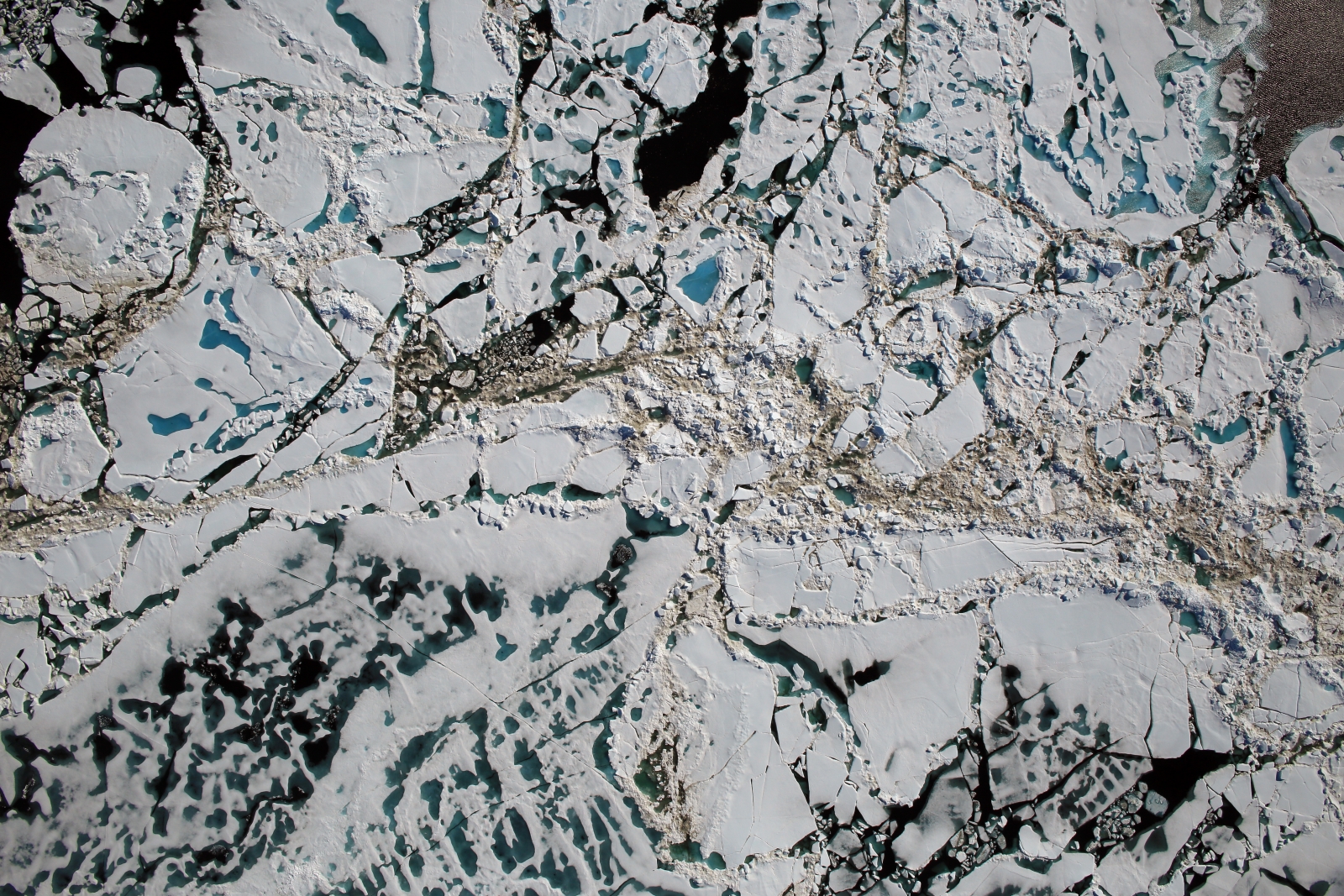
To put things into perspective, that means that temperatures were warm enough to melt snow and ice, even as winter is arriving in the Northern Hemisphere. That should set off alarm bells about the state of the polar ice caps, which seem to be already retreating at an alarming rate. We've had a lot of somber news from the Antarctic recently as well, but this is just another indicator that our planet is definitely in a state of flux right now, and we're running out of time to do anything about it.
It also doesn't bode well for any explorers hoping to make an expedition to the North Pole. If it is this warm in December, what will the conditions be like in March and April, or even into the summer. I know that there are a couple of expeditions planned for the Arctic next spring, but they could be dealing with unprecedented ice break up, and the largest leads of open water that have ever been seen at the top of the world.
Of course, we do have a long winter to go, and temperatures are sure to return to normal at some point. But so far, November and December have been unseasonably warm, and have climbed up close to the 0ºC mark once before as well. Worse yet, the long-range predictions are saying that 2017 could be another very warm year, with further melting of the ice caps.
I'm not sure how much longer climate deniers are going to keep their head buried in the sand. The signs are there, and we're mostly ignoring them at this point. Still, it isn't too late to try to make a change. Hopefully that will be the New Year's Resolution for some important people who are in a position to have an impact on policy and reform. Time will tell.
8/18/2014
Massive Reef Discovered at the Mouth of the Amazon River
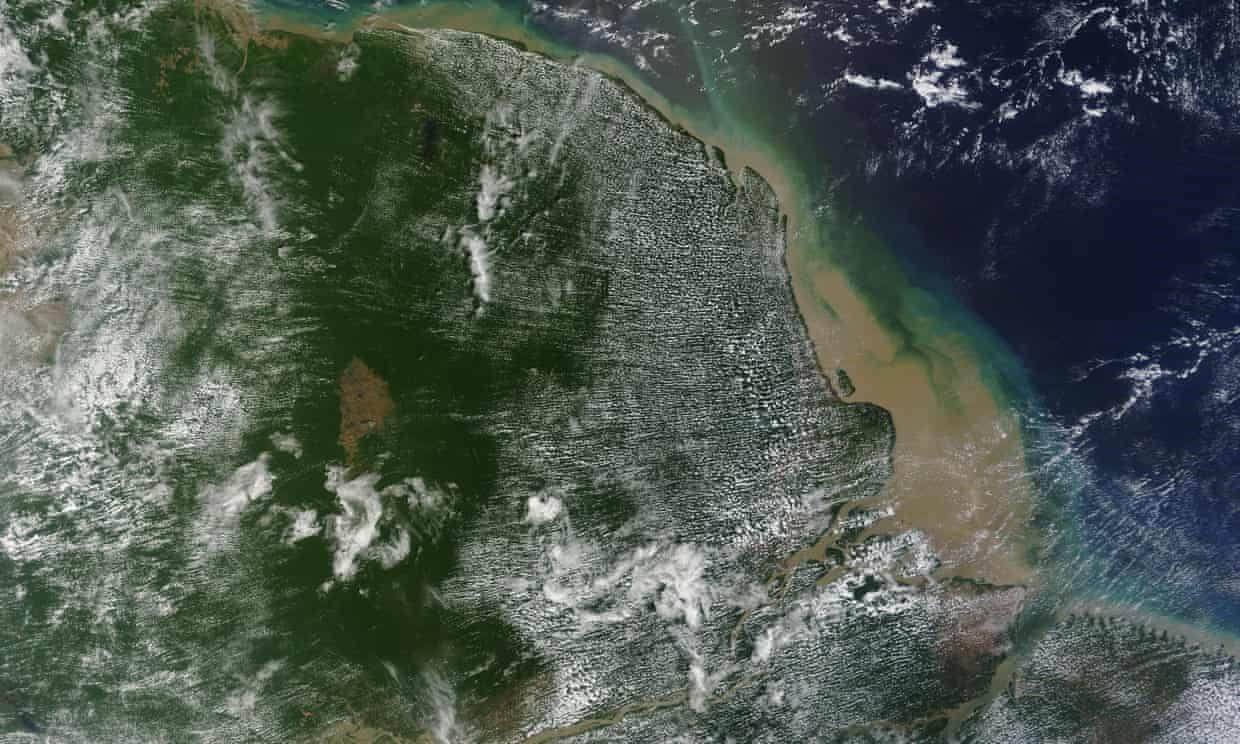
Indications that the reef might exist first appeared back in the 1970's when fishermen began catching fish that were more commonly found on and around reefs in other parts of the world. But confirmation of the existence of this particular reef didn't come until recently, when researchers were finally able to prove that against all our knowledge and understanding of the ocean that it was hidden away along the coast of Brazil.
The reef stretches for nearly 700 miles (1126 km), and is more than 3600 sq. miles (9300 sq. km) in size. It is also said to be home to at least 60 species of sponges and 73 species of fish. Even more surprising is the fact that unlike other reefs found around the world, this one appears to be very healthy, and even growing. Climate change has begun to warm the oceans, which is causing coral reefs to die at an alarming rate. But this one is not displaying those same symptoms.
What makes this new reef so amazing is that it exists in a place that it was previously believed one shouldn't be able to survive. While it is submerged in ocean waters, the surface of the Atlantic is covered in fresh water that is dumped in from the might Amazon River. The river also deposits plenty of mud and sentiment into the water, which is typically not conducive to the growth of coral either. On top of that, oceanographers typically find reefs in shallower waters that are warmer and clearer than where this one exists. This has left some scientists to wonder if other reefs are out there in our oceans, just waiting to be found.
But the good news over the discovery of this reef – and the fact that it is thriving – is tempered somewhat due to the fact that it is already being threatened by man. It seems that the Brazilian government has already sold 80 parcels of ocean to oil companies to start drilling at the mouth of the Amazon. 20 of those blocks are already in operation, some of which are believed to be right on top of the reef itself. How that will impact the life of the reef moving forward remains to be seen.
Coral reefs play an important role in the keeping the ocean healthy as they often form protective barriers for ecosystems both along the coast line and living within the waters themselves. As those reefs recede, ocean storms, hurricanes, and typhoons could have a larger impact on certain regions of the planet. The Earth's coral reefs are also seen as the canary in the coal mine in terms of indicating the impact of climate change on an area too.
Still, finding this particular reef is amazing, especially since it shouldn't exist at all. Hopefully it will be well protected moving forward.
7/17/2014
Patagonia to Close All Stores in the U.S. for Election Day

The move comes as part of Patagonia's Vote Our Planet initiative, which encourages us to support candidates that take a tough stand on environmental issues, something that should be of major concern for all outdoor enthusiasts. The idea is to rally around men and women who are running for office that are looking to preserve the planet for future generations and protect wildlife and wild spaces.
“During a time of catastrophic environmental crisis, when America needs strong leadership to confront the fundamental threat of climate change, voter turnout threatens to reach historic lows as people are turned off by the ugliness of politics,” said Patagonia CEO Rose Marcario. “As a business, we have a unique ability to take a stand and choose to prioritize the health of the planet over profit, and I think it’s important we take that opportunity when it truly matters. We want to do everything possible to empower citizens to make their voices heard and elect candidates up and down the ballot who will protect our planet.”
Obviously the presidential election to be held next week is an important one for many reasons. I don't often use this blog as a place to make a political statement or support any one candidate over another. But I will say that the future of the country, and perhaps the world, rests in the hands of who will be elected to the White House on November 8. While I have my own opinions on who should or should not be in charge, what is most important to me is that everyone get out to vote. Patagonia is making that a little easier, at least for its own employees and customers.
If you care about the environment, do a little research on the candidates in your area and get out and vote for the ones that are looking at ways to make things better moving forward. We are at a critical point when it comes to climate change and other environmental factors, and now is the time to have our voices heard. Vote on November 8 to at least play a role in that process.
6/22/2014
2016 Was The Hottest Year on Record
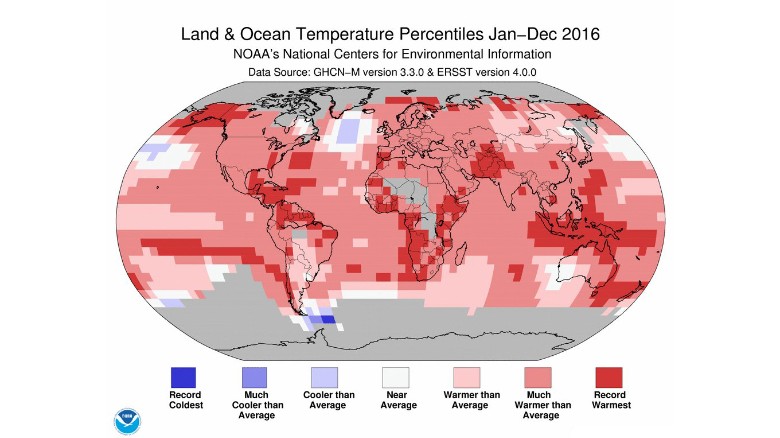
According to NASA and NOAA, 2016 was the hottest year on record, breaking the previous mark for the third consecutive year. And if that wasn't sobering enough news, the latest report on climate change also indicates that 16 of the 17 hottest years ever have taken place since 2000.
Studies indicate that the average temperature across the planet increased by 1.1ºC (1.98ºF) last year, which may not sound like much but it is enough to have a dramatic impact on large sections of the globe – especially in the polar regions. It also means that we're already well on our way towards surpassing the 1.5ºC goal set by the Paris Climate Agreement from 2015.
The cause for the increased temperature remains the same as it has for the past two decades, or longer. The burning of fossil fuels increases carbon dioxide emissions into the atmosphere, and the continued deforestation of rainforests – often referred to as the "lungs" of our planet. These harmful processes seem to be continuing to accelerate, despite efforts to reverse their effects.
Historical records of temperatures have been kept as far back as the 1880's, which means we have more than 130 years of data to compare the current trends to. It is also becoming increasingly more difficult to deny the impact of humans on the environment. As part of the report, Michael Mann, the director of the Earth Science Center at Pennsylvania State University, said "The effect of human activity on our climate is no longer subtle. It's plain as day, as are the impacts -- in the form of record floods, droughts, superstorms and wildfires -- that it is having on us and our planet."
To make matters worse, the Arctic seems to be warming at a faster rate than the rest of the planet, with temperatures now climbing to 3ºC (5.4ºF) higher than they were a decade ago. That means an increased rate of melting of the ice caps, which in turn leads to raising sea levels around the world. That will have a big impact on coastlines, eventually putting areas that are now inhabited potentially under water.
But, there is cause for some hope. Scientists believe that 2017 won't be warmer than the previous years thanks to El Nino keeping things a bit cooler. This is probably a temporary state of affairs however, even if it does buy us a brief respite.
How anyone can continue to deny climate change is beyond me. Whether or not humans are having an impact doesn't matter any longer. It's happening, and we need to do whatever we can to halt it. It's not too late, but time is running out.
1/08/2014
Video: Thru Hiking the Grand Canyon - Thirst and Threats in the Godscape (Part 3)
Today we have the third – and final – video in the National Geographic series that follows photographer Pete McBride and journalist Kevin Fedarko on 650 mile (1046 km) thru-hike of the Grand Canyon, as they explore the threats that that place now faces. They've discovered that amongst those threats are environmental issues, climate change, encroaching commercial interests, and more. As their journey nears and end, the two men face a challenge of their own – potentially running out of water in a remote corner of the national park. Find out how their expedition wraps up in this installment of the series.
Subscribe to:
Posts (Atom)