Showing posts with label South America. Show all posts
Showing posts with label South America. Show all posts
12/23/2017
Video: Meet the Hippos of Colombia
In 1980, drug lord Pablo Escobar brought several hippos from Africa to his compound in Colombia. It turns out that the environment there was very similar to their natural habitat, and the creatures adapted quite well to their new home. But later, when Escobar was finally brought down and taken in for justice, the animals were left to their own devices. Now, they are cared for by a local conservation organization, and they continue to thrive in the South American jungle. This video tells their story.

11/10/2017
Video: Walking the Roads of Argentina
In 2016, a pair of travelers visited Argentina, exploring both the Salta Region in the north, and Patagonia in the south. Along the way, they shot some very dramatic video footage, which has now been assembled into this beautiful clip which not only reveals the roads of Argentina, but plenty of other breathtaking images of landscapes and people too. This well crafted short film is a joy to watch, and will get your wanderlust going as well.
ROADS OF ARGENTINA from Guillaume JUIN on Vimeo.
7/18/2017
Video: Mountain Biking Through A Colombian Salt Mine
Professional mountain biker Marcelo Gutierrez knows what its like to push boundaries on his bike, but for this video he really took things to a new level. In shooting this clip, Marcelo went deep underground to ride through a subterranean salt mine in his home country of Colombia. His route started above ground in a small town, but eventually plunged under the Earth, where it came to and end in a spectacular unground cathedral. As you'll see here, it looks like it was quite an experience.
3/12/2017
Nat Geo Tells Us Where to Backpack in 2016
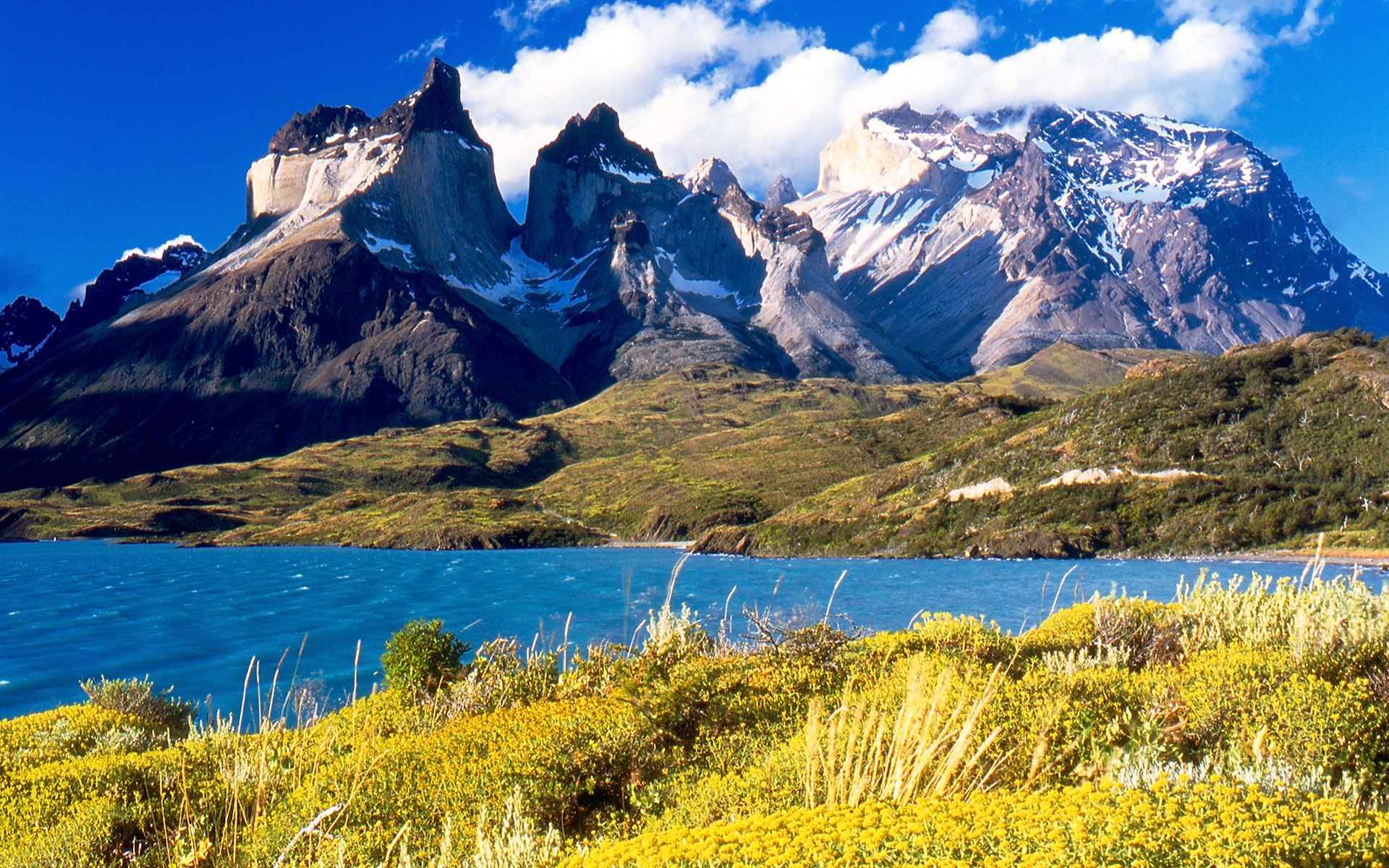
The complete list contains ten total designations, ranging from Argentina and Patagonia in South America, to Zimbabwe in Africa, to Vietnam in Asia, with plenty of other options inbetween. In fact, every continent is represented on the list with the exception of Antarctica, which means just about no matter where you go, there will be some exceptional hiking spots nearby.
Beyond just creating a list of excellent backpacking places, Nat Geo also offers some great travel advice for those visiting these places. For instance, they'll tell you how to get there, how to travel around once you arrive, and just where to stay too. The various write-ups for each destination also include tips on what to eat, when to go, and what activities you absolutely should not miss out on.
All in all, this is a fairly comprehensive travel piece with some good suggestions on where to go backpacking this year. While the individual articles do a good job of setting you on the path to going to that particular place, they also leave plenty of room for you to explore and plan your own excursions and activities too. Think of it as helpful advice from those who have been there before, with just enough information to get you intrigued and started with your planning.
Find out what other destinations made the list by reading the entire article here.
2/14/2017
Mountain Runner Sets Female Aconcagua Speed Record

But about the same time that Sir Ran was preparing to head home a few weeks back, another climber by the name of Sunny Stroeer was preparing to make a run – quite literally – at the speed record by a woman on the mountain. On January 23, she did just that, setting a new mark for climbing from Base Camp to the summit, despite the fact that she had a respiratory infection.
Outside magazine has posted a profile of the 32-year old Stroeer following her epic ascent, which took 8 hours and 47 minutes to complete, shaving 29 minutes off the previous record. Stroeer is no stranger to long endurance events, as she is an ultrarunner who has competed in such events as the legendary Western States, amongst numerous other 50 and 100k runs. Perhaps her biggest adventure so far however is quitting her job back in 2015 to focus on running and traveling full-time. Since then, she has roamed around the southwest states of the U.S., and gone trekking in Thailand, Nepal, Tanzania, Germany, and other places.
Back in 2014, Stroeer climbed Aconcagua for the first time, going solo and unsupported, which is an impressive accomplishment in its own right. She told Outside that she was shocked at how few women were on the mountain, which gave her the idea of forming an all ladies team to make another attempt on the summit. She did that this year, and her record-setting run was a part of that expedition.
Sunny's story is an impressive one on a number of different levels. There is certainly a lot of inspiration to be had from her adventures. Congrats on the new speed record!
2/13/2016
Activists To Launch 15,000 Mile, 5-Month Road Trip To Promote Clean Drinking Water In Americas

Cebul and Mueller will set out from Boston on Saturday and begin heading south. Their trip will take them across the U.S., into Mexico and then on into Central America. Eventually, they'll cross over the Panama Canal and move into South America, before eventually reaching Rio around July 13. Along the way, they'll pass through 70 different cities and visit an estimated 65 colleges and universities as they spread their message about the importance of clean drinking water, particularly in developing countries.
The two men are calling their expedition Water for the Americas, and while they have a website set up to support their initiatives, the site doesn't offer a lot of information at this time. Hopefully they'll update it before they hit the road, allowing us to follow their progress and adventures as they go.
Clean drinking water is one of the hot button topics across the globe right now. While most developed nations don't struggle with having water to drink, poorer nations have a difficult time, especially as climate change begins to take its toll on the environment. Cebul and Mueller hope to educate people about this issue, particularly in nations that are being most hard hit.
While I applaud their efforts, this sounds like just an excuse to make a months long road trip to the World Cup. I kid! I kid!
4/22/2015
Video: Traveling the Andes Mountains - Spine of the South
In 2015, photographer Eric Hanson spent seven months traveling the length of South America along the spectacular Andes Mountains. Starting in Ecuador and ending in Patagonia, he captured thousands of photos of the landscapes that he encountered along the way. The very best of those images can be found in this breathtaking video, which give us an incredible look at these amazing mountains. Sit back and enjoy this clip, it is gorgeous.
Spine of the South from Overland Collective on Vimeo.
3/09/2015
New Farthest Source Of The Amazon Discovered

Since 1971, the Apurimac River has been considered the furthest source of the Amazon, and many explorers and adventurers have operated in the region under that assumption. According to this new report however, the Mantaro River, located in southwest Peru, now holds that distinction.
The researchers who have asserted that the Mantaro is the new source used satellite imagery and topographic maps to study the Amazon and it's numerous tributaries. With GPS tracking points, the team determined that the Mantaro is actually about 10% longer than the Apurimac, which would make the furthest source.
But as I mentioned, there is some controversy afoot. The Mantaro doesn't flow for parts of the year, thanks to a dam that was built in 1974. When defining a "source," most geographers feel that a river must flow uninterrupted. The researchers behind this new finding say that the Mantaro would flow all year if it wasn't for the dam.
Does it really matter where the true source is located? Most would probably say no. But if you're one of the many adventurers who has attempted to travel the length of the river, or explored the Amazon Basin, it means quite a lot. This revelation could invalidate certain past expeditions that paddled the entire river for instance.
Personally, I happen to enjoy that we're still discovering things about our own planet. It is stories like this one that remind us that exploration is important, even in the 21st century. Now, who wants to be the first to go upstream and actually visit the source? I'm in!
11/17/2014
Sir Ranulph Fiennes Pulls Plug on Aconcagua Summit Attempt
The climb was part of Fiennes – who has been called "the world's greatest living explorer" – attempt to join the elite club of men and women who have reached both the North and South Poles, as well as topped out on the Seven Summits. He has undertaken this challenge to raise funds for the Marie Curie Foundation, which has been a frequent recipient of his charity work over the years. To date, he has summited Everest, Kilimanjaro, Elbrus, and Vinson. That would leave him with Denali and Carstensz Pyramid, in addition to Aconcagua.
According to reports, Sir Ran was within just a few hours of the 6961-meter (22,841 ft) summit of Aconcagua, which is not only the highest peak in South America, but the tallest outside of the Himalaya too. But, the explorer was in too much pain to continue upwards, and had to be assisted back down the mountain instead. He was then air lifted to Mendoza, Argentina, where he is reportedly in good condition. He'll now head home to the U.K. to consult with his doctor before proceeding any further with his plans.
In embarking on this challenge, Fiennes hoped to become the first person to traverse both polar ice caps and complete the Seven Summits. You may recall that he earned his stripes as an explorer by visiting the coldest places on the planet on multiple occasions. He has come to mountaineering a bit late in life, not summiting Everest until 2009 at the age of 66. Later he would add summits of Kilimanjaro and Everest, before embarking on what he calls the Global Reach Challenge in 2016. Whether or not he'll continue with those efforts remains to be seen, but considering his resume, I would assume that unless this is a very serious injury, he'll be back at it as soon as possible.
Get well soon Sir Fiennes.
10/10/2014
Video: Sunrise to Sunset In The Atacama Desert
Here's a brief, but very lovely, video that was shot in the Atacama Desert of northern Chile. It is a timelapse that captures the movement of the skies from sunrise, to sunset, and back again in one of the most amazing environments on the planet. I can tell you from my visit to the Atacama, that the skies really do look like that. It was one of the most breathtaking night skies that I have ever seen, and definitely worth the trip for that view alone. Simply amazing.
Ancients from Nicholas Buer on Vimeo.
8/18/2014
Massive Reef Discovered at the Mouth of the Amazon River
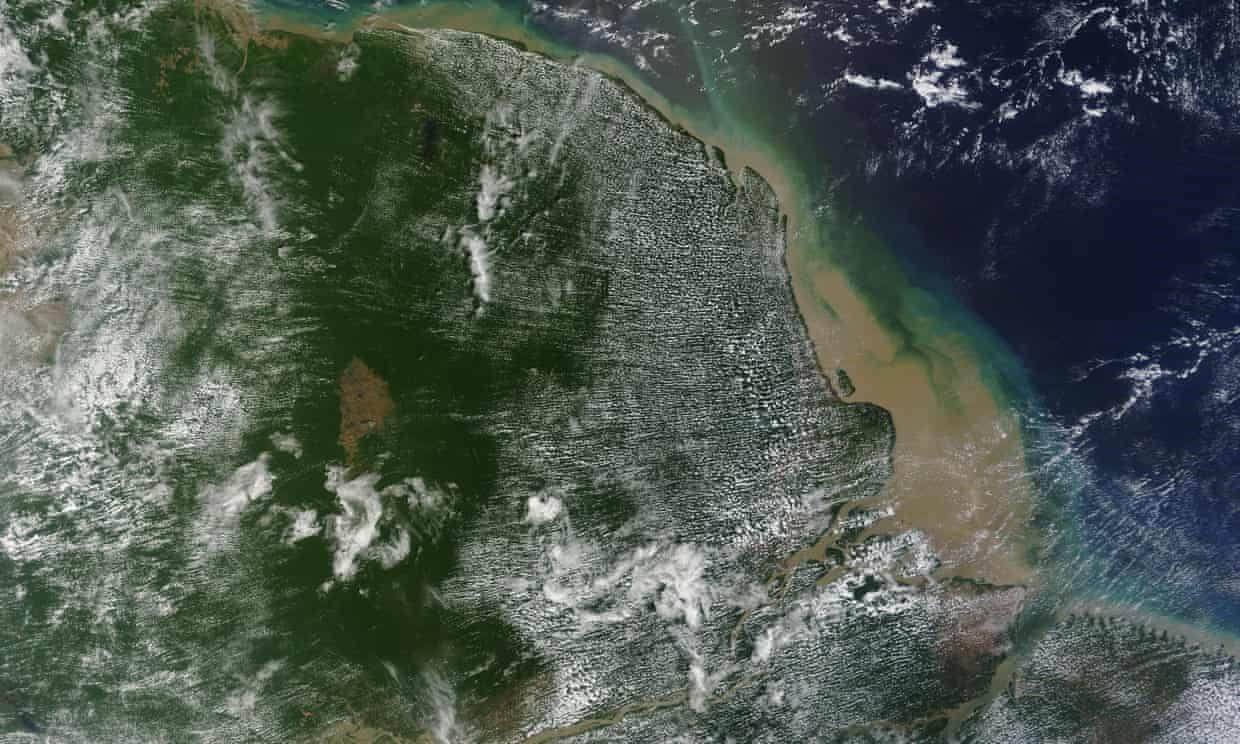
Indications that the reef might exist first appeared back in the 1970's when fishermen began catching fish that were more commonly found on and around reefs in other parts of the world. But confirmation of the existence of this particular reef didn't come until recently, when researchers were finally able to prove that against all our knowledge and understanding of the ocean that it was hidden away along the coast of Brazil.
The reef stretches for nearly 700 miles (1126 km), and is more than 3600 sq. miles (9300 sq. km) in size. It is also said to be home to at least 60 species of sponges and 73 species of fish. Even more surprising is the fact that unlike other reefs found around the world, this one appears to be very healthy, and even growing. Climate change has begun to warm the oceans, which is causing coral reefs to die at an alarming rate. But this one is not displaying those same symptoms.
What makes this new reef so amazing is that it exists in a place that it was previously believed one shouldn't be able to survive. While it is submerged in ocean waters, the surface of the Atlantic is covered in fresh water that is dumped in from the might Amazon River. The river also deposits plenty of mud and sentiment into the water, which is typically not conducive to the growth of coral either. On top of that, oceanographers typically find reefs in shallower waters that are warmer and clearer than where this one exists. This has left some scientists to wonder if other reefs are out there in our oceans, just waiting to be found.
But the good news over the discovery of this reef – and the fact that it is thriving – is tempered somewhat due to the fact that it is already being threatened by man. It seems that the Brazilian government has already sold 80 parcels of ocean to oil companies to start drilling at the mouth of the Amazon. 20 of those blocks are already in operation, some of which are believed to be right on top of the reef itself. How that will impact the life of the reef moving forward remains to be seen.
Coral reefs play an important role in the keeping the ocean healthy as they often form protective barriers for ecosystems both along the coast line and living within the waters themselves. As those reefs recede, ocean storms, hurricanes, and typhoons could have a larger impact on certain regions of the planet. The Earth's coral reefs are also seen as the canary in the coal mine in terms of indicating the impact of climate change on an area too.
Still, finding this particular reef is amazing, especially since it shouldn't exist at all. Hopefully it will be well protected moving forward.
2/02/2014
Adventurers to Attempt Atlantic to the Pacific Crossing of Amazon

The duo, who are planning on starting the expedition today, hope to create a four-part documentary series about their journey, which will look at the way various changes to their environment is impacting the lives of the Amazon people. Severe deforestation, climate change, and other factors have become a severe threat to the lifestyle of these tribes, potentially ending a way of life that has existed relatively unchanged for centuries.
Reza and Pip will be traveling by bike and boat across the Amazon. They'll start at the mouth of the mighty Amazon River in Belem in Brazil and eventually ending in Lima, Peru. Most of the journey will be done on bike (both are accomplished adventure cyclists), but they will take a boat up the Purus River in order to cross one very remote section of the route.
Dubbed the Transamazonica expedition, the plan is to follow a road of the same name that was built in the 70's to help open travel and commercialization of the rainforest. That road covers some 4000 km (2485 miles), and has been a major boon for companies who have logged and developed the Amazon Rainforest. The hope is that this expedition will help raise awareness of the challenges that are currently faced by the people living in the rainforest basin, which is undergoing significant changes.
It should certainly be interesting to follow Reza and Pip's adventure, which you can do on both of their websites linked above.
1/02/2014
Video: Scenes From Machu Picchu
One of the most spectacular displays of ancient architecture found anywhere in the world, the mountain fortress of Machu Picchu needs little introduction. But this beautiful video takes us high into the Peruvian Andes to share some amazing views of this spectacular place. The wonderful music gives the clip a tranquil feeling that makes it a joy to watch, so just sit back and take it all in.
And if you haven't been fortunate enough to visit Machu Picchu yourself just yet, my friends at Mountain Travel Sobek can make that journey are a reality. Check out all of their options for visiting Peru and start thinking about your own adventure in the Andes.
Machu Picchu from irenaVision on Vimeo.
And if you haven't been fortunate enough to visit Machu Picchu yourself just yet, my friends at Mountain Travel Sobek can make that journey are a reality. Check out all of their options for visiting Peru and start thinking about your own adventure in the Andes.
Subscribe to:
Posts (Atom)