Showing posts with label Russia. Show all posts
Showing posts with label Russia. Show all posts
9/23/2016
Video: The Wildlife of Chernobyl
It has been 30 years since the nuclear disaster at Chernobyl in the Ukraine. Since than, the city, and the surrounding area, has been mostly deserted of people, but wildlife has returned to the area and is thriving. In this video from National Geographic, we get a glimpse of those creatures that include wolves, foxes, dogs, and other animals. It is fascinating to see them wandering through a place where humans continue to shun. As is usual, nature finds a way.

6/16/2016
Adventurers Reach The Pole Of Cold

In order to reach the Pole of Cold, Felicity, Manu and Gisli drove more than 20,000 km (12,427 miles) through a variety of terrain that ranged from extremely well maintained highways to barely-there backcountry roads. Traveling in a Land Rover Defender, they were able to comfortably carry all of their gear and supplies, without fear of being hampered by the conditions. The Defender has a legendary background for use on off road expeditions, and it continues to show its worth today.
The team arrived in Oymyakon on Wednesday, but that point is far from the end of the actual journey. On the contrary, the Pole of Cold is actually just the halfway point. They will now travel back to their starting point at the Royal Geographical Society in London, albeit along a more southerly route. It is still the dead of winter in Siberia however, so they will face many of the same challenges along the way back to the U.K. as they have in the first half of their expedition.
You can follow along with their progress on the Pole of Cold website or on Facebook, where they are posting regular updates and photos from the field.
Personally, I think a journey like this one would be fantastic. What a great way to explore Europe and Asia. If anyone wants to loan me a Land Rover Defender, I'll be happy to report on my journeys as well! :)
11/19/2015
Video: Surfing the Arctic Ocean in Siberia
I don't cover surfing often here on The Adventure Blog, but I couldn't resist sharing this video, which takes us to Siberia where a group of adventurous surfers attempt to catch a wave in the frigid Arctic Ocean. The clip was shot over the course of a year near Murmansk, Russia, with the ocean showing the different sides of its character throughout the season. The dedication and commitment to this endeavor is admirable to say the least. The images captured here are astounding as well. I hope you enjoy.
SURF IN SIBERIA ARCTIC OCEAN 5 from Kokorev Konstantin on Vimeo.
8/12/2015
Trio of British Polar Explorers to Attempt North Pole Expedition in 2016

In recent years climate change has made that journey even more perilous, causing the ice to become more unstable, and opening large sections of open water in the Arctic Ocean that must be swam across or skied around. Additionally, those same climate forces have created storms that are more dangerous than ever.
The last team to complete a full expedition to the North Pole was Eric Larsen and Ryan Waters, who did so back in the early months of 2014. Their struggles have been well documented, and have prompted some to say that they might be the last two men to make the trek to the North Pole. But this year a team of three British adventurers will attempt to replicate that feat, albeit from the opposite side of the ice.
In February of 2016, Mark Wood, Paul Vicary and Mark Langridge will set out from Cape Arktichesky in Russia in an attempt to cross the Arctic Ocean and ski to the North Pole without resupply. The journey is expected to take 60 days to complete, covering more than 600 nautical miles (690 miles/1111 km). They're calling this expedition the Race Against Time, and their website can be found at NorthPole16.com.
The goals that the team has set for itself are many. In addition to attempting to raise funds for the Hire a Hero program in the U.K., the three men also hope to raise awareness and educate the public on the growing threat of climate change. To that end, they'll also be working with researchers at Warwick and Exeter Universities, as they collect data on their journey north. The trio also hopes to inspire a new generation of explorers to continue to search the planet for new discoveries as well.
All three of the members of this team have already completed full distance ski expeditions to the South Pole, but they'll find that the Arctic Ocean is a far different place than the Antarctic. For reasons already mentioned above, a ski journey to 90ºN is far more difficult and dangerous than one heading to 90ºS.
The expedition has picked up a couple of prominent patrons from the polar exploration world. Sir Ranulph Fiennes has given them his stamp of approval, as has Henry Worsley, who even now is working to complete his solo and unsupported traverse of Antarctica. The team also received some much needed support from British businessman Mark Tweddle, who stepped in to provide funds when it looked like the project could fall apart before it even got started. Without his aid, the explorers would have been forced to abandon their efforts altogether.
I was certainly amongst those who thought that a full-distance North Pole expedition probably wouldn't happen again in my lifetime. It remains to be seen if Wood, Vicary, and Langridge will be able to ski all the way to the Pole, but I definitely applaud their efforts. It will be interesting to follow their progress when they get underway on February 20. It could be history in the making for sure.
2/04/2015
Polar Bears Trap Russian Research Team Inside Arctic Base
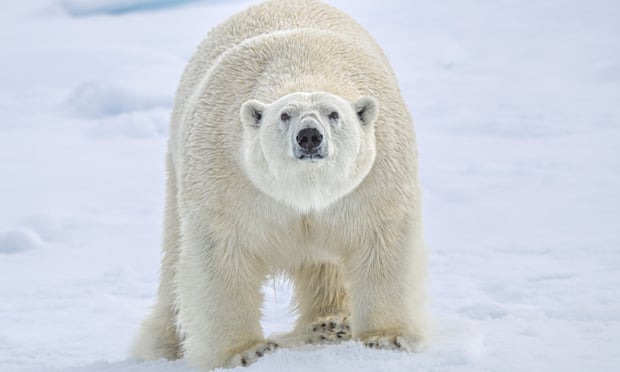
Normally, in order to keep the bears at bay, the scientists use flares and have dogs at the base to scare off the animals. But, the team had run out of flares, and according to Mashable the bears even killed one of the dogs. Because of this aggressive nature, the researchers have had to abandon some of their projects, and had been instructed to only leave the base when absolutely necessary.
It was originally reported that it would take weeks to deliver new flares and dogs to the station, but apparently relief came earlier today when a passing research vessel made a detour to lend a hand. The ship resupplied the team with flares, which were used immediately to scare off the bears. The next resupply ship wasn't scheduled to arrive for another month, but this should help buy the team some time.
Apparently, the bears gather near the base to wait for the Arctic Ocean to freeze. That typically occurs in late October or early November, at which time they'll depart the area and head north. Considering the current state of the arctic sea ice, it may take longer than usual before the bears begin their migration, and it is possible that they'll return to that location again in the days ahead.
In the past only about 4-6 bears have spent their summers on Troynoy, but apparently this year there are at least 10, including some large female with small cubs as well. One of the females has even been spending her nights just below one of the windows of the weather station, making it even more difficult for the team to sneak outside to record readings for their research.
Hopefully there will be some relief for these scientists soon. While watching polar bears up close sounds like an amazing experience, being locked inside and unable to go out doesn't seem like a lot of fun.
Subscribe to:
Posts (Atom)