Over the past few years, our smartphones have become central to just about every aspect of our lives. They help keep us in contact with friends and family, they keep us connected to the web and social media, and they even provide plenty of entertainment on the go. These high tech gadgets have also become integral to our workout routines, offering us ways to map our running and cycling routes, tracking our performance over time, and sharing our results with others. In short, they can be wonderful tools for a wide variety of activities.
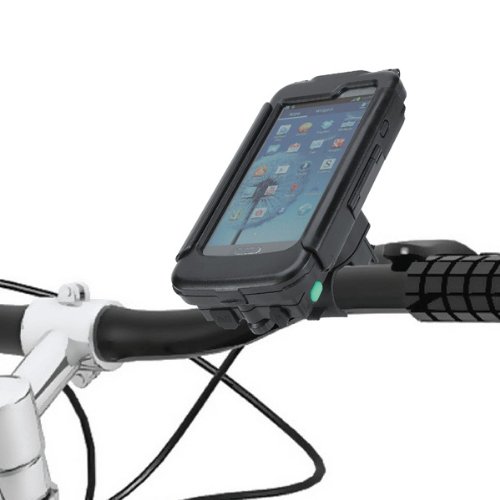
Cyclists in general have embraced the use of smartphones, tapping into a wide variety of apps that give realtime information about a variety of performance features. In fact, a good smartphone with the right software, can completely replace the traditional cycling computer, putting far more information at your fingertips, on a much larger screen that is easy to read while on the go. A good handlebar mount is essential however, and when it comes to holding your expensive electronic device in place, you certainly don't want to choose one that is subpar. Enter the Bike Console Power Plus from Tigra. It is protective case that packs a lot of features into a well built package.
The Bike Console comes with everything you need to quickly and securely fasten it to the handlebars of your bike. It only takes a couple of minutes to get the mount into place, and the sturdy, well built case then locks into place with a snap. Once there, it keeps your smartphone close at hand, making it easy to interact with, even while riding. The mount even allows the cyclist to rotate the case 360º, allowing apps to switch between portrait and landscape modes for more versatility.
The case itself is durable and solid, providing plenty of protection for the device inside. The flexible screen cover allows the user to still interact with his or her phone using its traditional touch interface. That allows you to launch your favorite apps, interact with the music player, answer phone calls, and read text messages or emails. Tigra says that the screen protector provides up to 90% sensitivity when using the touch screen on the phone, which translated to no noticeable difference when using the case with my iPhone 4S. The case also provides easy access to your phone's Home and Sleep buttons, and is built to allow use of the camera as well.
When sealed up tight, the case becomes both water and shock proof, providing even more protection for the smartphone inside. Should you find you're caught in an unexpected rainstorm during a ride, your phone will remain very safe inside this case. It will also prevent damage from being dropped, and the double locks that seal it tight will ensure that it won't accidentally spring open, sending the device skipping across the sidewalk.
As is, the bike console is a great way to safely attach your smartphone to your bike. But, this particular version of the case actually has yet another great feature for cyclists. It includes a built-in 1100 mAh battery, which can add 50% to the life span of your phone. That may not sound like it is particularly a lot, but means that you can go on a long ride, use your phone along the way, and still get back home with a decent charge in place. Besides, if you're using GPS to track your progress, that service can put a real hit on your overall battery life.
With apps like Map My Ride and Cycle Tracker Pro at your fingertips, navigating your routes or tracking your performance on the bike is now more fun and interesting than ever. The Bike Console Power Plus smartphone mount make it simple to use those apps (not to mention thousands of others) putting all the functionality of your smartphone right at your finger tips. It also provides plenty of extra protection for your expensive gadget while riding, which is never a bad thing. The fact that it brings more battery life along for the ride as well, is just icing on the cake.
The Bike Console Power Plus carries a price tag of $89.99, which strikes me as a relative bargain for everything that it delivers to cyclists. If you're looking for a durable, versatile smartphone mount for your cycling adventures, than I'd whole heartedly recommend this product. It is an excellent way to extend the use of your smartphone while on a ride.
Showing posts with label Gadgets. Show all posts
1/16/2017
4/18/2016
Adventure Tech: Iridium Announces New Voice And Data Device - the Iridium Go
Earlier today, satellite communication company Iridium announced a great new product that has the potential to revolutionize the way we communicate while in the remote places of the planet. The new device is called the Iridium Go, and the tiny gadget will give you the ability to make voice calls, send text messages, share social media updates, and more, all from the smartphone that you already own.
The Go somewhat resembles a mobile WiFi hotspot that are commonly used to connect laptops and other gadgets to cellular data networks. In this case however, the device actually connects to Iridium's satellite network instead. It then appears as a WiFi base station to your smartphone, allowing it to connect and use the Go's satellite signal to send and receive messages, connect to the web, post updates to Facebook and Twitter, share photos and of course make phone calls.
The Go will allow up to five devices, such as tablets, laptops, and smartphones, to connect at any given time. It also enables GPS location services for those devices, and has a built in SOS service to call for aid should the need arise. It puts all of those features into a small, compact package that won't take up a lot of room in a pack or add much in the way of weight either.
Iridium's approach of creating a device that allows us to use our own smartphones has a number of great advantages. For instance, you can use what ever phone you currently own at any given time, which means you'll be able to upgrade to new technology, while still being able to use the Go. It also means that your favorite apps can operate over the device too. And since it has a range of more than 100 feet, the Go can be set outside, in a location with a clear view of the sky, while you sit comfortably inside your tent, fully connected from your device.
The ruggedized Go is built to withstand the elements. It is water and dust proof, and is designed to withstand the shock of being dropped or jostled about. The device is designed to be taken to the remote corners of the world, and Iridium has built it to withstand the harshest environments, including the Himalaya and Antarctica.
At the moment, Iridium is planning on releasing Go apps for iOS and Android devices. That app will handle most of the communication between your smartphone and the satellite communications device. Those apps will be fully optimized to take advantage of the satellite data connection, compressing photos and messages down for more efficient sharing. The app will also be used to make phone calls, although it will have full access to the contacts you have stored on your device.
I'm told that using the Iridium Go will be simple to use. All you need to do is flip up its built in antenna and power the it on. After it establishes a connection to the satellites overhead, your smartphone will begin using it as its data source. The Go is also built to take advantage of Iridium Next, which is the company's second generation satellite network. Next is still a few years away from going into service, but it will provide much faster data options moving forward.
Iridium has also been working hard to develop an API for the GO, giving app developers the tools they need to make their programs compatible with the device. Those tools are said to have been well received so far, which means we could see some very cool integration with the Go and other apps in the future.
The Iridium Go is scheduled for a second quarter release this year, although no firm date has been set yet. The price is still in fluctuation as the engineers work on the final design and focus on getting battery life fine tuned. I'm told to expect it to be roughly around $800, although that could change before release. Service plans are also being tested at the moment, but Iridium promise that they will be more cost effective than past plans, especially considering the device can be shared with numerous people.
Look for more information on this product in the near future. I personally think that it has a ton of great potential, and I can't wait to hear how it works in the field.
3/14/2016
Gear Closet: Light & Motion GoBe+ 700 Spotlight
When it comes to creating headlamps and other high performance lights for use in the outdoors, it is really tough to top the products that Light & Motion puts out. The company creates bright, durable and efficient headlamps and cycling lights, often incorporating unique elements into their design that really sets them apart from the competition. But their new GoBe line of lights raises the bar even higher, delivering a bright, powerful light that can be used in almost any environment. Recently I was fortunate enough to test out the GoBe+ 700 spot, their new flagship product that delivers performance unlike anything you've likely seen before.
Unlike most of the other lights I've tested from Light & Motion, all of which were headlamps, the GoBe is closer in shape to a traditional flashlight. But to call it a "flashlight" greatly undersells exactly what this product can do. For starters, it is bright. Very bright. On its highest setting, it is capable of putting out as much as 700 lumens. How's that for bright? It's medium setting is still good for 325 lumens, while low and extended modes are 100 and 50 lumens respectively. There is also an SOS mode if you need to signal for help, which is also at 100 lumens.
The GoBe uses a rechargeable battery to power its lamp and naturally its burn time varies greatly depending on which mode you're in. On its highest setting, it can only run for about 1.5 hours while in extended mode it will light up the area for a full 24. A handy light integrated into the handle gives the user visual cues as to how much charge remains. When the light GoBe does run low on juice, it is recharged via USB on a computer or a wall adapter using its own proprietary USB cable.
L&M sees their GoBe lights as part of a larger system. With that in mind, they have built several mounting options for use in a variety of activities. The model I tested came with a bike mount that firmly held the light in place on my handlebars and illuminated the trail quite nicely as a result. Other mounts include a photo ball, a video locline, and a YS mount. Additionally, there are six different light heads available, which can be swapped out on the GoBe to extend its functionally further. Some of those include one head that provides a wider focus of light and another designed for search and rescue operations. Between all of these mounts and detachable heads, the versatility of this light really shines through. Pun fully intended.
The GoBe has also been designed to be rugged enough to take with you on all your adventures and it feels like it could survive just about anything. It also happens to make an excellent light for divers, as the system is rated to go down as deep as 120 meters (393 feet). That's an impressive depth for any light to function, let alone one that is as bright as this one.
Light & Motion ships the GoBe+ 700 with the flashlight body, head and body splash caps, a USB charging cable, handle bar mount, lanyard and more. All in all, it's an impressive package, with everything you'd need to use the light on just about any expedition. They also shipped me the Search Head, which focuses the standard beam down from a 60º spread, to a very tight 8º. This turns the light into a narrow, intense beam that makes the GoBe seem like a completely different product.
As with L&M's other products, this type of performance doesn't come cheap. The model I tested carries a price tag of $299, which is a pretty hefty cost to say the least. But this product isn't meant for someone just looking for a spare light to have around the home. It is for the active adventurer who needs a powerful, high performance light for a variety of activities. This is a light that you can mount on your bike, take on a hike, or on a dive deep under the ocean. It is unbelievably bright and versatile, which is everything you could ask for out of a product likes this one. For the person that meets that description, this is a light that is worth every penny.
1/11/2015
Gear Closet: iLand Fly Solar Charging System
As high tech gadgets have become more prevalent on our outdoor adventures, the ability to keep them charged while away from home has become more of a challenge as well. Over the past few years, we've seen some interesting and creative ways to power our high tech equipment, with some impressive options coming from companies like Goal Zero. Recently, I had the opportunity to test a new entry into the burgeoning solar charger market in the form of the iLand Fly, which isn't as powerful as some of its competitors, but still provides plenty of convenience for those who need a recharge on the go.
iLand has impressively packed a lot into the box with this product. Not only does it include a foldable, three-paneled solar cell, it also comes with a battery pack with a 2100mAh capacity. When that battery pack is plugged into the solar panel's USB port, it can collect and store a charge directly from the sun. That same battery pack can than pass along its charge to your gadgets at any time. A special USB cable, with changeable tips, allow you to charge just about any device that uses standard USB, mciro-USB, Apple 30-pin and or a few other plugs. A nice storage bag and cables that allow you to hang the solar panel from a tent or backpack, round out the package.
The included instructions indicate that it should take 3-4 hours to charge the battery pack using the solar panel. But, if you've ever used a solar charger like this in the past, you probably already know that the charging time is greatly influenced by how much direct sunlight it is able to absorb. On cloudier days, it'll take considerably longer to charge up the battery pack, even though it has a relatively low capacity.
When placed in direct sunlight, the solar cell is actually quite efficient at collecting light from the sun and converting it to energy. Considering how small the three panels actually are, I wasn't expecting much, but I ended up being pleasantly surprised at how well they performed. While the Fly won't win any races against other solar panels that I've tested, most of which are much larger in size, it more than holds its own.
The built in USB port on the solar panel itself is capable of charging our gadgets directly, including smartphones, cameras, GPS devices and other electronics. But iFly recommends that you actually charge your devices from the battery pack instead. This allows the solar panel to continually charge the pack, and then have a charge waiting for you whenever you need it. The battery pack is also far more efficient at passing on its charge to higher capacity devices such as the iPhone 5 or Samsung Galaxy S4.
It is clear that iLand built this system with outdoor adventurers and travelers in mind. Not only does it neatly fold up into a very small package, marking it easy to toss into your backpack and take with you anywhere, but it also weighs in at a mere .36 pounds (163 grams). For those looking to travel light, it is an excellent option. The solar panel is also water and dust resistant, which means you can take it with into the field without fear of damaging any of the components.
Because it was designed to be small and compact, the Fly has a somewhat limited capacity for charging. While it can handle a smartphone, mp3 player, or compact camera without too much trouble, it won't be adding much of a charge to your iPad for instance. That probably limits its usefulness on some expeditions, although it does make the perfect travel companion for those who don't need anything more.
If you're in the market for a small, efficient, and useful solar charing system for your adventures, the iLand Fly is a great option. It is compact enough to take with you just about anywhere and provides enough juice to keep all of your smaller electronics fully operational. Typically, the system is sold for $149.99, but for the holidays it was on sale for just $99.95. That deal is still being offered both on the iFly website and at Amazon. That makes it a highly affordable option on top of being an efficient one.
1/09/2014
Men's Journal Gives Us 51 Last Minute Gift Ideas
Okay, if you're still looking for the perfect Christmas gift for someone on your shopping list this year, and my 10 last minute gift ideas, nor Nat Geo's 31 suggestions, and Outside's list of 20 stocking stuffers for under $20 hasn't been much help, than perhaps Men's Journal can be of assistance. The magazine has posted it's selection of last minute holiday gifts as well, and it is lengthy one, offering 51 options for procrastinators.
Not all of the items on the list are specifically geared for the outdoors or travel, but there is still a lot of things that men (and women!) are going to like. For instance, some of the items that get the nod from MJ include a sweet cycling hat from Rothera, a fun daypack from Cotopaxi, a cool camera from Nikon, and a headlamp designed for runners from Nathan. You'll also find a number of interesting books, some useful gadgets, pants from Fjällräven, and a even a kayak from Perception.
All in all, this is a fairly wide list of suggestions for gifts for just about anyone in your life. Obviously here at The Adventure Blog we focus more on the outdoor and adventure travel items first and foremost, but there are all kinds of other great ideas as well for just about any type of personality. If you truly are stumped, perhaps this will at least provide a few ideas to help you get just the right thing for your loved one. If not, you're probably going to have some problems, as obviously the clock is ticking on the holiday shopping season.
Check out the entire list at MensJournal.com.
Subscribe to:
Posts (Atom)
