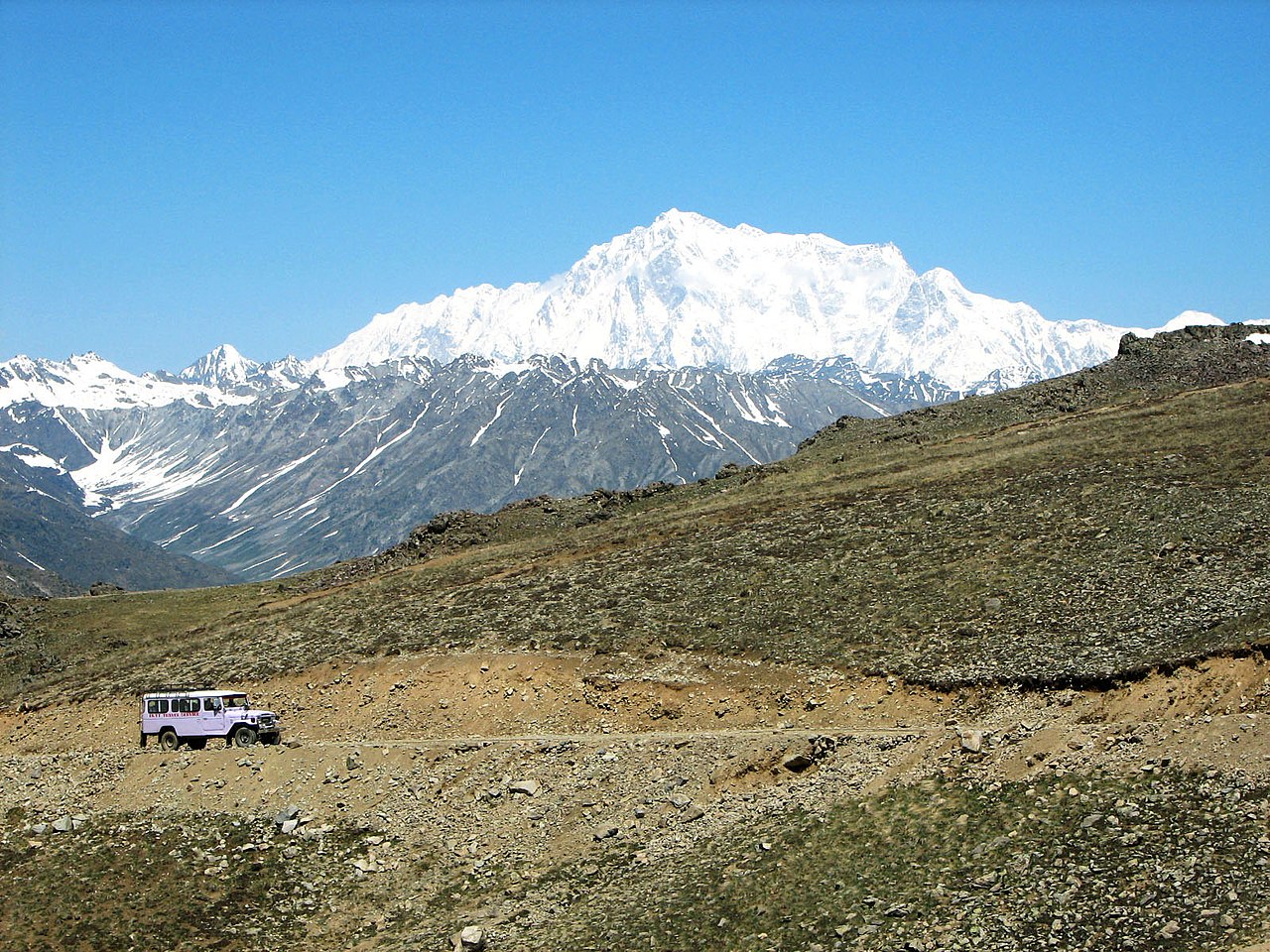
There has been little movement on Nanga Parbat since I wrote my last update at the beginning of last week. The teams are still mostly stuck in Base Camp where they are waiting for the weather to improve. With such a long delay, they may even have to acclimatize again before attempting the summit, although it remains to be seen if they will even get the chance. With five weeks to go in the season, time is starting to run short, particularly since the weather has been brutal for a few weeks now. But, the climbers that are on the mountain remain firmly in place, and are waiting for the opportunity to move up should the chance present itself.
Despite the fact that there has been little movement since the start of the month, there is still news to report however. For example, Italian climber Daniele Nardi has now departed BC following his much publicized dispute with teammate Alex Txikon. The two had a falling out over the logistics of their expedition, and as a result Nardi has now gone home. Meanwhile, Txikon has stayed behind and is working with Ali Sadpara, Simone Moro, and Tamara Lunger to continue working towards achieving the first winter ascent of the mountain.
While one climber has left, another is planning his return. Polish mountaineer Tomek Mackiewicz made an early season attempt on the mountain with Elisabeth Revol, but the two abandoned their efforts at the end of January. Revol has gone back to France, but Tomek has remained in Pakistan, and has been finding it difficult to get out due to an ongoing strike there. So, rather than head home, he has decided to go back to Nanga Parbat instead. He is still sorting out the details of his return, but he may already be back in BC and planning his next summit bid.
Finally, Brazilian-born American climber Cleo Weidlich is reportedly still on the Rupal Face although there has been no update on her progress. She is climbing with a group of Nepalese Sherpas, but it is unclear whether or not they have gone higher than Base Camp as of yet, although it seems likely that weather conditions are keeping them grounded too.
More news as it comes.
7/26/2017
7/24/2017
Video: Kayaking Through Underground Caves in Mexico
In this video, we join kayakers Rafa Ortiz, Jared Meehan, and Andrew Pollock as they head to southern Mexico to explore a system of underground rivers that pass through an intricate cave system. There aren't any massive waterfalls to drop, or Class V rapids to run, but there is a great sense of exploration and adventure as they paddle through this otherworldly environment. Catch a glimpse of a part of our planet that few ever get a chance to see, and marvel at what these intrepid kayakers find as they drift along.
7/20/2017
Antarctica 2016: Johanna Davidsson at the Pole and in Record Time!
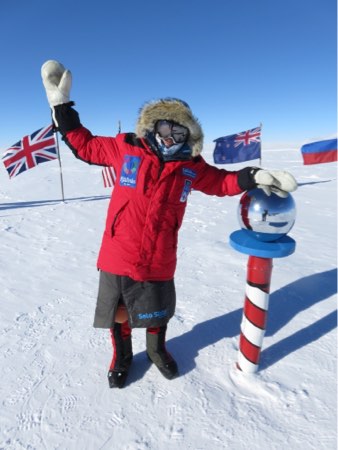
Before taking a hiatus for the holidays last Friday, I posted a story about Swedish adventurer Johanna Davidsson, who was on the verge of reaching the South Pole, and breaking the speed record for a female skier to reach that point on the planet. Now, we can confirm that she has indeed completed that stage of her journey, and has established a new mark for the fastest time from Hercules Inlet to 90ºS by a woman.
In the original story that I posted, I wrote that Johanna was aiming to reach the South Pole by December 25 – Christmas Day. Instead, she crossed the finish line on December 24, which mean that her journey took 38 days, 23 hours, and 5 minutes. That's 10 full hours faster than Hannah McKeand did it back in 2006.
ExWeb reports that for Johanna, this was a completely unexpected record. It was never part of her plan to set a ski to the Pole in such a quick time, and had originally told the website that she planned on a 50 day journey. Instead, she found that her training and gear were more than up to the task, and while conditions were challenging at times, she was able to cover further distances than she had originally intended on daily basis.
The final stretch wasn't an easy one however. Whiteout conditions made skiing a challenge, and the snow was soft enough that it slowed Johanna's progress. But, she pushed on with her goal in sight, and was able to finish one very long day of skiing to make it the research station located at the bottom of the world, where she was welcomed by the staff there with a hot meal and champaign.
The journey isn't quite done just yet however. She'll rest briefly at the Pole before turning around and heading back to her starting point at Hercules Inlet. If she's successful, she'll become the first Swede to complete the round-trip journey.
Congrats to Johanna on an amazing job setting a new speed record. We'll be following along as you head back to the coast.
In the original story that I posted, I wrote that Johanna was aiming to reach the South Pole by December 25 – Christmas Day. Instead, she crossed the finish line on December 24, which mean that her journey took 38 days, 23 hours, and 5 minutes. That's 10 full hours faster than Hannah McKeand did it back in 2006.
ExWeb reports that for Johanna, this was a completely unexpected record. It was never part of her plan to set a ski to the Pole in such a quick time, and had originally told the website that she planned on a 50 day journey. Instead, she found that her training and gear were more than up to the task, and while conditions were challenging at times, she was able to cover further distances than she had originally intended on daily basis.
The final stretch wasn't an easy one however. Whiteout conditions made skiing a challenge, and the snow was soft enough that it slowed Johanna's progress. But, she pushed on with her goal in sight, and was able to finish one very long day of skiing to make it the research station located at the bottom of the world, where she was welcomed by the staff there with a hot meal and champaign.
The journey isn't quite done just yet however. She'll rest briefly at the Pole before turning around and heading back to her starting point at Hercules Inlet. If she's successful, she'll become the first Swede to complete the round-trip journey.
Congrats to Johanna on an amazing job setting a new speed record. We'll be following along as you head back to the coast.
7/19/2017
Antarctica 2016: And Then There Was One...
The 2016 Antarctic season is all but over. Only one skier remains out on the ice, as everyone else has wrapped up their expeditions and headed home. And true to form, the frozen continent has already started to make things more difficult, with colder temperatures, blizzard-like conditions, and thankfully for this explorer, howling winds.
Mike Horn is still working on completing his traverse of the Antarctic continent. He reports that the winds returned with a vengeance yesterday, saying they are the strongest he's encountered yet. Considering the fact that he is kite skiing, having strong winds is better than no winds at all. Propelled along by these gusts, he's now 92 km (57 miles) closer to his goal, but he still has 430 km (267 miles) yet to go before he reaches the coastline, and the safety of his ship, the Pangaea.
In his most recent update, Horn says that he has been facing a constant battle with the winds, which have helped get his kites in the air, but haven't always been cooperative. Any kite-skier will tell you that you want strong winds, but not too strong, as they can be unruly and difficult to maneuver in. That's what the Swiss explorer has been dealing with over the past few days, coupled with large sastrugi on the surface that have made things interesting as well.
As you may recall, Mike is attempting to circumnavigate the globe via the poles, and this is just the first of his major ice cap crossings. Once he reaches his ship, he'll actually set sail for New Zealand and Australia, before heading north to the Arctic. But, there is still plenty of work to be done before he leaves the Antarctic.
Depending on wind conditions and how well he can work the kite, Horn could reach the coast line in as few as two days. But, if he manages to maintain the pace he has had over the past couple of days, he's more likely to finish around the end of the week. Should the winds disappear however, that time could extend further.
We'll continue to follow Mike's progress until he's off the ice. That shouldn't be too much longer, but his adventure isn't over just yet. The Antarctic summer is quickly coming to an end though, and he'll be departing just in the nick of time it seems.
Mike Horn is still working on completing his traverse of the Antarctic continent. He reports that the winds returned with a vengeance yesterday, saying they are the strongest he's encountered yet. Considering the fact that he is kite skiing, having strong winds is better than no winds at all. Propelled along by these gusts, he's now 92 km (57 miles) closer to his goal, but he still has 430 km (267 miles) yet to go before he reaches the coastline, and the safety of his ship, the Pangaea.
In his most recent update, Horn says that he has been facing a constant battle with the winds, which have helped get his kites in the air, but haven't always been cooperative. Any kite-skier will tell you that you want strong winds, but not too strong, as they can be unruly and difficult to maneuver in. That's what the Swiss explorer has been dealing with over the past few days, coupled with large sastrugi on the surface that have made things interesting as well.
As you may recall, Mike is attempting to circumnavigate the globe via the poles, and this is just the first of his major ice cap crossings. Once he reaches his ship, he'll actually set sail for New Zealand and Australia, before heading north to the Arctic. But, there is still plenty of work to be done before he leaves the Antarctic.
Depending on wind conditions and how well he can work the kite, Horn could reach the coast line in as few as two days. But, if he manages to maintain the pace he has had over the past couple of days, he's more likely to finish around the end of the week. Should the winds disappear however, that time could extend further.
We'll continue to follow Mike's progress until he's off the ice. That shouldn't be too much longer, but his adventure isn't over just yet. The Antarctic summer is quickly coming to an end though, and he'll be departing just in the nick of time it seems.
7/18/2017
Video: What Exactly is Adventure Racing?
I write about adventure racing regularly on this blog, but not everyone knows exactly what the sport consists of. Thankfully, the fine folks over at the Adventure Racing World Series have put together this excellent and helpful video to help explain the sport to newcomers and to remind long time fans just how awesome it is. For my money, adventure racers are amongst the best endurance athletes in the world. Don't believe me? Check out the clip below to find out why I feel that way.
10 Compact Cameras Specifically Built for Travelers
Photography is an integral part of travel. It not only helps document where we've been, but it captures a moment in time from our adventures that might otherwise have been lost. It is for those reasons that so many avid travelers and outdoors enthusiasts are also aspiring photographers too. But choosing the right camera to take with us on our adventures can be a real challenge. You want some that fast and responsive, with great image quality and color reproduction as well. It doesn't hurt if it is rugged enough to survive in the outdoors either, and if it can also be small and lightweight, it would pretty much be the perfect option. But does such a camera actually exist?
National Geographic has compiled a list of the top ten compact cameras built for travelers, and if you're in the market for a new model – or simply want to see what's new – the article is definitely worth a look. You'll find everything from durable point and shoot models to full-fledged DSLRs, with pretty much everything in between, including the mirrorless options that are so popular today. What's more, most of the major brands are represented on the list, so no matter if you're a fan of Nikon, Olympus, Panasonic, Sony, or something else, chances are you'll find something to your liking while still being able to maintain your brand loyalty.
So which cameras earned a spot on the Nat Geo list? The Fujifilm X-T2 was a particular favorite, as was the Panasonic Lumix DMC-GX8. The Olympus TG-4 took top honors for ruggedized point and shoots, while Sony's A6500 earned praise for being for its all around performance as well. Each of the cameras on the list is accompanied with an explanation of what makes it especially good for travel, as well as technical information on its sensor size and other features. There are also handy "Pro Tips" to help users get the most out of that particular model as well.
Over the years, I've been able to pair down my travel gear in some impressive ways, cutting a lot of weight and learning to leave nonessential items at home. But, a good camera remains a must and by the time you add a body and a lens or two, the weight adds up fast. I'd love to find a camera that helps me shed some weight, without compromising performance and image quality along the way. These new options are a step in the right direction, with 4K video, full-frame sensors, and fast performance. One of these days it's going to be time to get serious and invest in a new unit, and this article will certainly be helpful when that time comes.
National Geographic has compiled a list of the top ten compact cameras built for travelers, and if you're in the market for a new model – or simply want to see what's new – the article is definitely worth a look. You'll find everything from durable point and shoot models to full-fledged DSLRs, with pretty much everything in between, including the mirrorless options that are so popular today. What's more, most of the major brands are represented on the list, so no matter if you're a fan of Nikon, Olympus, Panasonic, Sony, or something else, chances are you'll find something to your liking while still being able to maintain your brand loyalty.
So which cameras earned a spot on the Nat Geo list? The Fujifilm X-T2 was a particular favorite, as was the Panasonic Lumix DMC-GX8. The Olympus TG-4 took top honors for ruggedized point and shoots, while Sony's A6500 earned praise for being for its all around performance as well. Each of the cameras on the list is accompanied with an explanation of what makes it especially good for travel, as well as technical information on its sensor size and other features. There are also handy "Pro Tips" to help users get the most out of that particular model as well.
Over the years, I've been able to pair down my travel gear in some impressive ways, cutting a lot of weight and learning to leave nonessential items at home. But, a good camera remains a must and by the time you add a body and a lens or two, the weight adds up fast. I'd love to find a camera that helps me shed some weight, without compromising performance and image quality along the way. These new options are a step in the right direction, with 4K video, full-frame sensors, and fast performance. One of these days it's going to be time to get serious and invest in a new unit, and this article will certainly be helpful when that time comes.
Nat Geo Gives Us 20 National Park Leaders Under the Age of 30
As most everyone knows by now, last week the National Park Service celebrated its 100th anniversary. In the days since then, we've seen a lot of celebrations across the country, with thousands of people saluting the government agency tasked with protecting the parks while at the same time making them accessible to the public.
The celebration will continue throughout the rest of the year, but it is also a time to begin looking forward to the next century. There is still a lot of work to be done to ensure that the national parks will be around for future generations to enjoy as well. To that end, National Geographic has selected 20 scientists, filmmakers, activists, and educators who have dedicated their lives to protecting the parks, both in the U.S. and abroad. Oh yeah, and each of these men and women happen to be under the age of 30 as well.
Amongst those making the list are Ben Masters, a filmmaker and horseman who is working to protect wild mustangs. He's joined by Cassi Knight, an NPS scientist who is searching for dinosaur remains in Denali National Park, and Elizabeth and Cole Donelson who spent the past 12 months visiting all 59 U.S. national parks. Others include Jen Guyton, a scientists helping to protect animals from poachers in Mozambique, and cartographers Ross Donahue and Marty Schnure, who are mapping remote areas of Patagonia.
As you can see, this is a diverse and interesting group of individuals, each of which is playing a vital role to help promote national parks both at home in the U.S. and in other countries around the world. The concept of creating public lands that are set aside for future generations to enjoy too has been called "America's Best Idea," and these young men and women are helping to spread that idea further. Hopefully in another hundred years we'll be continuing to celebrate the National Park Service, and the effort that these individuals have made along the way.
The celebration will continue throughout the rest of the year, but it is also a time to begin looking forward to the next century. There is still a lot of work to be done to ensure that the national parks will be around for future generations to enjoy as well. To that end, National Geographic has selected 20 scientists, filmmakers, activists, and educators who have dedicated their lives to protecting the parks, both in the U.S. and abroad. Oh yeah, and each of these men and women happen to be under the age of 30 as well.
Amongst those making the list are Ben Masters, a filmmaker and horseman who is working to protect wild mustangs. He's joined by Cassi Knight, an NPS scientist who is searching for dinosaur remains in Denali National Park, and Elizabeth and Cole Donelson who spent the past 12 months visiting all 59 U.S. national parks. Others include Jen Guyton, a scientists helping to protect animals from poachers in Mozambique, and cartographers Ross Donahue and Marty Schnure, who are mapping remote areas of Patagonia.
As you can see, this is a diverse and interesting group of individuals, each of which is playing a vital role to help promote national parks both at home in the U.S. and in other countries around the world. The concept of creating public lands that are set aside for future generations to enjoy too has been called "America's Best Idea," and these young men and women are helping to spread that idea further. Hopefully in another hundred years we'll be continuing to celebrate the National Park Service, and the effort that these individuals have made along the way.
Subscribe to:
Comments (Atom)